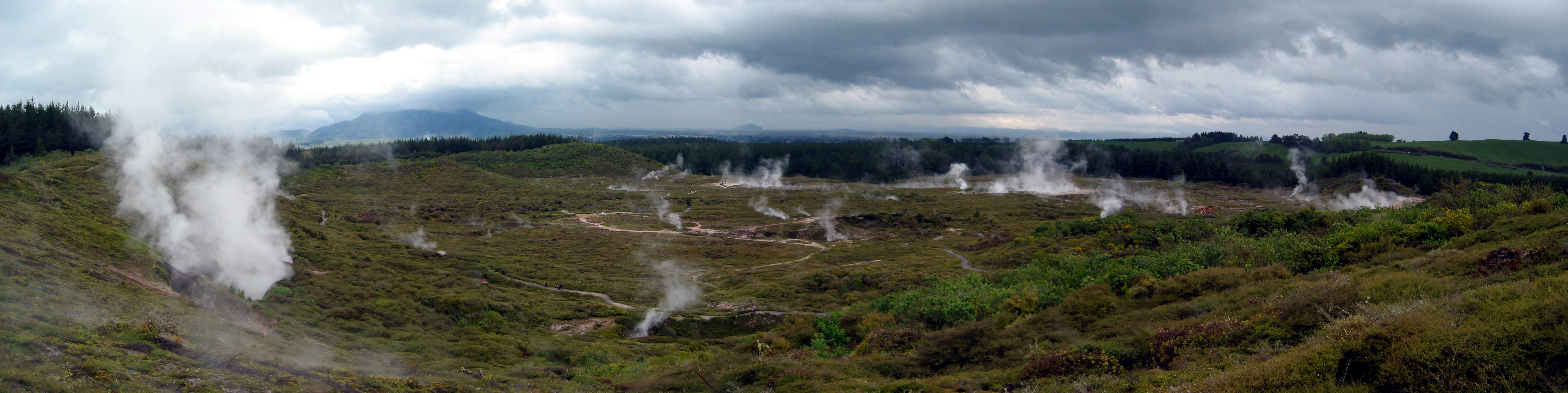
Craters of the Moon
The craters are not ancient. That is the first surprise at Karapiti, the Māori name for this 36-hectare field of heated ground just north of Taupō. While the geothermal energy beneath it has simmered for millennia, the craters themselves - the barren, brilliantly coloured pits that give the site its English name - are a relatively recent phenomenon, created not by volcanic eruption alone but by the interaction of deep heat with human engineering. When the nearby Wairakei geothermal power station began drawing energy from the underground reservoir in the 1950s, it shifted the pressure balance. The land responded by blowing holes in itself.
The Safety Valve of the North Island
Long before the craters appeared, the Karapiti Blowhole announced this ground's restless nature. When Austrian geologist Ferdinand von Hochstetter passed through in 1859, he recorded a colossal column of steam visible from 20 kilometres away, rising from a fumarole so powerful that the surrounding valley floor was soft, warm, iron-stained clay impossible to approach safely. By the early twentieth century, the blowhole had become a tourist attraction. A 1927 account describes visitors watching a guide throw a kerosene-soaked sack into the vent - the burning pieces were caught by the superheated steam and launched upward in a display of "very weird fireworks," the sparks staying alight in the dry heat, proving the steam's temperature. Māori tradition held the blowhole had been constant for at least 200 years, serving as a beacon visible to canoes crossing Lake Taupō six miles distant.
When the Balance Shifted
The Wairakei geothermal power station, commissioned in 1958, was a pioneering achievement - one of the world's first large-scale geothermal power plants. But extracting energy from a pressurised underground system has consequences. As the power station drew fluid from the geothermal reservoir, pressure dropped in some areas and redistributed in others. At Karapiti, the changing pressure regime created conditions for hydrothermal eruptions: steam pressure beneath the surface exceeded the weight of the overlying ground, and the ground gave way. Explosions of hot water, steam, mud, and pumice blasted material up to 100 metres into the air, leaving craters as deep as 20 metres. These eruptions still occur roughly once a year, constantly reshaping the terrain. The boardwalks that allow visitors to cross the field must be periodically rerouted as old paths collapse and new vents open.
A Landscape That Refuses to Hold Still
Walking the main circuit at Craters of the Moon takes about 45 minutes, but the landscape you walk through will not be the same one the next visitor sees. Steam vents shift, collapse, and reform. The single active mud pool bubbles with grey clay as hydrogen sulphide gas reacts with water to form sulphuric acid, which dissolves the surrounding rock into the paste that burps and pops at the surface. The most powerful fumarole ever measured here, in December 1967, had a heat output of 116 megawatts. The ground temperature around active vents can reach dangerous levels, which is why visitors stay on designated paths. Vegetation is sparse and specialized - the prostrate kānuka, a low-growing variety of Kunzea ericoides, is one of the few species that tolerates the heat, alongside tropical ferns and mosses that have no business growing at this latitude but thrive in the artificially warm soil.
Where the Earth Smells of Sulphur
The site sits within the Wairakei geothermal field, the largest in New Zealand at roughly 25 square kilometres, itself part of the Taupō Volcanic Zone. Crown Land administered by the Department of Conservation, it has been tended since 1991 by the volunteer-run Craters of the Moon Trust, which began when a local solicitor named Jeremy Nash organised volunteers to address the persistent problem of car break-ins at the isolated car park. The trust built an information kiosk, then a larger one in 2000, and eventually extended similar services to the nearby Huka Falls. A steeper loop trail climbs to a viewing point where the full extent of the steam field becomes visible - plumes rising from dozens of vents across a terrain that looks genuinely extraterrestrial, the bright mineral colours of the crater walls vivid against barren grey ground, the sulphur smell sharp and inescapable.
From the Air
Located at 38.65°S, 176.07°E, approximately 4 km north of Taupō on the North Island. The site is part of the larger Wairakei geothermal field - look for steam plumes rising from a patch of barren, discoloured ground adjacent to developed farmland. The Wairakei power station is nearby to the north. Lake Taupō dominates the landscape to the south. Nearest airports: NZAP (Taupō, 4 km S), NZRO (Rotorua, 75 km NE), NZHN (Hamilton, 130 km NW). The Huka Falls on the Waikato River are a visible landmark 2 km to the north.