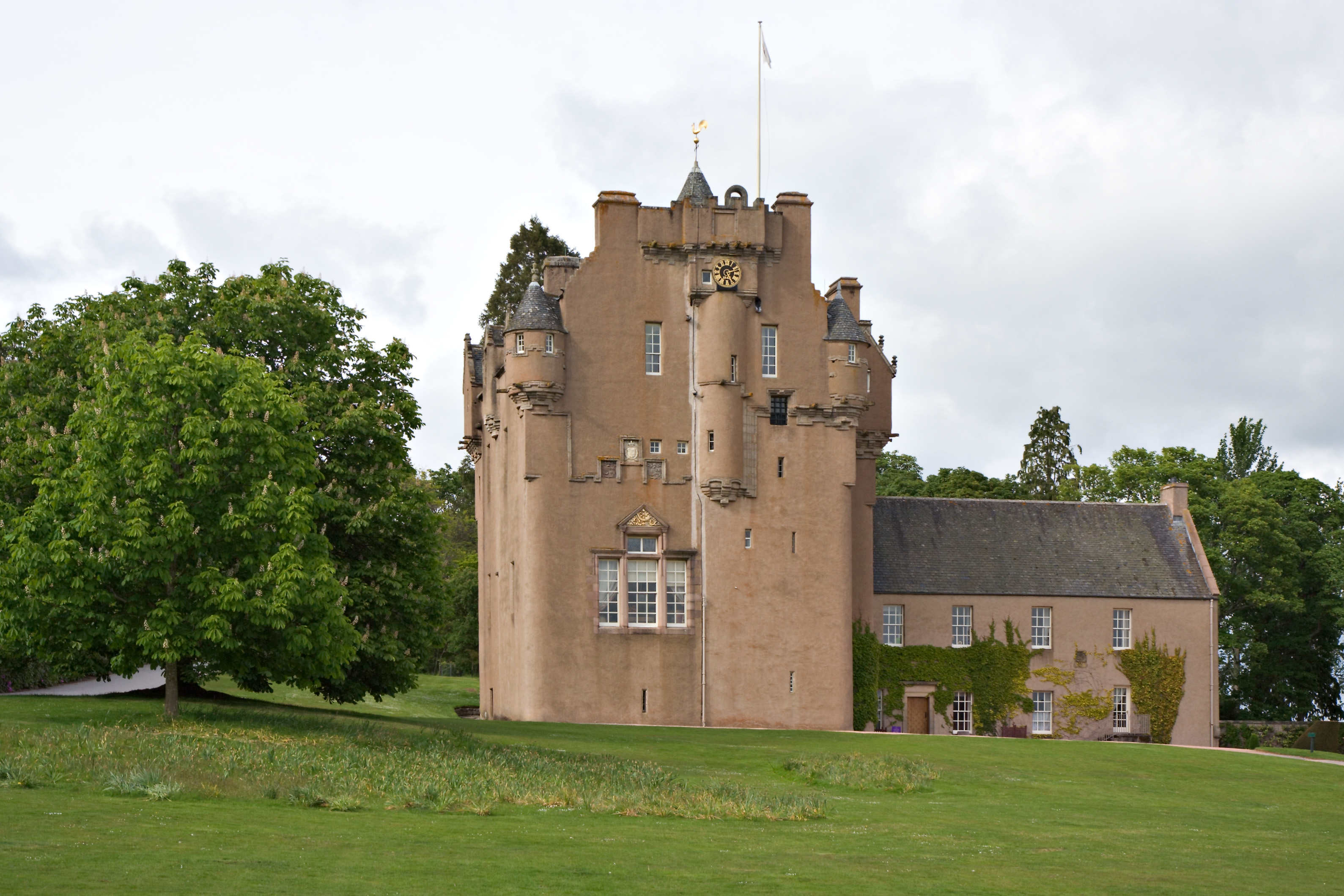
Crathes Castle
The Horn of Leys is a jewelled ivory horn that has hung in Crathes Castle for seven centuries. According to tradition, Robert the Bruce himself presented it to Alexander de Burnard in 1323, along with the lands of Leys, as a reward for loyal service during the Wars of Scottish Independence. Whether Bruce actually touched the horn is unprovable. What is provable is that the Burnett family held these lands from that date until 1951 - over six hundred years of continuous occupation that left the castle layered with the accumulations of a family that never quite left and never quite stopped building.
A Tower House for Troubled Times
Construction of the present castle began in 1553 and was completed in 1596, spanning the tumultuous reign of Mary Queen of Scots and the early years of her son James VI. The tower house form was standard for Scottish lairds of this period - a vertical dwelling that prioritised security over comfort, with thick walls, narrow windows, and a single defensible entrance. Crathes follows the classic L-plan, with a main tower and a projecting wing creating a re-entrant angle that allowed defenders to cover the entrance. The Burnetts were not great nobles but minor gentry - important enough to need protection from feuding neighbours, not important enough to build on the scale of the royal castles. The result is a building of modest footprint but considerable height, rising through six storeys to a roofline of turrets and corbelled rounds that echo the Scottish Baronial style.
The Painted Ceilings
Crathes contains some of the finest original painted ceilings in Scotland, dating from the late sixteenth and early seventeenth centuries. The Chamber of the Nine Worthies features portraits of the same classical and biblical heroes found at Craigievar - Alexander, Caesar, Arthur, Charlemagne - but executed in paint rather than plaster, with bold colours and inscriptions in Scots. The Chamber of the Muses depicts the nine muses of classical mythology, each identified by name and attribute. These ceilings survived because the rooms were sealed and forgotten, their paintings hidden behind later plasterwork until rediscovery in the twentieth century. The Green Lady's Room takes its name from the castle's resident ghost, said to be a young woman carrying a baby. A skeleton of a woman and child, discovered behind the fireplace during Victorian renovations, lent the legend an uncomfortable material reality.
Gardens Older Than the Union
The walled gardens at Crathes are among the finest in Scotland, and they begin with the yew hedges planted in 1702 - fifteen years before the Act of Union joined Scotland to England. These massive, sculpted hedges divide the garden into eight distinct areas, each with its own character and planting scheme. The hedges have been clipped and maintained continuously for over three centuries, growing into organic architectural forms that function as walls, rooms, and corridors. The gardens within them are rich with herbaceous borders, rare shrubs, and specimen plants that benefit from the sheltered microclimate the hedges create. The National Trust for Scotland, which has managed the property since 1951, maintains the gardens as a living collection that changes with the seasons.
An Ancient Calendar Beneath the Ground
In 2004, archaeological excavations in the castle grounds uncovered something unexpected: a series of pits dating to approximately 8000 BC that researchers from the University of Birmingham identified as the world's oldest known lunar calendar. The pits, arranged in an arc, appear to track the phases of the moon and align with the midwinter sunrise, suggesting that Mesolithic hunter-gatherers used this site for astronomical observation ten thousand years ago. The discovery pushed back the known history of calendar-making by several thousand years and established that this particular piece of Aberdeenshire landscape has been significant to human beings since the end of the last Ice Age. The Burnetts, arriving in the fourteenth century, were relative newcomers.
The Castle and Its River
Crathes stands on a wooded hillside above the River Dee, between Banchory and Aberdeen, in the heart of Royal Deeside. The Dee is one of Scotland's great salmon rivers, and the surrounding landscape is a patchwork of farmland, birch woodland, and the purple heather moorland that clothes the higher ground. The castle grounds include 240 hectares of mixed woodland with marked trails, offering walks that range from gentle strolls through the garden to longer circuits through the estate. From the upper floors of the tower, the views extend across the Dee valley to the hills beyond. The combination of castle, gardens, painted interiors, and landscape makes Crathes one of the most visited National Trust for Scotland properties, yet its setting in the quiet Deeside countryside gives it an unhurried quality that larger attractions cannot replicate.
From the Air
Crathes Castle is located at approximately 57.061°N, 2.440°W near Banchory, on the north bank of the River Dee in Royal Deeside. From the air, the castle and its extensive walled gardens are visible within a wooded estate. The River Dee runs east-west through the valley below. Nearest airport is Aberdeen Airport (EGPD), approximately 15 miles east. The A93 road passes close to the castle grounds. Best viewed at 1,500-2,500 feet, where the garden layout and the castle's relationship to the Dee valley are clearly visible.