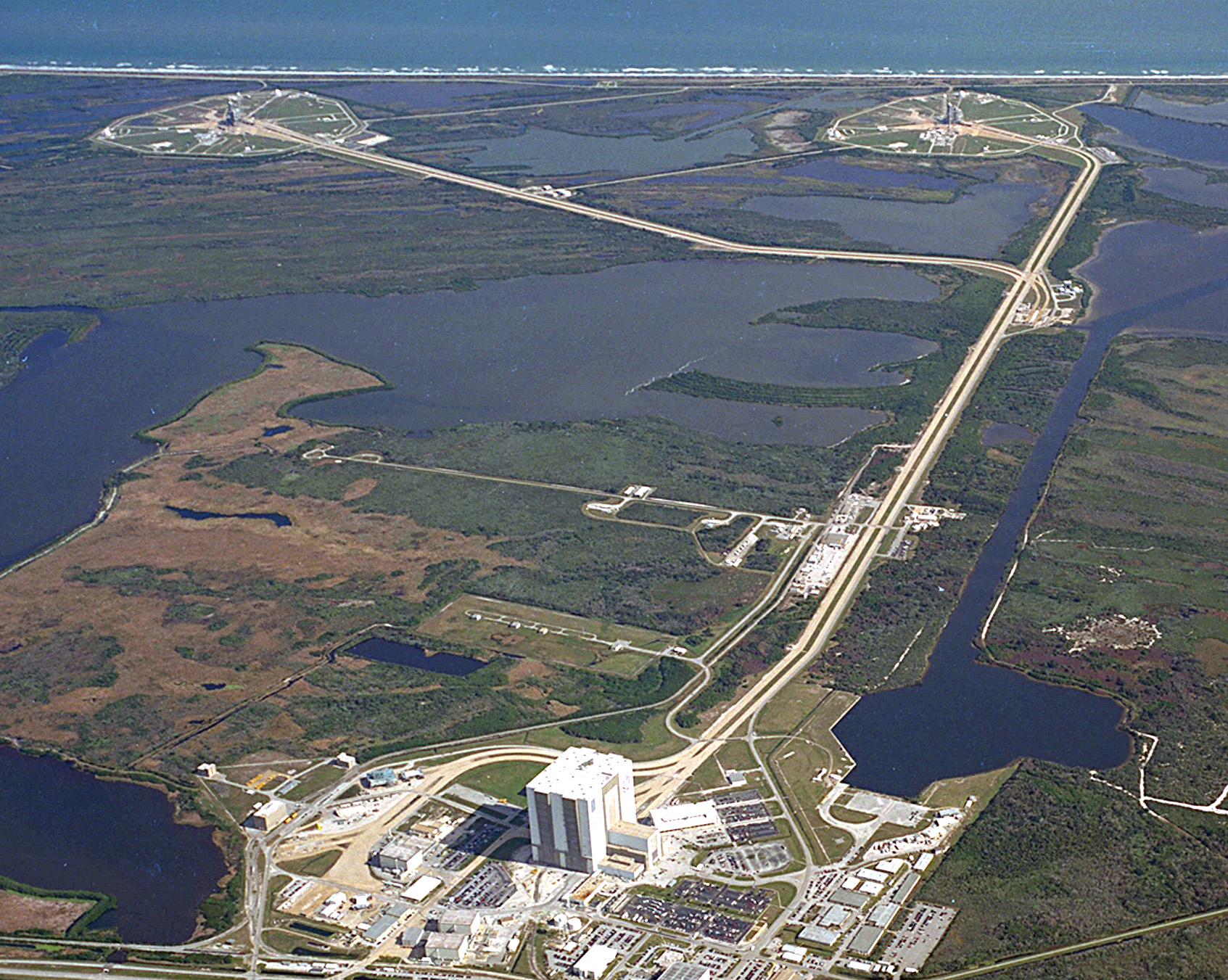
The Crawlerway: NASA's Slowest Road to Space
It is a road that goes nowhere fast -- by design. The Crawlerway at Kennedy Space Center is a double-lane gravel path stretching roughly 3.5 miles from the Vehicle Assembly Building to the launch pads at Launch Complex 39. Nothing about it looks remarkable from above: a pale strip flanked by Florida marshland, connecting two of the most famous structures in American spaceflight. But this humble road has carried every Saturn V, every Space Shuttle, and every Space Launch System rocket on the final leg of their journey from assembly to ignition. The surface is not asphalt, not concrete, but river rock hauled from Alabama -- chosen after exhaustive testing for its hardness, roundness, and ability to bear loads that would crush ordinary pavement.
Built for a Giant's Footsteps
The Crawlerway was constructed in 1963 and 1964 to solve an engineering problem unlike anything NASA had faced before. The Saturn V rocket, its mobile launcher platform, and the Launch Umbilical Tower together weighed roughly 18 million pounds. This colossal assembly had to travel from the Vehicle Assembly Building to the launch pad without tilting, sinking, or suffering vibration damage. The solution was a road built in layers: two lanes, each 40 feet wide, separated by a 50-foot median. At the bottom, compacted fill. Above that, graded and crushed stone. And on top, a surface of carefully selected Alabama river rock -- rounded, hard, and resilient. The river rock was chosen for its performance on the Los Angeles abrasion test, a measure of how well stone resists grinding and crumbling under heavy loads. On straight sections the rock layer is roughly 4 inches thick, increasing to 8 inches on curves where the massive crawler-transporters exert greater lateral force. The Crawlerway's construction also reshaped local geography, connecting Merritt Island with the mainland and forming a peninsula.
The Slowest Parade on Earth
The crawler-transporters that use this road are among the largest self-powered vehicles ever built. Each weighs roughly 6 million pounds and moves at about one mile per hour when loaded. A trip from the VAB to Launch Pad 39A takes approximately six hours. To Pad 39B, the journey is slightly longer. Along the way, the crawler's leveling system keeps the rocket stack vertical within fractions of a degree, even as the road climbs a five-percent grade approaching the pad. The Saturn Causeway, the main vehicle access road to the launch pads, runs alongside the Crawlerway, providing ground-level perspective for anyone watching the procession. During the Apollo era, rollouts became unofficial holidays for space workers and their families -- a slow-motion spectacle of a 363-foot rocket gliding above the flat Florida horizon on a machine that looked like a mobile parking lot.
Sixty Years of Wear and Reinvention
Photographs taken during the Crawlerway's early years show the Alabama river rock smooth and uniformly rounded. Images from 2005 and later tell a different story: decades of crawler passages have ground the once-smooth stones into angular fragments. NASA has periodically resurfaced sections, hauling in fresh river rock and regrading the layers beneath. In 2013, as NASA prepared for the Space Launch System -- a vehicle even heavier than the Space Shuttle stack -- engineers conducted a foundation compatibility study to determine whether the Crawlerway could handle the increased loads. Upgrades included reinforcement of the roadbed and improved drainage to protect against Florida's heavy rains. The road that was built for Saturn V in the 1960s was being reengineered for a new generation of Moon-bound rockets.
A Road on the National Register
The Crawlerway is listed on the National Register of Historic Places as part of the Launch Complex 39 Historic District, recognizing its role in every major American crewed spaceflight program since Apollo. It is an artifact of an era when engineers solved problems with gravel, steel, and sheer scale. The road has no speed limit signs, no lane markings, no traffic lights -- just the two wide paths and the median between them, stretching from the world's largest single-story building to the pads where humans have departed for the Moon. From the air, it reads like a scar across the wetlands, the straightest line in a landscape of winding waterways and tangled mangroves. It is the last stretch of Earth that every American Moon rocket has touched before flight.
From the Air
The Crawlerway is located at approximately 28.604°N, 80.628°W on Merritt Island, Kennedy Space Center, Florida. From the air, it appears as a distinctive pale double-lane path running roughly north-south from the Vehicle Assembly Building to the launch pads at Complex 39. The VAB, one of the largest buildings in the world, is the unmistakable landmark at the southern end. The path splits into branches toward Pads 39A and 39B at the northern end. Best viewed at 3,000-5,000 feet AGL. Nearby airports include KTIX (Space Coast Regional, Titusville) and KMLB (Melbourne Orlando International). The Kennedy Space Center restricted airspace (P-093) may limit approach options; check NOTAMs before overflying.