Creative Growth Art Center
Judith Scott could not speak. Born deaf and with Down syndrome, she was institutionalized at age seven and spent 35 years in state care before her twin sister became her guardian and brought her to a converted auto-repair shop in downtown Oakland. There, at Creative Growth Art Center, Scott began wrapping yarn and fiber around found objects -- sticks, chairs, shopping carts -- creating dense, mysterious sculptures that no one had taught her to make. In 2017, her work was exhibited at the Venice Biennale. In 2018, it hung in the National Gallery of Art in Washington, D.C. The art world did not discover Judith Scott. Creative Growth did, by doing something deceptively simple: giving her a studio, materials, and the belief that she had something to say.
A Garage in Berkeley
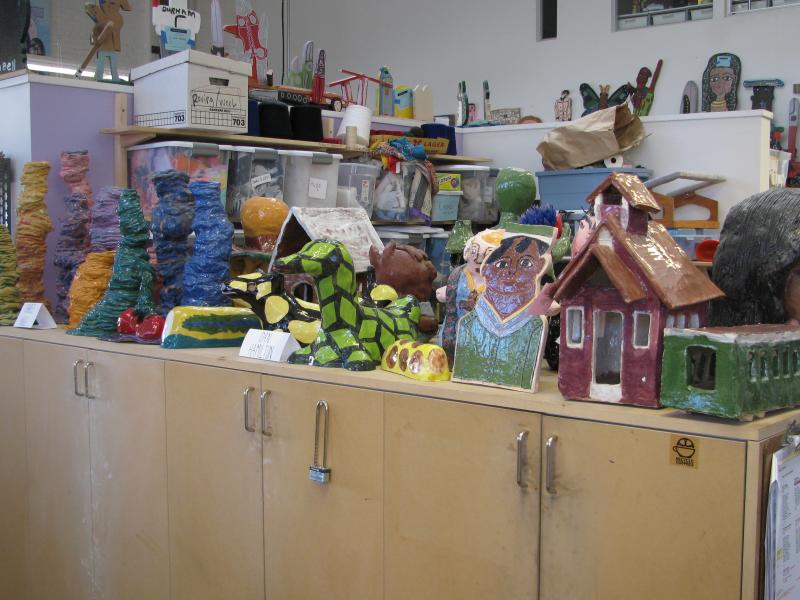
Florence Ludins-Katz and Elias Katz, a married couple who were both psychologists and artists, founded Creative Growth in 1974. Their workspace was their garage in Berkeley. The premise was radical for the time: that people with developmental, mental, and physical disabilities were not patients to be managed but artists who needed what any artist needs -- space, materials, and time. In 1978, the center moved to a former auto-repair shop in downtown Oakland, a raw industrial space with high ceilings and concrete floors. That building remains its home today. Roughly 160 artists work there at any given time, painting, sculpting, weaving, and drawing in an open studio environment. There is no curriculum. No one tells the artists what to create. The philosophy is rooted in a conviction the Katzes held from the beginning: creativity does not require instruction. It requires permission.
Art That Refuses Category
The work that emerges from Creative Growth's studios resists easy classification, which is precisely why the mainstream art world has embraced it. Dan Miller, an artist with autism who is largely nonverbal, creates dense, layered drawings and paintings built from compulsively repeated words and numbers. His work was included in a 2008 exhibition at the Museum of Modern Art in New York. William Scott, another Creative Growth artist, paints vivid, architecturally detailed cityscapes drawn from memory, and his work has been shown at White Columns gallery in Manhattan. These are not outsider-art curiosities displayed for novelty. They are works that hold their own in the most competitive exhibition spaces in the world, judged by the same standards applied to any artist. What makes Creative Growth remarkable is not that its artists have disabilities, but that the center treated them as artists long before galleries and museums caught up.
Beyond the Canvas
In 2010, Creative Growth launched Beyond Trend, a fashion show that began as a modest in-gallery presentation and grew into something the center's founders could scarcely have imagined. By 2018, the event filled the 1,250-seat Scottish Rite Center in Oakland and was co-chaired by Paper magazine co-founder Kim Hastreiter and Target's Chief Creative Officer Todd Waterbury. The artists design the textiles and patterns themselves. Models walk the runway wearing fabric printed with their paintings, drawings, and digital designs. The fashion industry, always hungry for the genuinely original, has taken notice. But Beyond Trend is more than a fundraiser or a spectacle. It is an assertion: that the artists who work in the Oakland studio are capable of producing work across mediums, that their creative vision extends beyond gallery walls and into the designed world people actually wear and inhabit.
An Open Door in Oakland
What sustains Creative Growth across five decades is a philosophy so simple it barely sounds like one: keep the door open. The center does not audition artists or demand portfolios. It serves people with a wide range of disabilities -- developmental, physical, mental -- and its only requirement is showing up. The television series Art21 devoted a segment to Creative Growth in its ninth season in 2018, and what struck viewers was the ordinariness of the studio's daily rhythm. Artists arrive, choose their materials, and work. Staff members offer support but not direction. In 2010, curator Matthew Higgs of White Columns organized an exhibition called 'Everyone!' that included work by every single artist then enrolled in the program -- more than 130 people. The show's title was also its thesis. Thousands of artists have passed through Creative Growth's doors since 1974. The center's contribution to American art is not that it found exceptional talent among people others had overlooked, though it did. It is that it insisted -- quietly, persistently, from a garage in Berkeley to an old repair shop in Oakland -- that there was no such thing as a person without creative capacity.
From the Air
Located at 37.81°N, 122.26°W in downtown Oakland, California. The center sits in the urban core east of the Port of Oakland, with the distinctive street grid of downtown Oakland visible from above. Best viewed at 2,000-3,000 feet AGL. Nearest airports: Oakland International (KOAK) approximately 5 nm south, Hayward Executive (KHWD) approximately 12 nm southeast. Lake Merritt is a prominent visual landmark approximately 0.5 nm to the east.