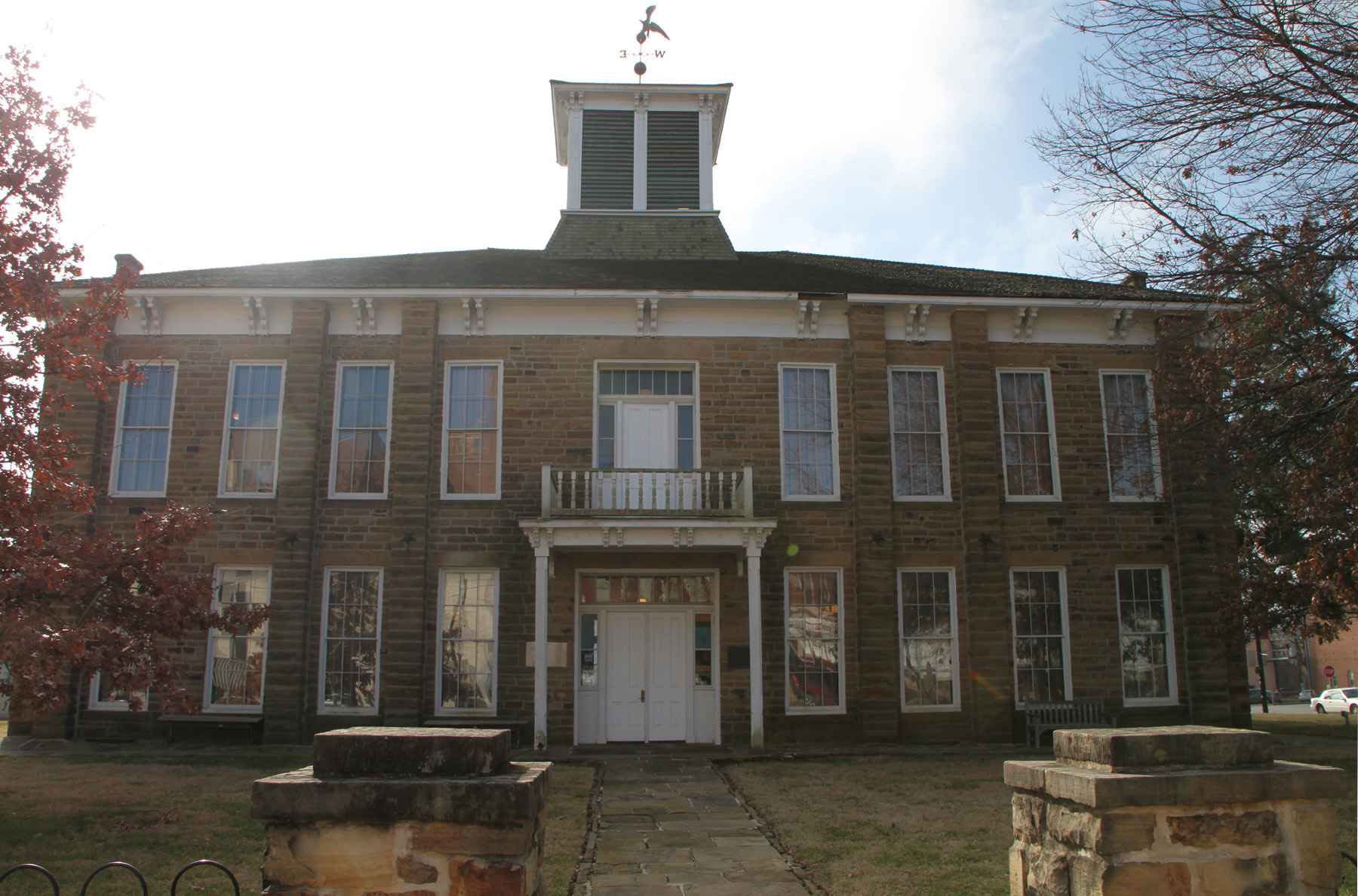
Creek National Capitol
In 2010, the Muscogee (Creek) Nation paid $3.2 million to buy back a building that was already theirs. The Creek National Capitol in downtown Okmulgee had been the seat of their government from 1878 to 1907, built with their own $10,000 appropriation on the site of their original log council house. Then Oklahoma statehood arrived, the federal government took it, and the building spent the next century as a county courthouse, a sheriff's office, a Boy Scout meeting room, and a YMCA. The ceremony marking the tribe's regaining of ownership was, by any measure, a century overdue.
The House of Kings and Warriors
The Muscogee people arrived in Indian Territory as survivors of the Trail of Tears, forcibly removed from their southeastern homelands in 1837. They gathered at the historic Council Oak Tree in what would become Tulsa and began rebuilding their nation. By 1867, they had established their government at Okmulgee, constructing a two-story log council house the following year. When that structure proved insufficient, Chief Ward Coachman approved $10,000 in 1877 for a new stone-and-brick capitol. The old council house sold for $60. The new building, completed in 1878, contained separate chambers for executive and judicial functions, with the legislature divided into the House of Kings and House of Warriors, a governmental structure that predated Oklahoma statehood by three decades.
Taken by Degrees
The 1906 Five Civilized Tribes Act ended self-governance for the Muscogee Creek Nation along with the Cherokee, Chickasaw, Choctaw, and Seminole nations. When Oklahoma became a state in 1907, the federal government leased the council house to newly organized Okmulgee County for $2,000 a year to serve as a courthouse. A 1908 congressional act authorized the Secretary of the Interior to seize all tribal lands used for government purposes. In 1919, the Department of the Interior sold the building and its grounds to the City of Okmulgee for $100,000, depositing the proceeds in the U.S. Treasury under the tribe's name. In the 1920s, proposals surfaced to tear it down or convert it into a hotel.
Will Rogers Intervenes
The building's salvation came from an unlikely source. When entertainer Will Rogers, himself of Cherokee heritage, visited Okmulgee and learned of the demolition proposals, he called publicly for the Council House to be preserved. In 1923, activists founded the Creek Indian Memorial Association to protect Muscogee historical monuments. The 1934 Oklahoma Indian Welfare Act began restoring some tribal sovereignty, and in 1961 the Council House was declared a National Historic Landmark, one of the first properties listed on the National Register of Historic Places in 1966. The recognition established its significance but did nothing to return it to Muscogee ownership.
A Long Road Home
The path back accelerated after Congress authorized the Five Tribes to democratically elect their chiefs in 1970. The Muscogee Nation adopted a new constitution in 1979, restructuring their government with executive, legislative, and judicial branches. Meanwhile, the Creek Indian Memorial Association raised $1 million to restore the Council House as a museum, completing the work in 1992. The restoration earned the National Preservation Honor Award from the National Trust for Historic Preservation in 1993. Finally, in August 2010, the City of Okmulgee agreed to sell the building back to the Muscogee Nation for $3.2 million. Today the Creek Council House Museum displays artifacts about Muscogee history and the arts and crafts of other Native American tribes, housed in the very chambers where the House of Kings and House of Warriors once governed a nation.
From the Air
Located at 35.62°N, 95.97°W in downtown Okmulgee, Oklahoma. The stone Capitol building is situated in the Okmulgee Downtown Historic District. Nearest airport: Okmulgee Regional (KOKM), approximately 3 nm southeast. At low altitude, look for the historic stone building among the downtown blocks. The town lies roughly 40 nm south of Tulsa along US-75.