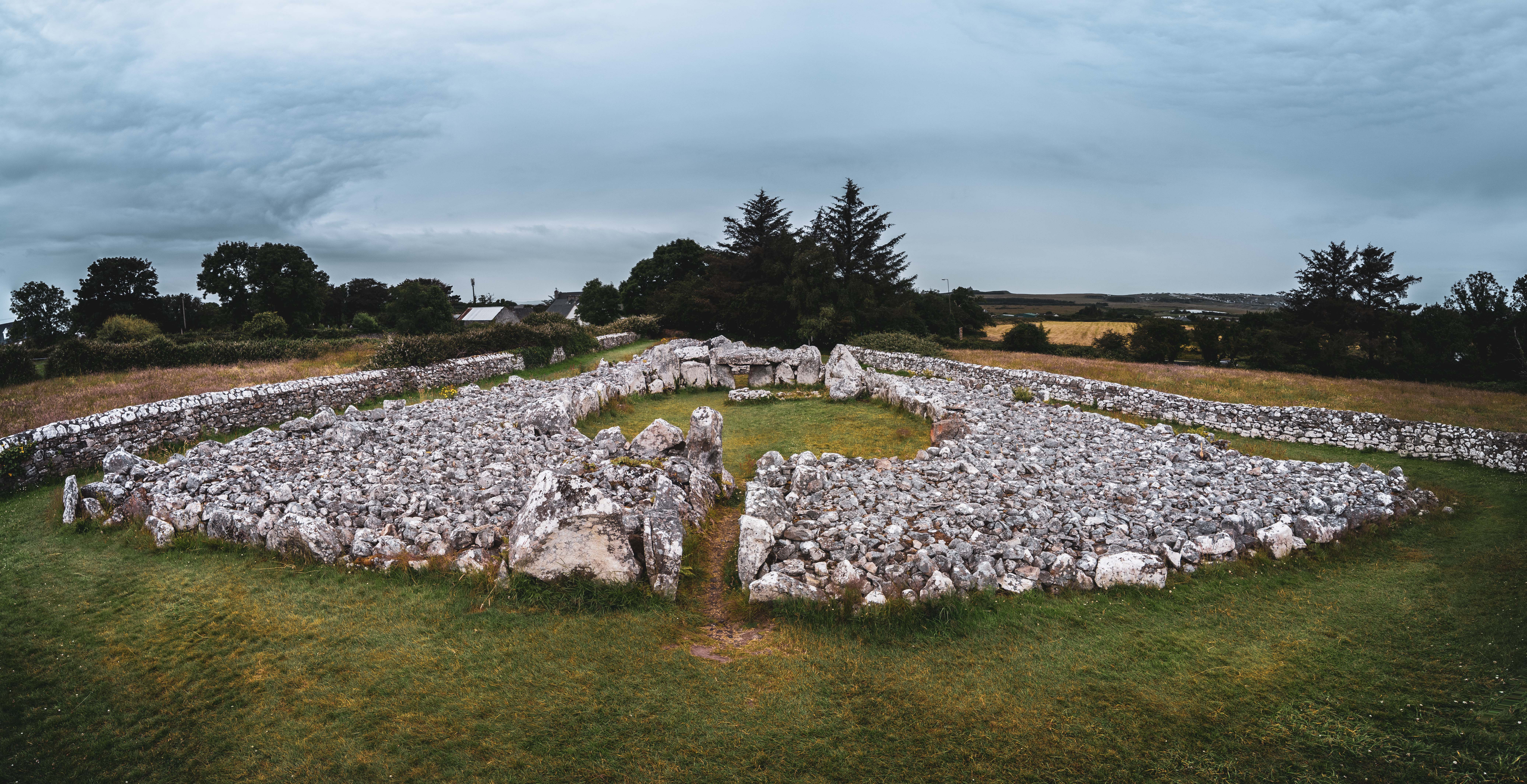
Creevykeel Court Tomb
A prophecy attached to Creevykeel held that the great lintel stone over the entrance would be toppled "by three brothers of the one name." Around 1905, three brothers did exactly that. The story was already old when Edward Connelly, an 80-year-old neighbor of the cairn, told it to the Harvard archaeologists who arrived in 1935. Creevykeel has always attracted stories -- prophecies, ghost lights, white hares. But the monument itself, a trapezoid cairn stretching 55 meters along its east-west axis, needs no embellishment. Built around 3500 BC by Neolithic farming communities, it is one of the finest court tombs remaining in Ireland.
The Architecture of the Dead
Court tombs are distinctively Irish. They consist of a roofed burial gallery preceded by an open, semicircular court where ceremonies for the dead were presumably conducted. At Creevykeel, the cairn measures 55.5 meters long, 25 meters wide at its eastern facade, and tapers to 10 meters at the western tail. The stones are a hard local sandstone with a bluish tint. Evidence of large corbel slabs used for roofing survives in the inner chamber. At the western end, three subsidiary chambers were built into the body of the monument -- described by some as small passage graves, though they appear to date from a later Neolithic addition. The original name, Caiseal an Bhaoisgin (the Fort of Bhaoisgin), connects it to a nearby well, Tobar an Bhaoisgin. The monument is one of five megalithic sites in the immediate area.
Harvard Comes to Sligo
In 1935, the fourth Harvard Archaeological Mission arrived at Creevykeel -- an American collaboration with the Irish Free State government that conducted the first modern scientific excavations in Ireland. From 25 July to 4 September, the team carefully removed the cairn material, documented the positions of every megalithic boulder, and then replaced the cairn. They found that the massive structural stones rested on the old ground surface rather than in sockets, having sunk into the soil over millennia. Inside one structure, they discovered a mixture of charcoal, ashes, and burnt soil surrounding a hearth flanked by severely scorched stones. A large chunk of iron slag suggested Early Christian-era metalworking. Deeper down, in a chamber that had been cleared and refilled in modern times, they found the fetal bones of at least two individuals alongside the skeleton of a cat, pig and ox bones, and broken china.
Blue Lights and Poteen
The folklore of Creevykeel is as layered as its archaeology. The chamber was used as a still house for distilling poteen -- the illegal Irish spirit -- which likely explains the local reports of eerie blue lights emanating from the monument. Burning alcohol produces a blue flame visible at a distance, and what looked like supernatural activity was probably someone running an after-hours operation inside a 5,000-year-old stone chamber. The site is also associated with a white hare, a creature that appears in Irish folklore as a shape-shifting spirit or omen. The fetal bones found during the 1935 excavation probably indicate that the monument was briefly used as a burial ground for unbaptized children -- a practice known across Ireland, where such children were often interred at ancient or liminal sites.
Standing at the Crossroads
Creevykeel sits beside the N15 road from Donegal Town to Sligo, just 50 meters north of the crossroads, near the village of Cliffoney. A second megalithic monument once stood 300 meters to the north but was demolished around 1890. The surviving tomb is a national monument, its bluish sandstone walls still holding their shape after five and a half millennia. From the open court at the eastern facade, you can see across the north Sligo countryside toward Benbulben. The builders chose this place for a reason -- a crossroads of routes and landscapes, where the living could gather and the dead could be honored. Five thousand years later, the N15 still runs past the door.
From the Air
Located at 54.44°N, 8.43°W beside the N15 road near Cliffoney in north County Sligo. The monument is difficult to spot from high altitude but identifiable at low level as a long stone cairn beside the main road. Nearest airport: Sligo Airport (EISG), approximately 15 km to the south. Benbulben and the Dartry Mountains dominate the skyline to the southeast.