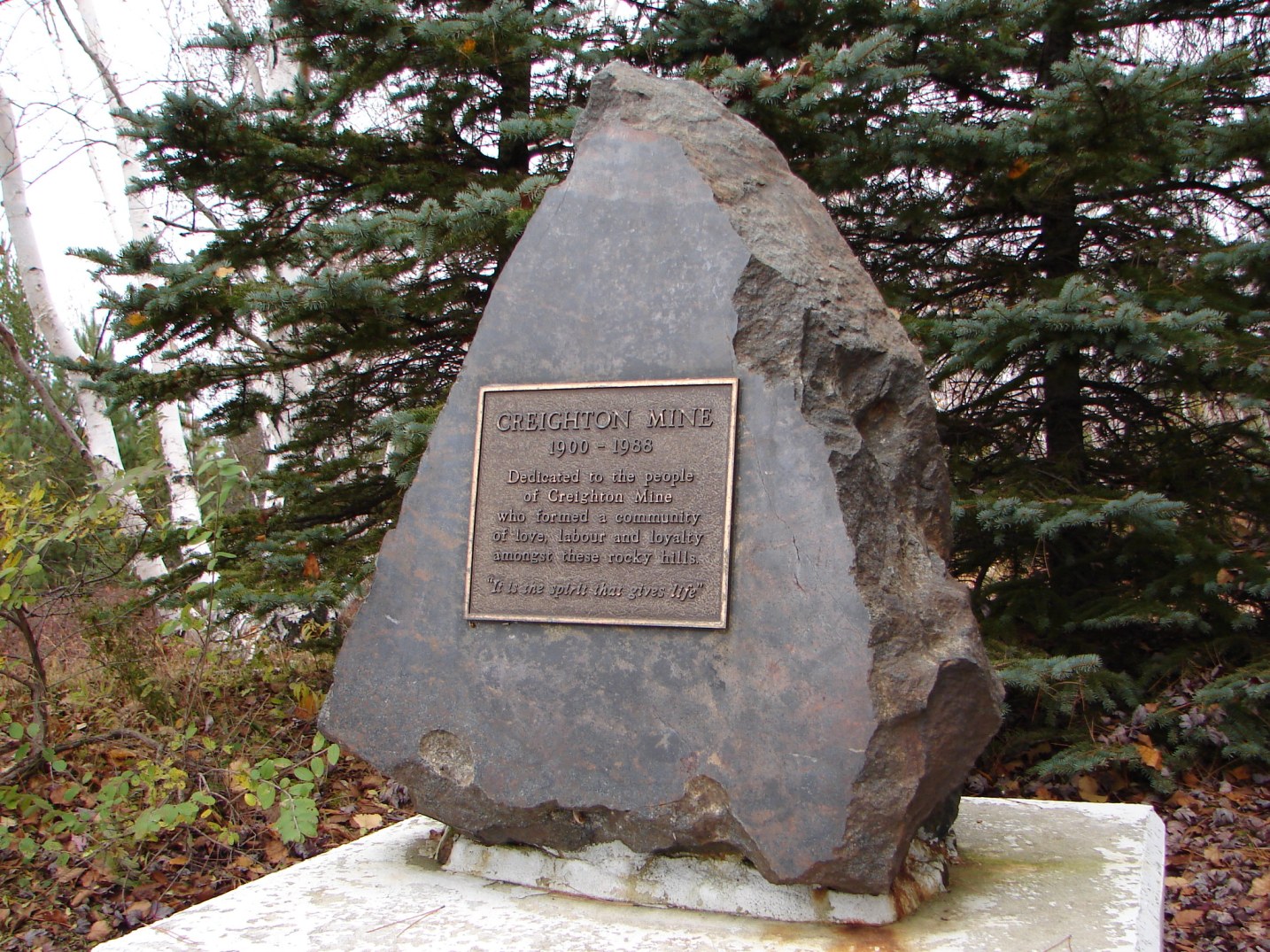
Creighton Mine
Two kilometres below the scarred landscape of Greater Sudbury, Ontario, physicists hunt for the invisible particles that stream through your body by the trillions every second. They do this inside an active nickel mine. Creighton Mine has been pulling ore from the earth since 1901, when open-pit workers first broke into deposits laid down by a catastrophic event: a bolide impact 1.85 billion years ago that punched a crater 200 to 250 kilometres across and melted the pre-existing rock. The molten material settled, cooled, and trapped immense concentrations of nickel, copper, and platinum-group elements in the fractured footwall of the Sudbury Igneous Complex. More than a century later, Creighton remains one of the deepest and most productive mines in the Western Hemisphere -- and one of the strangest, with a world-class neutrino observatory and an underground forest growing alongside the ore.
Crater of Riches
The Sudbury Basin is the second-largest confirmed impact structure on Earth, and Creighton Mine sits in its South Range geologic unit, where the physics of the ancient collision concentrated the richest deposits. The bolide impact created a crater so vast it reshaped the regional geology, melting rock that partially filled the depression as it cooled into what geologists call the Sudbury Igneous Complex. Copper, nickel, and platinum-group-element-rich sulfides settled to the base of the melt sheet and formed veins and stockworks of mineralization in the underlying footwall rock. The mine's ore occurs as massive to disseminated sulfides, grading from dense concentrations near the footwall toward scattered mineralization in the hanging wall. Open-pit mining began in 1901 under the Canadian Copper Company. Underground operations followed in 1906 as miners chased the ore body deeper. In 1969, the No. 9 shaft was completed at 7,138 feet, making it the deepest continuous mine shaft in the Western Hemisphere. Today, the mine is owned and operated by Vale Limited, successor to the International Nickel Company, and produces not just nickel and copper but also gold, silver, cobalt, selenium, and tellurium.
The Deepest Clean Room on Earth
At the deepest active level of Creighton Mine sits SNOLAB, the world's deepest clean underground physics laboratory. The facility grew out of the Sudbury Neutrino Observatory, a heavy-water Cherenkov detector that solved one of physics' great puzzles: where the sun's missing neutrinos had gone. The original SNO laboratory was excavated in the mine's deep rock, shielded by two kilometres of overburden that filters out the cosmic rays that would drown out the faint signals physicists need to detect. In 2004, a $7.5 million three-storey lab was constructed at the mine, and a subsequent $48 million expansion transformed the site into the general-purpose facility known as SNOLAB. Researchers there now pursue experiments in dark matter detection, neutrinoless double-beta decay, and other questions at the frontier of particle physics. The mine provides something no surface laboratory can: a silence so profound that the faintest whispers of subatomic particles become audible against the background noise of the universe.
When the Rock Fights Back
Mining two kilometres underground means contending with forces that surface operations never face. Creighton Mine contains four families and twelve total shear zones, areas where immense tectonic stress has fractured the rock. As mining removes material and redistributes pressure, these shear zones re-mobilize, producing seismic events that range from imperceptible rumbles to full rock bursts felt in nearby Sudbury. Between January 2000 and September 2013, the mine recorded 123 seismic events, both felt and unfelt. Rock bursts -- sudden, violent failures of rock under stress -- are among the most dangerous hazards in deep mining. The mine's operators have developed sophisticated monitoring systems and ground support techniques to manage the risk, but the fundamental challenge remains: at these depths, the weight of the overlying rock generates pressures that can cause the walls of a tunnel to explode inward without warning. In 2007, exploration drilling expanded Creighton's proven and probable reserves to 32 million tons of ore grading 2.2% nickel and 2 to 2.3% copper, ensuring decades of future production -- and decades of wrestling with the restless rock.
A Forest in the Dark
At the 4,800-foot level, where the temperature and humidity are carefully controlled by the mine's ventilation systems, a fully automated greenhouse grows approximately 100,000 jack and red pine seedlings. The trees are not for decoration. They are destined for the surface, where they will be planted as part of the ongoing regreening and remediation of the Sudbury Basin. For decades, sulfur dioxide emissions from Sudbury's smelters had killed vegetation across thousands of hectares, leaving a moonscape so barren that NASA used it to train Apollo astronauts. The region's regreening program, one of the most ambitious ecological restoration projects in the world, has planted millions of trees since the 1970s. Creighton's underground greenhouse is part of that effort, nurturing seedlings in the controlled environment before transplanting them to the recovering landscape above. The mine is also transitioning its underground vehicle fleet from diesel to electric, reducing both heat generation and contamination at depth -- a practical measure that also shrinks the operation's environmental footprint.
Still Descending
Production at Creighton Mine continues at industrial scale. In 2019, the mine produced 6.13 million tonnes of ore with copper grades of 2.67% and nickel grades of 2.68%. Ore is processed off-site at Vale's Clarabelle Mill for nickel and copper, while platinum-group-element intermediates travel to Vale's processing facility in Port Colborne, Ontario. Groundwater flowing through the tailings area poses an environmental contamination risk, so it is continuously pumped to treatment plants before being discharged into the local watershed. The mine's story is one of constant adaptation: from open-pit beginnings in 1901, to the record-breaking No. 9 shaft in 1969, to neutrino observatories and underground forests in the 21st century. Creighton Mine is a place where the deep past -- a meteorite impact nearly two billion years ago -- continues to shape the present, yielding metals for the modern world, answers to fundamental questions about the universe, and pine trees to heal the scars that mining itself created.
From the Air
Located at 46.46°N, 81.17°W in Greater Sudbury, Ontario. The mine's surface infrastructure -- headframes, processing buildings, and tailings areas -- is visible from the air, set amid the distinctive scarred-and-recovering landscape of the Sudbury Basin. Greater Sudbury Airport (CYSB) is approximately 20 km to the northeast. The Sudbury Basin impact structure is visible as a large elliptical depression from higher altitudes. Best viewed at 3,000-6,000 feet AGL to appreciate the mine complex and the contrast between regreened areas and remaining barren patches. The nearby Superstack, a 380-metre smelter chimney (one of the tallest in the world), serves as a prominent visual landmark.