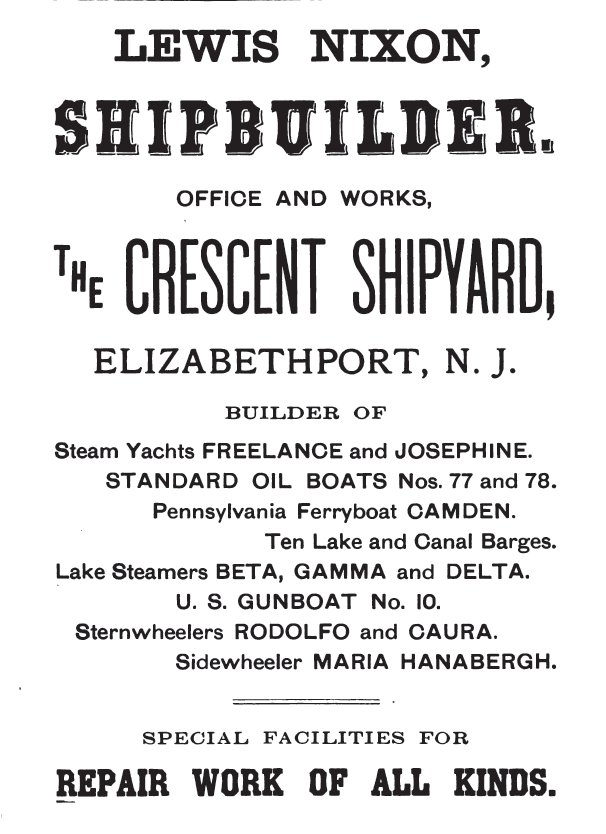
Crescent Shipyard
On April 11, 1900, the United States Navy took possession of a vessel that would reshape warfare at sea. The USS Holland (SS-1), America's first commissioned submarine, had been built not at some vast government arsenal but at a modest private shipyard on Newark Bay in Elizabeth, New Jersey. The Crescent Shipyard, founded just five years earlier by two former colleagues from the Philadelphia shipbuilding world, had quietly produced one of the most consequential naval innovations in modern history.
Two Men from Cramp's
Arthur Leopold Busch, a recent emigrant from Great Britain, and former Navy Lieutenant Lewis Nixon met while working at the renowned William Cramp & Sons shipyard in Philadelphia. Both men had built reputations as among the best in their fields - Nixon as a naval architect who had designed America's first class of battleships, Busch as a master builder and construction superintendent. In January 1895, they pooled their expertise and founded the Crescent Shipyard on the industrial shoreline of Newark Bay. The location placed them within easy reach of New York harbor and the Navy Yard in Brooklyn, positioning the young firm to bid on government contracts. Within months, they were building gunboats, monitors, and cruisers for a Navy that was rapidly modernizing in the years before the Spanish-American War.
The Holland Dives
The shipyard's defining achievement began taking shape in late 1896, when John Philip Holland's torpedo boat company contracted Crescent to build a revolutionary new vessel. Under Busch's direct supervision, workers laid the keel for the Holland VI in early December of that year. Holland, an Irish immigrant schoolteacher turned inventor, had spent decades refining submarine designs that the Navy had repeatedly rejected. This time the design worked. The Holland VI combined an internal combustion engine for surface running with an electric motor for submerged operation - a dual-propulsion concept that would define submarine design for the next sixty years. When the Navy purchased the vessel on April 11, 1900, industrialized nations around the world took immediate notice. Several acquired rights to build submarines based on Holland's design almost at once. Busch went on to supervise the construction of the prototype Fulton, which served as the template for America's first class of production submarines.
From Submarines to Steel
Holland's company evolved into the Electric Boat Company after its incorporation on February 7, 1899 - a firm that remains one of the world's premier submarine builders to this day, now based in Groton, Connecticut. Isaac Rice's Electric Launch Company, which built electrically propelled small craft, also began operations at the Crescent yard. Nixon ran the shipyard until 1904, when Bethlehem Steel acquired the property. The industrial giant leased portions to the John W. Sullivan Company and the New Jersey Dry Dock & Transportation Company, both of which built cargo ships, tugboats, ferries, and fireboats through the 1910s and 1920s. When Bethlehem Steel took over direct operation in 1916, the yard pivoted to wartime production, turning out cargo ships, tankers, and reefer ships for the Emergency Fleet Corporation during World War I.
A Quiet Legacy
The shipyard closed permanently in 1921, shortly after the armistice. Its physical traces have largely vanished into the industrial landscape of Elizabeth's waterfront. But the innovations born here rippled outward in ways the founders could scarcely have imagined. Busch, after leaving Crescent, went on to supervise the construction of Japan's first five submarines at the Fore River shipyard in Quincy, Massachusetts, working under Admiral Francis T. Bowles for Electric Boat. The submarine technology that emerged from this unassuming stretch of Newark Bay would shape naval strategy through two world wars and into the nuclear age. Today, the site where America's submarine fleet was born sits unremarkably among the container terminals and port facilities of one of the East Coast's busiest harbors.
From the Air
Located at 40.645N, 74.189W on the western shore of Newark Bay in Elizabeth, NJ. The former shipyard site sits among modern port facilities visible along the waterfront. Newark Liberty International Airport (KEWR) is approximately 2 nm to the north. Best viewed at 2,000-3,000 ft AGL. The Bayonne Bridge and container cranes of Port Elizabeth serve as visual references.