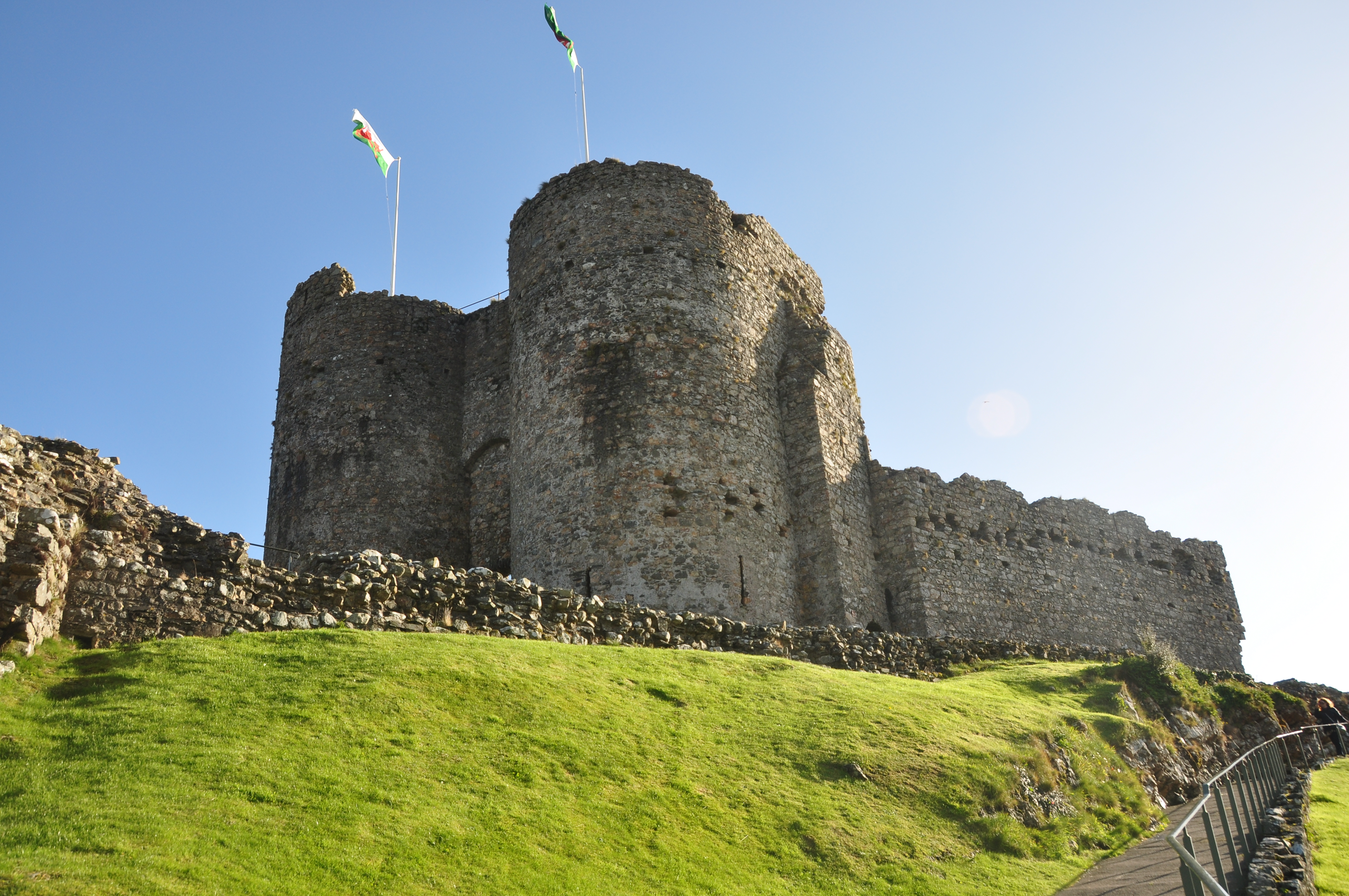
Criccieth Castle
Most castles in North Wales were built by the English to subjugate the Welsh. Criccieth was built by the Welsh themselves. Llywelyn the Great constructed the original fortress in the 1230s on a rocky headland jutting into Tremadog Bay, and his grandson Llywelyn ap Gruffudd expanded it. When Edward I conquered Gwynedd in 1283, he did not demolish Criccieth. He recognized good engineering when he saw it, and instead poured money into enlarging and strengthening it -- turning a native Welsh castle into an instrument of English occupation.
Llywelyn's Headland
The site is natural theatre. A rocky peninsula rises above the bay, commanding views across the water to the Llyn Peninsula and, on clear days, toward Snowdonia's peaks inland. Llywelyn ab Iorwerth -- Llywelyn the Great -- chose it in the 1230s for an inner ward with a formidable twin-towered gatehouse, the most prominent feature still standing today. His grandson Llywelyn ap Gruffudd added to the defences before the English conquest. The inner curtain wall and gatehouse survive to nearly their full height, a testament to the quality of native Welsh military architecture that is too often overshadowed by the later Edwardian castles. Criccieth proves that the Welsh princes were building sophisticated stone fortifications decades before Edward I arrived with his master mason.
Edward's Appropriation
After his conquest of Gwynedd in 1283, Edward I spent considerable sums remodeling Criccieth. An outer ward was added, nearly surrounding the original inner enclosure. New towers were built, though these -- along with the outer curtain wall and the inner ward buildings -- are now significantly more ruinous than the earlier Welsh work. Edward appointed English constables and installed a garrison, transforming Criccieth into part of his chain of fortifications across North Wales. The castle received provisions by sea through a dock below the headland, a critical advantage for a fortress that might find itself cut off from land routes during Welsh uprisings. Town records show the settlement around the castle grew under English administration, though the Welsh population remained a majority.
Glyndwr's Fire
The castle's definitive moment came during the Glyndwr Rising. Owain Glyndwr's forces attacked Criccieth around 1404, and the castle was taken and burned. Archaeological evidence of intense fire damage confirms what the chronicles describe: the destruction was thorough. The gatehouse towers survived the blaze structurally -- their thick walls resisted what flames could not consume -- but the castle was never reoccupied as a working fortress. What Llywelyn the Great had built, and Edward I had enlarged, Glyndwr ended. There is a pointed irony in the fact that a Welsh prince's castle, appropriated by the English crown, was ultimately destroyed by a Welsh revolt. Criccieth's story tracks the arc of Welsh independence -- its assertion, its suppression, and its final, violent reassertion.
The Headland Today
Cadw maintains the ruins, and the castle's position above the bay makes it one of the most scenically dramatic sites in North Wales. The twin towers of the inner gatehouse still dominate the headland, their silhouettes visible from miles along the coast. The seaside town of Criccieth, which grew in the Victorian era as a holiday resort, spreads below. David Lloyd George, who became Prime Minister in 1916, grew up nearby in Llanystumdwy, and the connection gives the area a double claim on Welsh national identity -- medieval and modern. From the castle walls, the view across Tremadog Bay encompasses a landscape that has witnessed every chapter of Welsh history: Roman roads, Norman incursions, native Welsh castle-building, Edwardian conquest, and Glyndwr's rebellion. The headland has outlasted them all.
From the Air
Located at 52.92N, 4.23W on a prominent headland overlooking Tremadog Bay, Gwynedd. The twin-towered gatehouse is clearly visible from the air. Nearest airports: Caernarfon (no ICAO), Llanbedr (EGOD) 15nm south. Best viewed at 1,500-2,500ft AGL. The headland projects into the bay and is unmistakable from coastal approaches. Snowdonia's peaks are visible to the northeast.