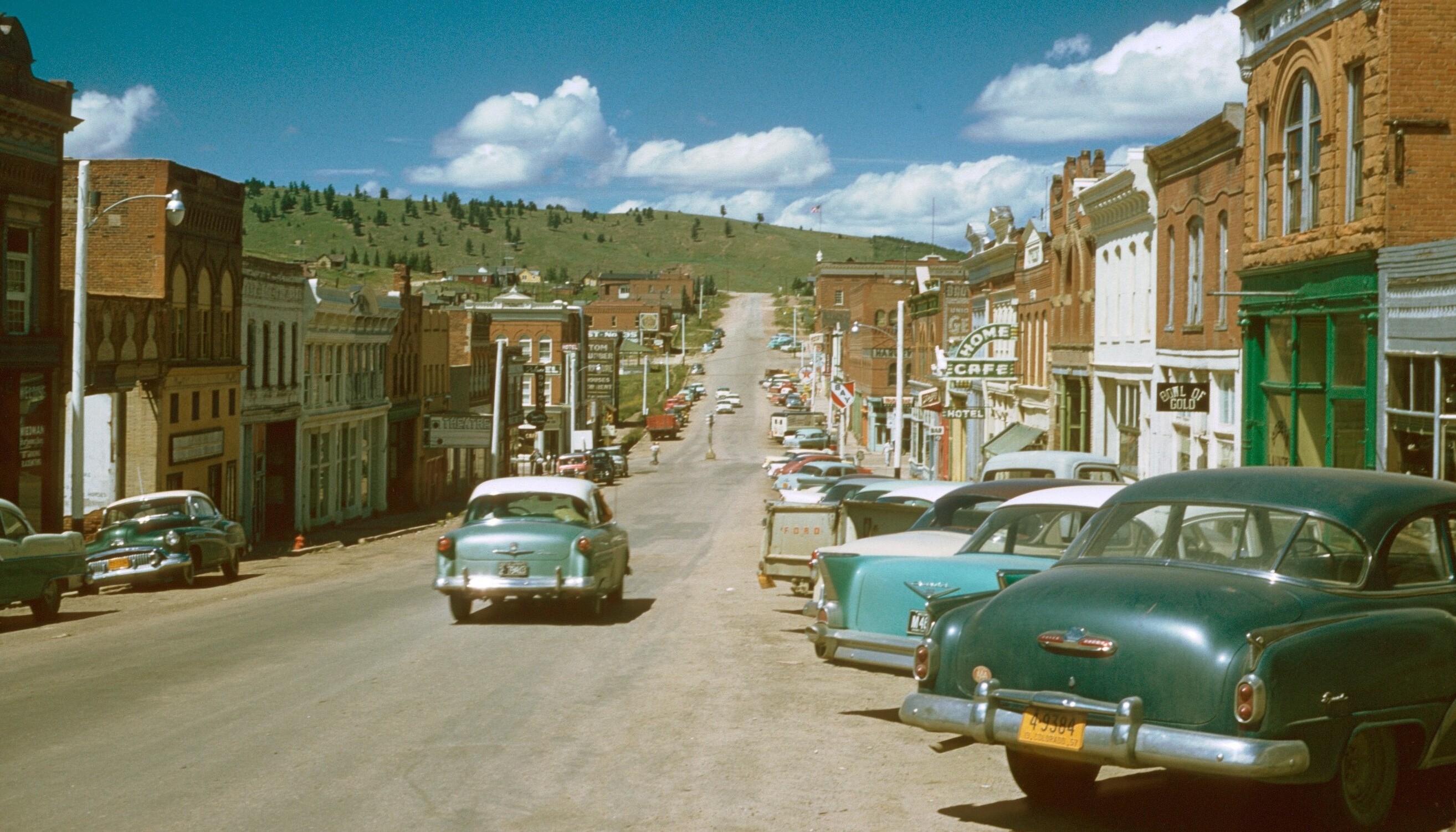
Cripple Creek Historic District
Bob Womack sold his gold claim for $500. The mines that followed it produced over $350 million in gold. That single miscalculation captures the entire story of Cripple Creek: a place where fortunes appeared and vanished with staggering speed, where a cattle pasture became the most productive gold district in Colorado history, where an entire town burned twice in a single month and rebuilt itself in brick before the embers cooled. Declared a National Historic Landmark in 1961, the Cripple Creek Historic District preserves the bones of a city that once rivaled Denver in ambition, if not in size.
The $300 Million Cow Pasture
For years, the high valley at 9,494 feet was nothing more than ranchland beneath the slopes of Mount Pisgah. Ferdinand Hayden's geological survey passed through in 1873, and one of his geologists, H.T. Wood, returned the next year with a hunch that the area held mineral promise. But Colorado was caught up in a silver boom, and nobody cared about gold in a cattle field. Bob Womack prospected the area stubbornly from 1880 to 1890, locating the El Paso claim in Poverty Gulch. On October 20, 1890, he found rich ore and the last great Colorado gold rush began. Still, miners remembered a nearby hoax from years earlier, and the stampede was slow to start. It took additional discoveries in 1891 to break the dam. Winfield Scott Stratton staked his claim on July 4, 1891, naming it the Independence. He became Cripple Creek's first millionaire and sold the mine in 1899 for $11 million.
Boomtown at Ten Thousand Feet
The population explosion was staggering. Within two years of the first townsite plat, Cripple Creek housed roughly 18,000 people. By 1900, the entire mining district swelled to over 55,000 residents. At its peak, the town of Cripple Creek alone supported a population of 25,000, making it one of the largest cities in Colorado. The mines were astonishingly productive: over 500 mines in the district ultimately produced 21 million ounces of gold, surpassing the combined output of the California and Alaska gold rushes. The district's wealth built grand hotels, courthouses, churches, and an entire commercial district that hummed with the energy of round-the-clock mining operations. Ore from the mountainside was processed at mills in nearby Colorado City, and the Midland Terminal Railway connected the remote mountain camp to the outside world.
Fire, Brick, and Reinvention
In April 1896, two devastating fires swept through Cripple Creek, leveling much of the wooden boomtown. The response was swift and defiant: the business district was rebuilt in brick, and the structures that rose from the ashes form the architectural core of the historic district today. The Midland Terminal Depot, the Teller County Courthouse, the Imperial Hotel, the Old Homestead, St. Paul's Catholic Church, the Mansard Roof House on Warren Avenue, and the Teller County Hospital with its Greek Revival facade all survive from the gold mining era. The district's boundary is defined not by streets but by mountaintops: from Mineral Hill at 10,255 feet to Globe Hill at 10,436 feet to Carbonate Hill at 10,335 feet, the peaks encircle both the town and Poverty Gulch, where the original ore discoveries were made.
Decline, Casinos, and What Endures
The gold district reached peak production in the early twentieth century, then began a long, slow decline. The population shrank from tens of thousands to barely over a thousand. In 1961, the district earned National Historic Landmark status, recognizing both its architectural survivors and its extraordinary place in American mining history. A new chapter began in 1990 when Colorado voters approved limited-stakes gambling, allowing Cripple Creek to build casinos. The gaming revenue has generated millions for historic preservation across the state, but it has also transformed the very town the casinos were meant to help preserve. Today, the population stands at roughly 1,155, a ghost of its former self. Yet the brick buildings still line the streets, the mountain peaks still ring the valley, and State Highway 67 still winds through terrain that yielded more gold than anywhere else in Colorado.
From the Air
Located at 38.752N, 105.175W in Teller County, Colorado, at approximately 9,500 feet elevation. The historic district is ringed by peaks exceeding 10,000 feet including Globe Hill (10,436 ft) and Mineral Hill (10,255 ft). State Highway 67 is the principal road and visual landmark. Nearest airport is Meadow Lake Airport (00C). Colorado Springs Airport (KCOS) is approximately 45 miles east. Mountain weather can change rapidly; expect turbulence near the ridgelines. Best viewed at 11,000-13,000 feet MSL.