The Judge's Gallery
In 1870, a California judge named Edwin B. Crocker was living in rented lodgings in Dresden, Germany, spending his days buying paintings. Not postcards, not souvenirs -- paintings. Crocker and his wife Margaret had left Sacramento the year before on what was supposed to be a European trip. Instead, they stayed for two years, traveling mostly through Germany, acquiring 694 paintings and 1,344 Old Master drawings along with untold numbers of prints. When they shipped it all home and hung it in a purpose-built gallery attached to their house at Third and O Streets, their private collection held more paintings than the Metropolitan Museum of Art in New York. The oldest art museum in the Western United States started as one couple's spectacular act of cultural ambition in a city most Easterners still considered frontier.
A Gallery That Outshone New York
Edwin Crocker was a wealthy lawyer and judge whose brother, Charles, was one of the Big Four railroad magnates who built the Central Pacific. Edwin's fortune gave him the means; his two years in Europe gave him the appetite. The gallery he and Margaret created upon returning to Sacramento in 1871 was not a private vanity project locked behind closed doors. They opened it to the public, using proceeds to fund the Sacramento Library. The gallery became the social hub of the city, hosting benefits for local organizations and attracting visitors whose names still resonate. Queen Liliuokalani of Hawaii visited in 1878. President Ulysses S. Grant walked through the rooms in 1879. Oscar Wilde came in 1882, one imagines with opinions. By 1886, an art school had been established on the premises, transforming the gallery from a display into an institution.
What the Crockers Actually Bought
The initial 1876 catalogue listed works attributed to Rembrandt, Rubens, Poussin, Salvator Rosa, and even Leonardo da Vinci. Subsequent decades of scholarly reattribution deflated some of those claims, but what remained was remarkable in ways the Crockers themselves may not have fully appreciated. Among their purchases were genuinely rare works by a broader array of artists than the couple realized, particularly German and Central European painters who were alive and working at the time. These nineteenth-century paintings formed the core of the European collection, alongside seventeenth-century Flemish and Dutch Golden Age still lifes, genre scenes, and French and Italian works from the seventeenth and eighteenth centuries. The drawings collection proved equally significant: approximately 1,500 Old Master drawings spanning the major European schools, with particular strength in seventeenth- and eighteenth-century works by artists including Albrecht Durer, Fra Bartolommeo, Francois Boucher, and Jean-Honore Fragonard.
A Ballroom, a Bowling Alley, and a Museum
The building itself was a statement. Architect Seth Babson designed the home and gallery as an integrated complex demanding the finest materials available. The gallery building included a bowling alley, skating rink, and billiards room on the ground floor. A natural history museum and library occupied the first floor. Above them stretched a sixty-foot-long ballroom and a grand staircase. Public rooms gleamed with gold-leafed and frescoed panels separated by long mirrors. It was domestic architecture on a civic scale, a private home that functioned as a public institution decades before Margaret Crocker formally donated the entire collection to the city in the years following Edwin's death in 1875. That gift -- an art collection, a gallery building, and a mandate to serve the public -- became the foundation of the Crocker Art Museum.
Renoir's Grandson and the Modern Collection
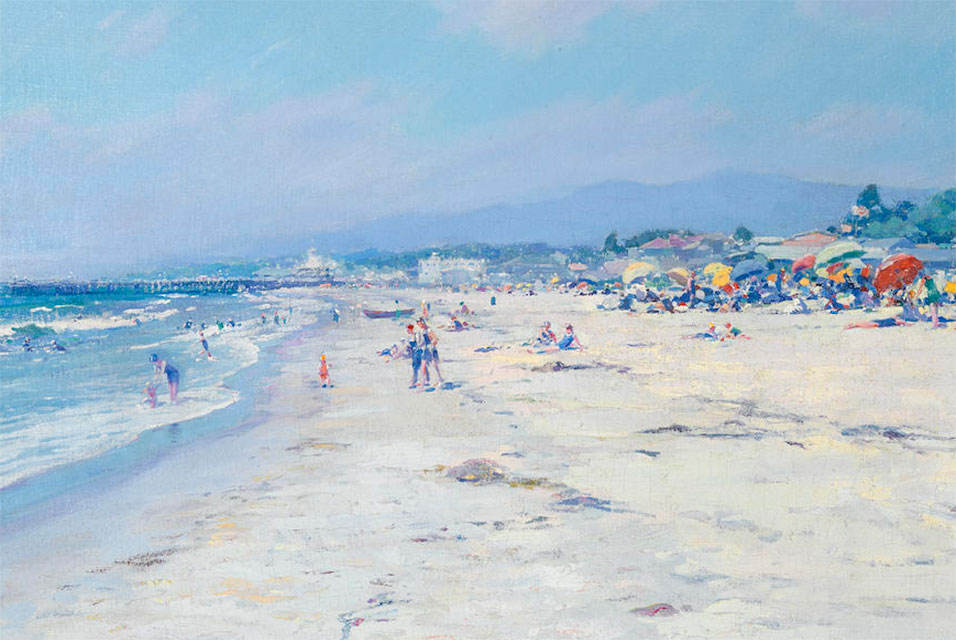
The museum's collection continued growing long after the Crocker family's original bequest. Philanthropist Alan Templeton expanded the European holdings in the twenty-first century with works by Guercino, Bernardo Strozzi, Simon Vouet, Philippe de Champaigne, and Sir Thomas Lawrence. The Beekhuis family contributed sixty-seven nineteenth-century Dutch landscapes. One of the museum's most personal connections to art history came through Alain Renoir, grandson of Pierre-Auguste Renoir and a professor at the University of California, Berkeley, who donated bronzes, terra cotta relief sculptures, a Cagnes landscape painting, works on paper, and a ceramic vase made by his father, the filmmaker Jean Renoir. The collection now encompasses American works from the Gold Rush to the present, one of the largest international ceramics collections in the country, and growing holdings of Asian, African, and Oceanic art.
Still at Third and O
In 2010, the museum completed a major expansion with the Teel Family Pavilion, a modern wing that added education centers, studio classrooms, an auditorium, and community exhibition galleries while preserving the historic Crocker mansion at the complex's heart. The museum earned accreditation from the American Alliance of Museums, a distinction shared by fewer than a thousand institutions nationwide. What Edwin and Margaret Crocker started with their shopping spree in Dresden endures a century and a half later at the same corner of Third and O Streets. The California Impressionist paintings, the Gold Rush-era canvases, the Old Master drawings -- all of it accessible in a city that the Crockers believed deserved art as much as any capital in Europe. They were right, and their gallery proved it.
From the Air
Located at 38.58N, 121.51W at Third and O Streets in downtown Sacramento, two blocks south of the Capitol Mall. The museum complex, combining the historic Italianate mansion with the modern Teel Family Pavilion, is identifiable from the air along the Sacramento River waterfront. Sacramento Executive Airport (KSAC) lies 3nm south; Sacramento International (KSMF) is 10nm northwest. Best viewed at 2,000-3,000 feet AGL on clear days.