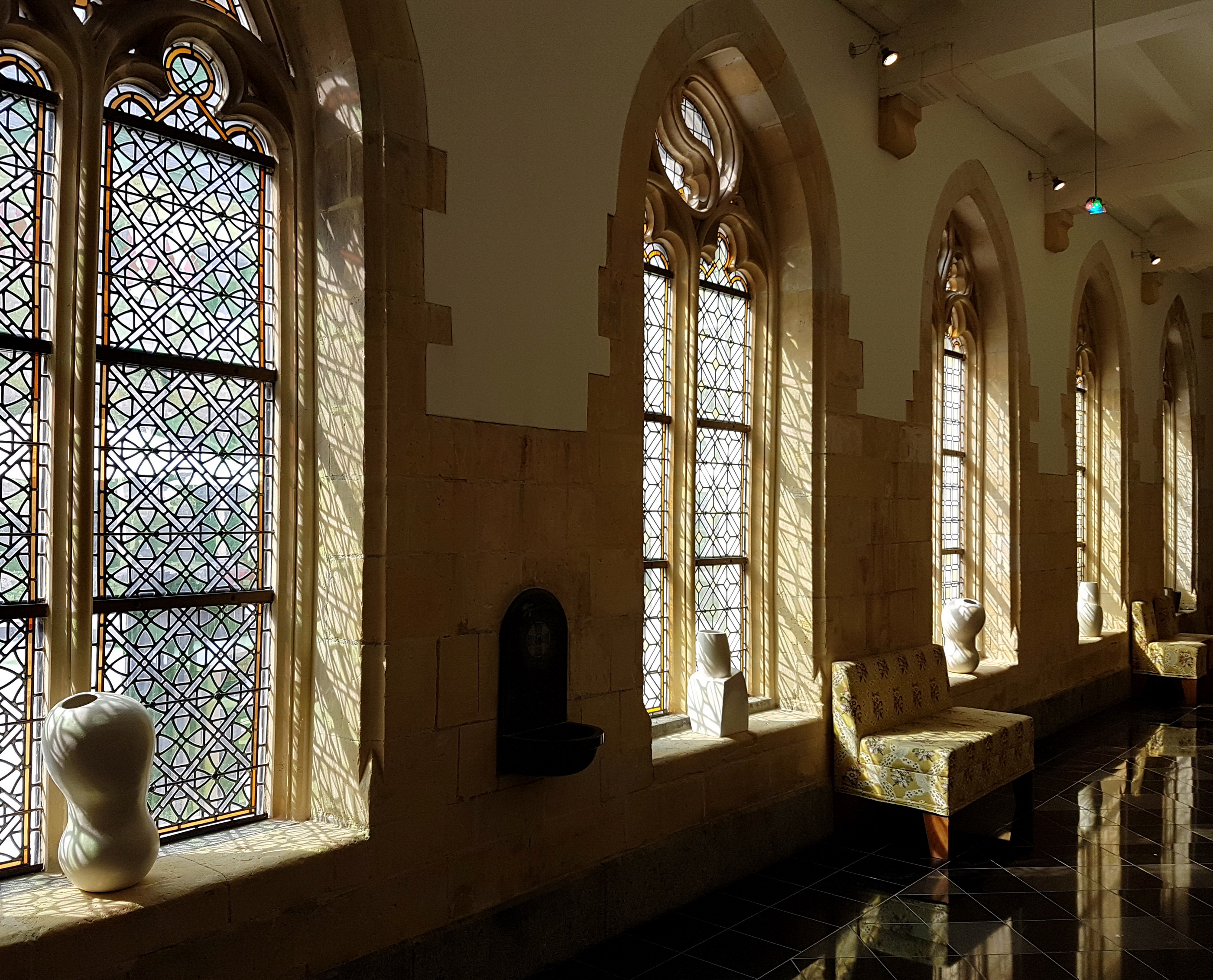
Crosier Monastery, Maastricht
Walk into the church through a copper tunnel and you will find a restaurant suspended above the nave on a steel mezzanine. Below it, where the choir stalls used to be, is a wine cellar enclosed in glass. The vaulted ceiling overhead still carries painted floral motives and sculpted keystones from the 15th century. This is the Kruisherenkerk in Maastricht - and since 2005 it has been the lobby of a five-star hotel, the only one of its kind in Limburg. The whole insertion was designed to be reversible: 'box in box', the architects called it. If anyone ever wanted the monastery back, they could have it.
A Stopover That Stayed
The Crosiers - Canons Regular of the Order of the Holy Cross, also called Crutched Friars - were founded around 1210 in Huy, south-west of Liege, by Theodore of Celles, a canon and former crusader. By the early 15th century the order required every prior to attend the annual general chapter back in Huy, and priors travelling south through the Low Countries needed a place to sleep in Maastricht along the way. In 1433 they ran into a problem: the heiligdomsvaart, a seven-yearly relic pilgrimage, had filled every inn in town. A wealthy citizen named Gilles of Elderen took them in. Three years later he donated five houses with gardens at Kommel and enough money to start a monastery. The bishop of Liege gave his blessing in January 1438. Four friars moved in. A new house of the Holy Cross had been founded almost by accident, as a fix for a booking problem.
Building a Mosan Gothic Church
The first stone of the church was laid in 1440. Petrus Toom and Johannes van Haeren were named as master builders. The choir was finished in 1459 but not consecrated for another eleven years. Twice, in 1462 and 1480, storms tore the clock tower down. A smaller ridge turret replaced it. The nave and aisles were not finished until 1509, under prior Walterus Beckers of Herentals. The monastery wings went up around the same time - east wing in 1480, west wing started in 1495, south wing last of all under prior Mathias Mijnecom after the old brewery and bakery burned. By 1520 the complex had the shape it would keep for five hundred years. The walls used local Limburg mergel limestone, the colour of pale honey, on plinths of bluestone from Namur. By 1500 the Maastricht house was among the larger Crosier foundations in Europe.
Sieges, Wigs, and the End
The monastery sat near the western city wall, on rising ground - which meant it caught a lot of cannonballs. The Eighty Years' War nearly killed it. During the 1579 siege of Maastricht many of the friars died, and the plague that followed took most of the rest. The 1632 capture by Frederick Henry of Orange and the 1673 capture by the French each brought fresh damage; Louis XIV at least donated 2,100 guilders for repairs. By the 18th century the friars were wearing wigs and fashionable clothes, the Counter-Reformation enthusiasm had drained away, and only ten new Crosiers took holy orders in Maastricht between 1760 and 1796. Then General Kleber's French army arrived in 1794 and absorbed the city into the First Republic. By 1796 the monastery was dissolved. Eight priests and two lay-brothers were given a year to leave. Six refused to swear the French Oath of Hatred and were deported toward the penal colony at Cayenne; one fell ill and was allowed home, one fled to Germany, others were pardoned later through the intervention of a Francophile lawyer.
Barracks, Bakery, Beet Tests
What followed was almost two centuries of indignity. The French turned the monastery into an arsenal and barracks. When the Dutch garrison took over in 1814, the wings became storage for military uniforms and a garrison bakery. A request to install a cholera clinic was refused as 'incompatible with military purposes'. By the late 19th century the buildings were rotting. The civil servant and heritage campaigner Victor de Stuers found the money to save them, and from 1897 the National Agricultural Testing Station - the Rijkslandbouwproefstation - moved in. The church became a warehouse and meeting hall; during the Great Depression the unemployed registered for work inside it. A wooden laboratory shed was eventually built inside the nave. The agricultural scientists moved out to Wageningen in the late 1970s. For a while in the 1980s the church served as a temporary parish church and then as opera storage. Squatters occupied parts of the wings.
Hospitality, Again
In 2000 the city sold the complex to Camille Oostwegel, a Limburg hotelier with a taste for restoring difficult buildings. Architect Rob Brouwers led a restoration that inserted two steel mezzanines inside the church - one running the length of the nave with a restaurant on top and a wine bar below, the other filling the north aisle - all designed to be removable without scarring the medieval fabric. The German designer Ingo Maurer added the copper-tunnel entrance and a series of light sculptures, including an egg-shaped office and an illuminated column once filled with three thousand litres of silver-dust water. The Kruisherenhotel opened on 1 September 2005. At the ceremony, the superior general of the Crosier Order pointed out that hospitality had always been part of the building's job: the friars had taken in travelling priors, lay guests, and the elderly who 'bought themselves into the monastery'. In 2017 it became the only officially-rated five-star hotel in Maastricht and Limburg. The 16th-century mural of Saint Gertrude - patron saint of travellers - still watches over the south-west chapel.
From the Air
The Crosier Monastery sits at 50.849 N, 5.684 E in the historic centre of Maastricht, on the west bank of the Meuse near the streets Kruisherengang and Kommel. Look for the spireless Gothic church without a tower, surrounded by four wings of pale limestone with red-and-white shutters. The Sint Pietersberg ridge lies just south. Nearest airport: Maastricht Aachen (EHBK), 8 km north. Liege (EBLG) is 30 km southwest. The compact medieval core is easy to pick out from 3,000-5,000 ft - look for the long bridge over the Meuse and the dense, irregular street pattern west of it.