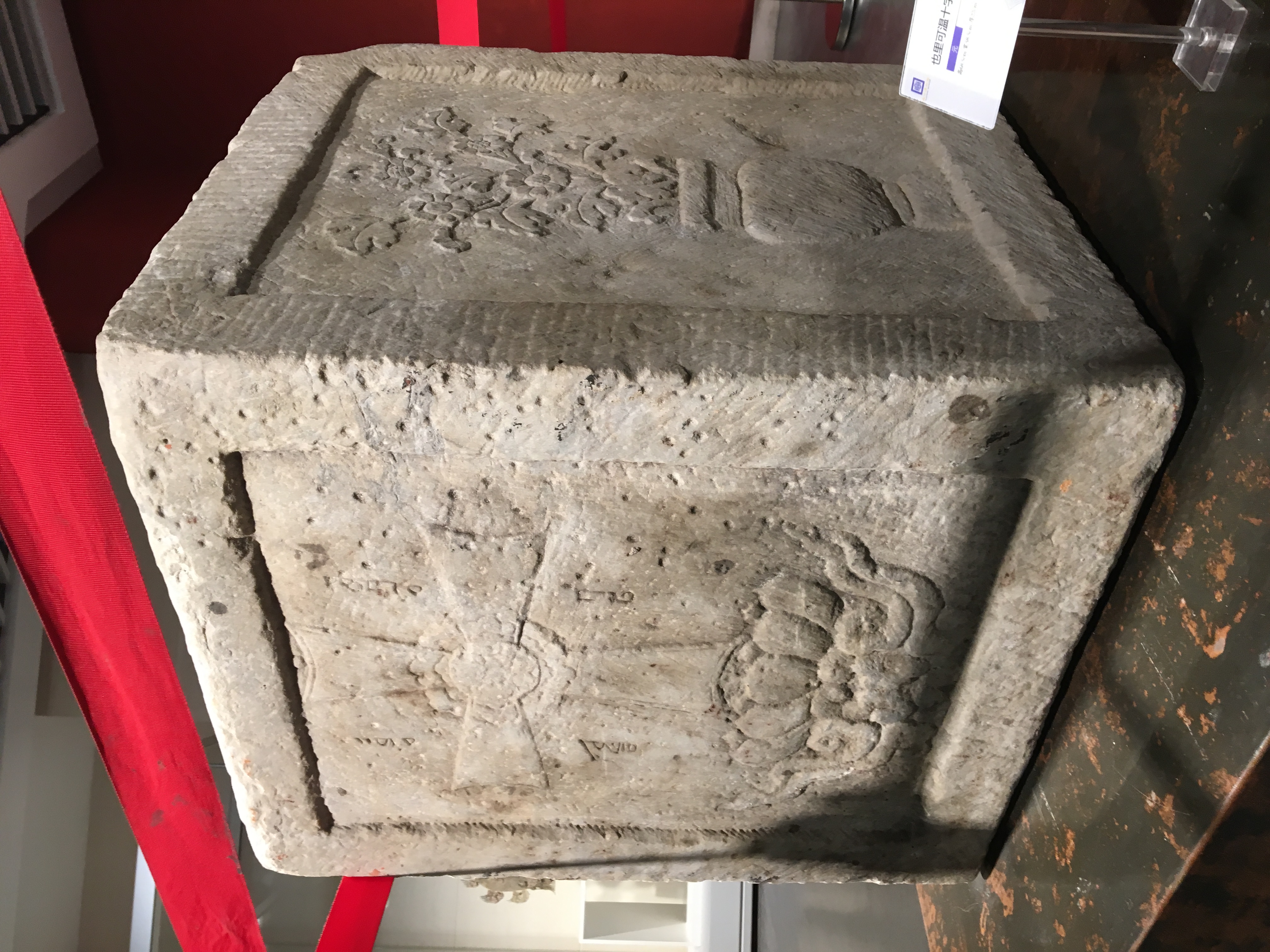
Cross Temple, Fangshan
In the summer of 1919, a Scottish diplomat named Reginald Johnston was caught in a thunderstorm southwest of Beijing. Seeking shelter, he stumbled onto the ruins of a temple near Chechang Village in Fangshan District. What he found there -- stone blocks carved with Christian crosses mounted on Buddhist lotus bases, one of them framed by an inscription in Syriac quoting Psalms 34 -- launched a century of scholarly debate about how a faith born in the Middle East came to inhabit a Buddhist temple in the hills outside the Chinese capital, and what happened when it left.
A Temple Between Faiths
According to a Liao dynasty stele at the site, a Buddhist monk named Huijing began building the temple in 317, during the Eastern Jin dynasty, though some scholars believe it was actually constructed during the Later Jin dynasty centuries later. What is clear is that the temple existed as a Buddhist institution for a very long time before anyone associated it with Christianity. The monk Yiduan refurbished it in 639 during the Tang dynasty. By the Liao dynasty, around 960, it was called Chongsheng Yuan, and Buddhists rebuilt it under Emperor Muzong of Liao. The Liao stele makes no mention of Christianity. But the story of the Cross Temple cannot be understood without understanding what was happening on the other side of the world -- and along the roads in between.
The Long Road from Ephesus
After the Council of Ephesus condemned Nestorius in 431, his followers migrated into the Sasanian Empire and joined the Church of the East, which sent missionaries along the Silk Road into Central Asia and beyond. In 635, a Christian monk named Alopen reached the Tang capital of Chang'an. Nestorian communities became relatively numerous in Chinese trade cities. Then came the Huichang persecution of 845 -- aimed primarily at Buddhists, but sweeping up all foreign religions. Buddhism recovered. The Church of the East in China did not. It vanished for centuries. When Nestorian Christians returned to northern China in the 12th and 13th centuries, carried on the wave of Mongol conquest, they were Central Asians with no connection to the Tang-era communities. Under the Mongol-ruled Yuan dynasty, Beijing had a metropolitan bishop, and the government established the office of Chongfu Si in 1289 to oversee Nestorian clergy. It was during this period that the Cross Temple appears to have passed into Christian hands.
The Hermit and the Shining Cross
Rabban Sauma, a Uyghur Nestorian monk born in Yuan-dynasty Beijing, spent seven years as an ascetic on a mountain a day's journey from the capital before embarking on an extraordinary journey to Baghdad and eventually to the courts of Europe. Scholars have argued that his hermitage was at or near the Cross Temple, based on descriptions of the terrain that match the site. When Nestorian Christians eventually abandoned the temple -- probably before 1358 -- a Buddhist monk named Jingshan reclaimed it. According to the Yuan stele, Jingshan dreamed of a deity during meditation, then saw a shining cross atop an ancient banner at the temple site, and initiated a reconstruction completed in 1365. The temple's two carved stone blocks, with their crosses rising from lotus pedestals and one bearing the Syriac inscription from Psalms, were reportedly discovered underground in 1357 during repairs. Johnston documented them in 1919; by 1931, fearing foreign removal, Chinese authorities transferred them to the Peiping Museum of History. They now reside in the Nanjing Museum, a thousand kilometres from the hillside where they were carved.
What Remains
No buildings stand at the Cross Temple today. The site holds groundwork, pillar bases, remnants of stairs, two ginkgo trees -- one ancient, one planted to replace another destroyed by fire -- and two steles from the Liao and Yuan dynasties, both broken during the Cultural Revolution and later repaired. The steles' inscriptions were tampered with during the Ming dynasty in 1535, when Buddhist monks altered the texts to claim royal charters and famous donors, elevating the temple's prestige. A stone plaque that once hung above the gate had already fallen and broken by 1931. A replica of the famous Xi'an Stele -- the primary source for Tang-dynasty Nestorian Christianity in China -- was placed at the site in the early 21st century. In 2006, the ruins were designated a Major Historical and Cultural Site Protected at the National Level. Some scholars consider the Cross Temple the only discovered place of worship of the Church of the East in China. Whether that is precisely true matters less than what the site represents: a place where two of the world's great spiritual traditions occupied the same ground across a thousand years, leaving behind stone inscriptions in two scripts and crosses growing from lotus flowers.
From the Air
Located at 39.74N, 115.90E near Chechang Village in the Zhoukoudian Area, Fangshan District, southwest of Beijing. The site is a walled enclosure in hilly terrain with no standing structures -- look for the two ginkgo trees and steles amid the groundwork. Near Yunju Temple, another Fangshan religious site. Nearest major airport is Beijing Daxing International Airport (ZBAD). Recommended viewing at 2,000-4,000 feet AGL.