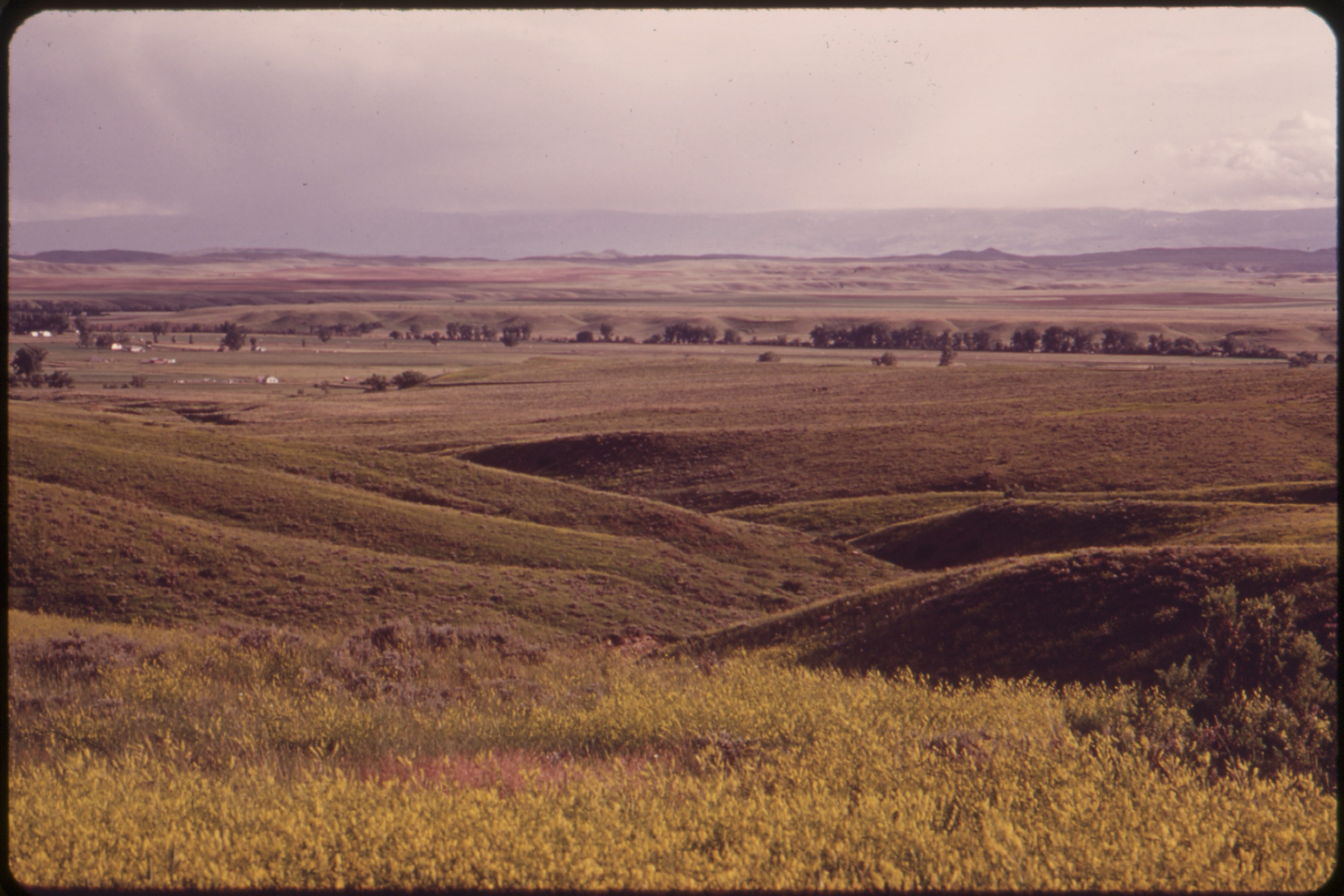
Crow Indian Reservation
Every August, the third week brings over a thousand teepees to Crow Agency, Montana, forming what the tribe calls the Teepee Capital of the World. The Crow Fair has run since 1904, a gathering that predates statehood for much of the region, and it unfolds on a reservation that was once thirty million acres and is now closer to two million. The Apsaalooke, as the Crow call themselves, have occupied this land in south-central Montana since migrating here in the 1500s. They have watched it shrink through treaty after treaty, fought to protect what remained, and built a modern economy atop 1.4 billion tons of coal beneath their feet.
Thirty Million Acres
The 1851 Fort Laramie Treaty recognized Crow territory across a vast swath of what is now Montana and Wyoming. But by May 7, 1868, pressures had mounted from all directions. Europeans pushed south of the Yellowstone River while Lakota warriors, including Crazy Horse and Sitting Bull, followed dwindling buffalo herds west into Crow country. Gold seekers trampled north along the Bozeman Trail. Steamboats on the Missouri brought more prospectors. Under these converging forces, the Crow sold thirty million acres and accepted a reservation of about eight million. Land cessions in 1882, 1892, and 1906 carved away more. By 1937, after adjustments connected to the Bighorn Canyon Dam construction, the reservation had reached its current boundaries, the fifth or sixth largest in the country depending on how water is counted.
The Prayer in Room 314
In 1917, as Congress considered yet another appropriation of Crow land, Chief Plenty Coups and Robert Yellowtail traveled to Washington, D.C. In a hotel room, they performed a ceremony. They opened a sacred bundle over incense made from buffalo chips sourced from animals in the National Zoo. They prayed. The next day, Congress defeated the appropriation. Seventeen years later, Yellowtail became the first Native American to serve as superintendent of his own tribe's reservation, an appointment that made national headlines. The man who had prayed for his land in a hotel room now administered it from an office, navigating a system designed by the same government he had petitioned against.
Black Diamonds
The 1973 Arab Oil Embargo changed everything for the Crow. Suddenly, the enormous coal deposits beneath their territory had real value. The tribe owns 1.4 billion tons of the mineral, enough to supply the entire United States for a year. The Absaloka coal mine opened in 1974, a single-pit operation that employs 170 people and provides half of the tribe's nonfederal budget. The economics are straightforward: coal means jobs and revenue in a region where both are scarce. But the commodity also ties the tribe to global energy markets and the uncertain future of fossil fuels. Each ton extracted represents both wealth and a resource that will not return.
Living Language
Of the approximately 11,000 enrolled members of the Crow Tribe, about 7,900 live on the reservation today. Eighty-five percent still speak Crow as their first language, a remarkable survival rate for an Indigenous tongue in modern America. The language preserves ways of thinking that English cannot capture, connections to land and kinship that predate the reservation system by centuries. The tribe has worked to strengthen Crow language education, understanding that the words carry more than meaning. They carry identity. When elders speak Crow to children on reservation lands that stretch from the Bighorn Mountains to the Pryor Mountains to the Wolf Mountains, they transmit something no treaty can diminish.
Plenty Coups' House
Near the town of Pryor stands Chief Plenty Coups State Park, preserving the two-story lodge house and grocery store of the leader who helped save the reservation in 1917. Plenty Coups, whose Crow name was Alek-Chea-Ahoosh, chose accommodation with the U.S. government as a survival strategy. The Crow served as scouts for the Army, and Plenty Coups cultivated relationships with American officials throughout his life. His home near Pryor became a meeting place and a symbol. When he died in 1932, he willed the property to the public, asking only that it honor all people who loved their homeland. The small museum there tells his story and the larger story of a nation that has endured where others were erased.
From the Air
Located at 45.39N, 107.75W in south-central Montana, the Crow Indian Reservation stretches across Big Horn, Yellowstone, and Treasure counties. The landscape includes the northern Bighorn Mountains to the south, Wolf Mountains to the east, and Pryor Mountains to the west. The Bighorn River flows north through the reservation, meeting the Little Bighorn near Hardin. Crow Agency, the tribal headquarters, lies along Interstate 90. Best viewed from 5,000-8,000 feet AGL to appreciate the reservation's scale and varied terrain. Nearby airports: Billings Logan International (KBIL) approximately 60nm northwest. The Little Bighorn Battlefield National Monument sits within reservation boundaries east of Crow Agency.