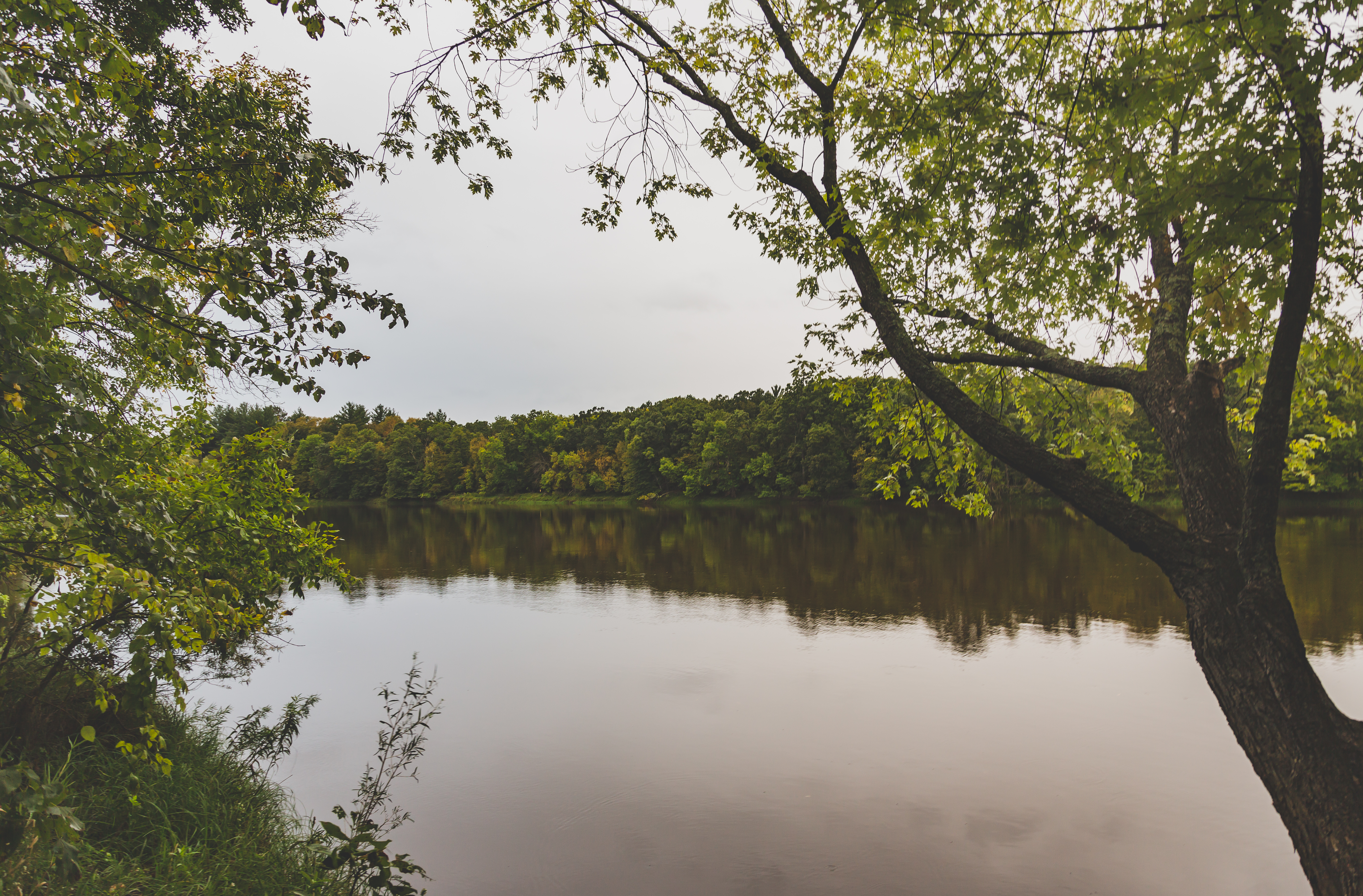
Crow Wing State Park
The shallow depressions are easy to miss. Marked by a simple interpretive sign in Crow Wing State Park, these indentations in the earth are labeled 'Indian Rifle Pits,' and they may be the oldest visible human feature in the park -- vestiges of a two-day battle in 1768 that decided who would control the confluence of the Mississippi and Crow Wing Rivers. A Dakota war party had raided an Ojibwe village and carried off several women in their canoes. The village warriors, returning from their own failed raid, dug shallow pits on a high riverbank and waited. When the Dakota convoy passed below, the Ojibwe opened fire while the captive women overturned the canoes and swam for shore. The Dakota regrouped and counterattacked by land but were driven back. That battle cemented Ojibwe control over a natural crossroads that would draw fur traders, missionaries, railroad speculators, and settlers for the next century -- and then fall silent.
Crossroads of the Fur Trade
European fur traders began arriving at the confluence in the late 18th century, drawn by the same geography that had attracted indigenous peoples for generations. A trading post opened in 1823, and a town slowly grew around it. When a new section of the Red River Trails was blazed through the area in 1844, connecting Saint Paul to the Selkirk Settlement in present-day Manitoba, the local economy boomed. The town of Crow Wing produced a remarkable number of early Minnesota leaders: the men after whom Morrison County, Aitkin County, and Rice County are all named came from here. A Metis named Clement Hudon Beaulieu ran the American Fur Company's trading post, while William Whipple Warren, also Metis, wrote one of the earliest histories of the Ojibwe people. Three churches were established in town, including a Catholic mission founded by Father Francis Xavier Pierz.
A Town Erased by the Railroad
Crow Wing's collapse was swift and thorough. In 1868, the Ojibwe were resettled on the White Earth Indian Reservation, removing a major part of the community. Then, in 1871, railroad magnate James J. Hill decided to route his Northern Pacific Railroad across the Mississippi at Brainerd, several miles to the north. The railroad was the lifeblood of 19th-century towns, and Crow Wing had none. By 1880, most residents had packed up and left. Buildings were dismantled or simply abandoned to the elements. What had been one of the most populous towns in Minnesota during the 1850s and 1860s faded into forest and prairie. Today, most structures have decayed or been moved away, but traces remain. Beaulieu's house, with its distinctive Greek Revival architecture, was relocated back to its original site in 1988. Several headstones are still visible in the Catholic cemetery, quiet markers of a community that once bustled with oxcarts and ambition.
Glacial Landscape, Living Forest
The park sits on an outwash plain formed by the retreat of Glacial Lake Grantsburg, which left behind sandy, well-drained soils that support a distinctive mix of oak forest, red pine, white pine, jack pine, and quaking aspen, with scattered prairie and wetland openings. This is transition country, where the northern coniferous forests begin giving way to the tallgrass prairies of the south and west. Eagles ride thermals above the river corridor. Beaver reshape the wetlands with their dams. Coyotes, white-tailed deer, hawks, muskrats, and fox move through the understory. The entire park was listed on the National Register of Historic Places in 1970, and a section of the Red River Trails that once carried Metis oxcart caravans through Old Crow Wing received its own separate National Register listing -- a recognition that even the paths people walked here carry historical weight.
Where Rivers and Trails Converge
The Crow Wing County Historical Society championed the creation of the park, which the Minnesota Legislature authorized in 1959. A minor controversy arose when the Knights of Columbus built a chapel on the site of Father Pierz's original mission, but since the chapel stood on a privately held parcel and used no public funds, separation of church and state held firm. The park expanded in 2006 with new Mississippi River frontage purchased through state funds and private donations. Today, the Paul Bunyan State Trail passes through the park, connecting it to a broader recreational network. The campground offers 61 sites and a camper cabin, with a boat ramp providing access to both rivers. But the most compelling experience may simply be walking the old townsite, reading the interpretive signs where houses and trading posts once stood, and understanding how quickly a thriving community can return to forest when the currents of commerce shift course.
From the Air
Located at 46.27°N, 94.33°W at the confluence of the Mississippi and Crow Wing Rivers in central Minnesota. The river junction is clearly visible from altitude, with the Crow Wing entering from the west-southwest. The park terrain is flat glacial outwash plain covered in mixed pine-oak forest. Brainerd Lakes Regional Airport (KBRD) lies approximately 8 nm to the north. Camp Ripley military airfield is nearby to the south. The Paul Bunyan State Trail corridor is visible as a linear clearing through the forest. Best viewed from 2,000-4,000 feet AGL, where both river channels and the confluence point are most dramatic.