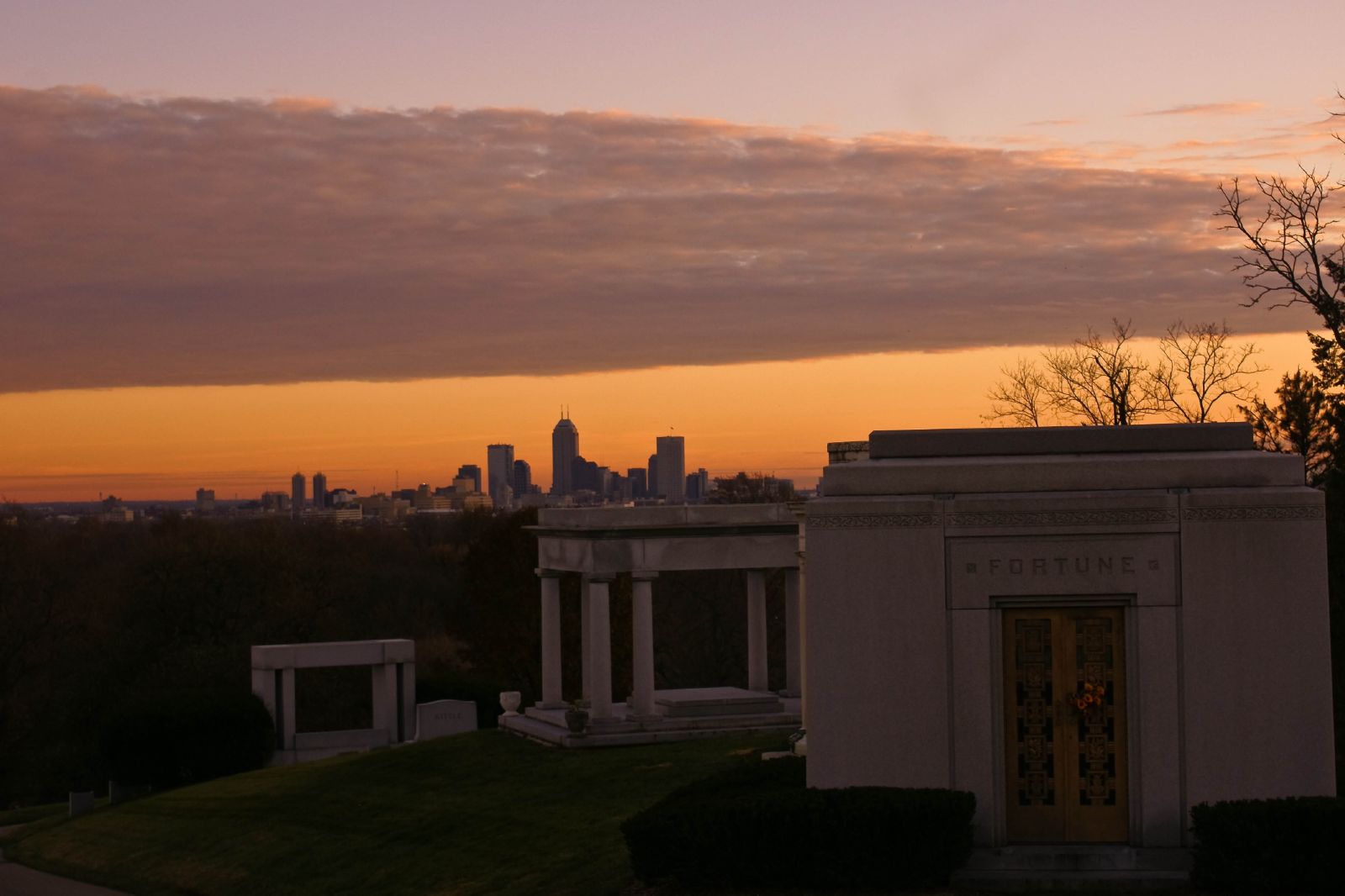
Crown Hill Cemetery
A president and a bank robber lie within walking distance of each other. Benjamin Harrison, the 23rd President of the United States, is buried at Crown Hill Cemetery in Indianapolis, and so is John Dillinger, the Depression-era outlaw the FBI branded "Public Enemy Number One." Three vice presidents rest here too -- Charles W. Fairbanks, Thomas A. Hendricks, and Thomas R. Marshall -- along with eleven Indiana governors, the four founders of the Indianapolis Motor Speedway, poets, painters, Civil War generals, and 1,616 Confederate soldiers who died as prisoners far from home. Crown Hill holds more than 225,000 graves across its grounds, making it the third-largest non-governmental cemetery in the United States. It was established in 1863, dedicated on June 1, 1864, and listed on the National Register of Historic Places in 1973.
Strawberry Hill Becomes the Crown
Before Crown Hill existed, Indianapolis buried its dead at Greenlawn Cemetery on the city's southwest side. By the Civil War, Greenlawn was filling fast with Union soldiers and Confederate prisoners of war from nearby Camp Morton, while industrial development pressed in from all directions. A group of civic leaders formed the Association of Crown Hill on September 25, 1863, and acquired land at Strawberry Hill, a high point northwest of the city center. They renamed its summit "The Crown" and hired Frederick Chislett as the first superintendent. Frederick's father, Pittsburgh landscape architect John Chislett Sr., along with Prussian horticulturalist Adolph Strauch, designed the grounds in the Victorian Romantic style -- winding roads that followed natural contours, preserving the mature trees and rolling terrain. The first burial was Lucy Ann Seaton, a 33-year-old mother who had died of consumption. Visitors reached the cemetery by omnibus or by steam-powered boat up the Central Canal.
The Living and the Dead
Crown Hill was never just a burial ground. By the mid-19th century, Indianapolis residents came for picnics, strolls, and carriage rides, drawn by the sweeping views of the city skyline from The Crown. That dual identity -- memorial and public park -- persists today. The grounds are home to more than 10,000 trees representing some 130 species, earning Level II Accreditation from the ArbNet Arboretum Accreditation Program in 2022. White-tailed deer and birds shelter among the old-growth canopy. The Hoosier Artists Contemporary Sculpture Walk, established for the cemetery's 140th anniversary, threads works by ten artists through the landscape, including Michael B. Wilson's "Social Attachments" and Eric Nordgulen's "Antenna Man." Three limestone statues of the Greek goddesses Themis, Demeter, and Persephone, salvaged from the old Marion County Courthouse when it was demolished in 1962, stand among the graves.
Soldiers on Both Sides
In 1866, the federal government purchased land within Crown Hill for a national military cemetery, paying the board $5,000. The remains of more than 700 Union soldiers who had died in Indianapolis during the Civil War were moved from Greenlawn to the new National Cemetery in Sections 9 and 10. As of December 31, 1998, the National Cemetery is full, with 795 burial sites. Crown Hill also holds the Confederate dead from Camp Morton, Indianapolis's notorious prisoner-of-war camp. In 1931, when industrial development forced the removal of remains from Greenlawn, 1,616 Confederate soldiers and sailors were interred in a mass grave known as Confederate Mound in Section 32. A memorial with ten bronze plaques listing each of their names was dedicated in 1993. The Field of Valor, dedicated on Veterans Day 2004, expanded the military sections for those who served in Afghanistan and Iraq.
Monuments in Stone and Iron
The cemetery's architecture tells its own story of Indianapolis craftsmanship. Diedrich A. Bohlen designed the High Victorian Gothic chapel and vault in 1875 at a cost of $38,922 -- a structure later renovated for $3.2 million and recognized with an excellence in Architecture Award from the American Institute of Architects Indiana chapter in 2007. Adolf Scherrer, an architect of Swiss origins, designed the three-arched Bedford limestone gateway and Waiting Station at the east entrance on 34th Street, completed in November 1885, just in time for the funeral of Vice President Thomas A. Hendricks. In 1914, landscape architect George Kessler designed the brick and wrought-iron perimeter fence, nearly $138,000 in cost and completed in 1920. An underpass beneath 38th Street, known as the Subway, connects the north and south grounds and was finished in 1927 at a cost of $170,000.
The Poet on the Summit
The most visited grave at Crown Hill belongs to James Whitcomb Riley, the beloved Hoosier poet best known for "Little Orphant Annie." After Riley's death on July 22, 1916, the board offered his family the summit -- The Crown itself -- as his final resting place. He was buried there on October 6, 1917, beneath a large open-canopied monument that looks out over all of Indianapolis. From that vantage point, the city spreads in every direction: the Statehouse dome, the downtown towers, the neighborhoods where Riley once walked and wrote. Crown Hill even has a fictional resident -- in John Green's novel The Fault in Our Stars and its 2014 film adaptation, the character Augustus Waters is buried here in a gravesite facing 38th Street. Real or imagined, the stories converge at Crown Hill, where 225,000 lives are gathered on a single Hoosier hilltop.
From the Air
Crown Hill Cemetery is located at approximately 39.82N, 86.17W, roughly two miles northwest of downtown Indianapolis. From 3,000 to 5,000 feet, the cemetery's 555 acres are clearly visible as a large green expanse surrounded by urban development, with The Crown summit rising as the highest point in the area. The nearest major airport is Indianapolis International (KIND) about eight miles southwest. The cemetery's winding roads, brick perimeter fence, and Gothic chapel are distinguishable on clear days at lower altitudes.