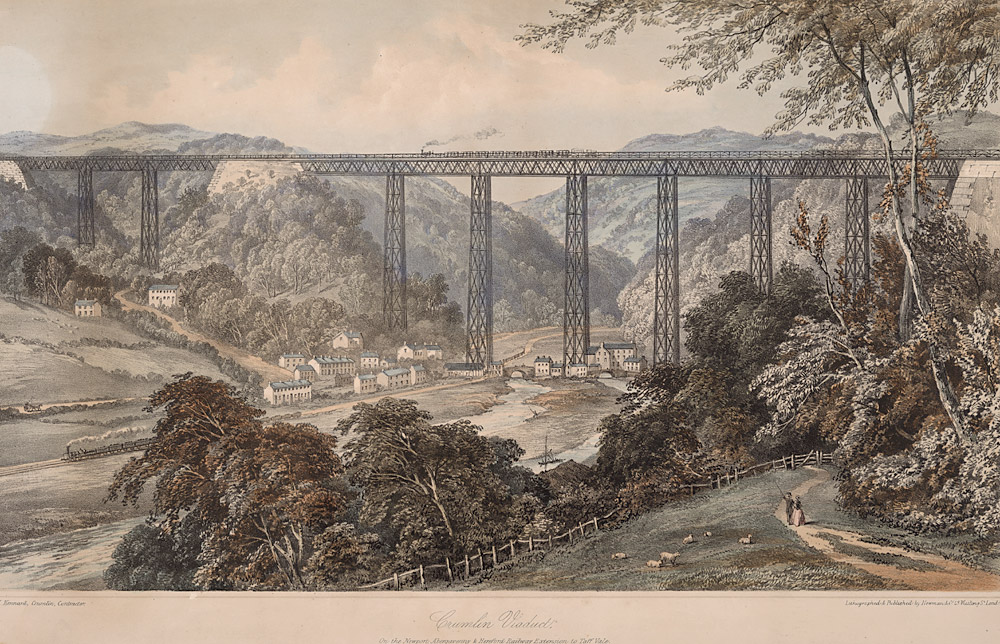
Crumlin Viaduct
"When eternity looks you straight in the face, you may as well go at full speed to meet it!" Those were the words of John Thomas Jenkins -- known as "Mad Jack" -- the locomotive driver who raced across the untested Crumlin Viaduct in 1857, having first visited every pub in the village. He had been told to cross slowly. He chose otherwise. The engineers were furious, but Mad Jack's bravado captured something essential about this structure: it was built by people who refused to be intimidated by scale.
Iron Ambition over the Ebbw
At 200 feet high and 1,650 feet long, the Crumlin Viaduct was the tallest railway viaduct in Great Britain throughout its entire working life. Built to carry the Taff Vale Extension of the Newport, Abergavenny and Hereford Railway across the Ebbw River, it was also celebrated as the least expensive bridge for its size ever constructed. The iron structures were cast at Kennard's Falkirk Ironworks, after experimental work at the Blaenavon Ironworks, then shipped to Newport Docks and hauled up into the valley. Contracts were signed in December 1852, and by 1857 the structure was ready for testing. Six locomotives loaded with pig iron and lead -- 370 long tons in all -- were assembled for the Board of Trade inspection. The measured deflection was less than an inch and a half. The bridge was approved the same month it was tested.
A Costly Giant
Lady Isabella Fitzmaurice formally opened the viaduct on Whit Monday, 1 June 1857. What followed was a century of constant maintenance battles. The location proved susceptible to high winds, just as the engineer Liddell had predicted, and the resultant swaying demanded expensive upkeep. The route itself, threading through steep valleys at considerable height, became one of the most costly railway lines in the entire United Kingdom to operate. After the post-war nationalisation, British Railways reduced the line to single track in 1947 -- an early signal that the viaduct's days were numbered. The Beeching Axe fell in 1964, and on Saturday 13 June, the last scheduled westbound passenger train ran over the viaduct: the 8.55pm from Pontypool Road to Aberdare, calling at Crumlin High Level at 9.20pm.
Hollywood's Brief Cameo
Between the line's closure and the viaduct's demolition, something unexpected happened. Universal Pictures arrived in the valley to shoot scenes for the 1966 film Arabesque, starring Sophia Loren and Gregory Peck. The abandoned viaduct, still towering above the village with its ten iron trusses and two great spans, made for dramatic cinema. It was a fitting farewell for a structure that had always commanded attention. But the glamour could not save it. A structural survey revealed the cast iron's poor condition, and the cost of preservation was judged prohibitive -- especially since housing had spread into the lower valley directly beneath it.
What Remains
Demolition by Bird's of Swansea began in June 1965 and took nine months, requiring a Bailey bridge to assist the work. The iron parts were completely dismantled by the end of 1967. Today, only the stone and cast concrete abutments remain visible on the valley sides, barely hinting at the scale of what once stretched between them. The nearby Hengoed Viaduct, built of stone by the same engineer, still stands -- a reminder that materials matter as much as ambition. Crumlin's viaduct had been scheduled as a structure of architectural and historical interest, but scheduling alone could not overcome the mathematics of decay. What it represented, though -- the audacity of Victorian engineering in the Welsh valleys -- endures in photographs, paintings, and the memory of Mad Jack, who met eternity at full speed and lived to tell the tale.
From the Air
Located at 51.68N, 3.14W in the Ebbw Valley, South Wales. Only stone abutments remain visible on valley sides. The nearby Hengoed Viaduct (stone, still standing) provides a reference point. Nearest airport: Cardiff (EGFF), approximately 20nm south. Fly at 2,000-3,000ft AGL to appreciate the valley topography where the viaduct once stood.