Crypt of Civilization
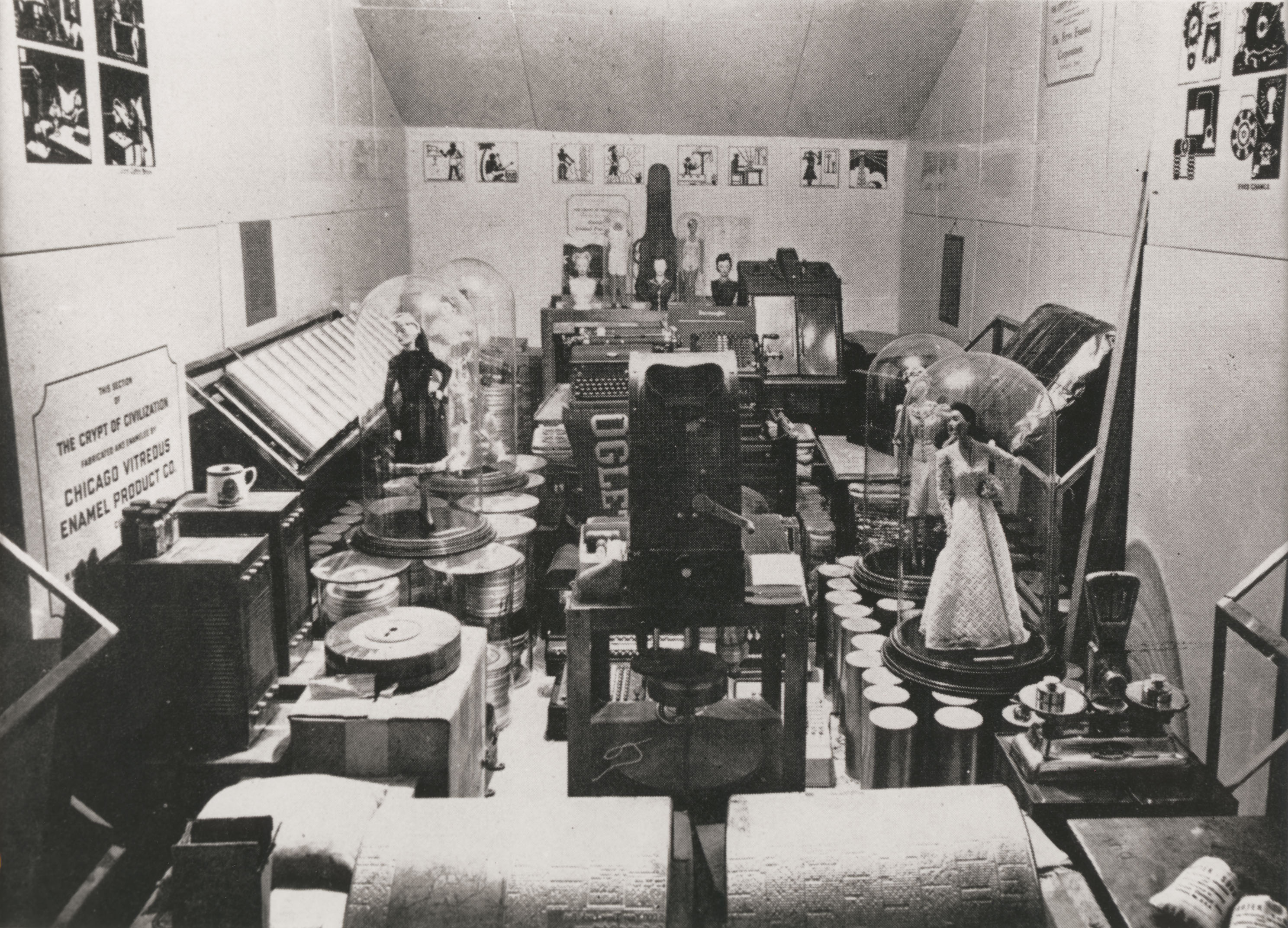
Somewhere in the basement of Phoebe Hearst Hall at Oglethorpe University in Brookhaven, Georgia, a bottle of Budweiser beer sits in a stainless steel container filled with inert gas, waiting to be opened in the year 8113. It shares the room with a plastic Donald Duck, a manual typewriter, Lincoln Logs, voice recordings of Franklin Roosevelt and Adolf Hitler, the sound of a professional pig caller, and a hand-cranked device designed to teach English to whoever finds the vault six thousand years from now. The Crypt of Civilization is the world's first genuine time capsule -- an airtight, room-sized chamber sealed on May 28, 1940, and meant to remain untouched for 6,177 years.
The Man Who Counted Backward from Egypt
Thornwell Jacobs, president of Oglethorpe University from 1915 to 1944, came up with the idea in the 1920s while researching a book. He was struck by how little detailed information survived about everyday life in ancient Egypt -- practically everything scholars knew came from items found in pharaonic tombs and rock inscriptions from Assyria. No complete record existed of how any single generation actually lived. Jacobs decided to fix that for the future. He calculated that 6,177 years had passed since the start of the Egyptian calendar in 4241 BC and proposed sealing a comprehensive record of twentieth-century life, to be opened after another 6,177 years -- in 8113 CE. In 1935, he pitched the concept to Orson Munn, editor of Scientific American, who publicized the project in a November 1936 article. The Guinness Book of Records later declared it the first genuine attempt to permanently preserve a record of twentieth-century culture.
A Swimming Pool Becomes a Tomb
Jacobs and scientist Thomas K. Peters chose an unlikely vessel: the swimming pool in the basement of Phoebe Hearst Hall. Between 1937 and 1940, they converted it into an airtight chamber sitting on a bedrock floor with a stone roof several feet thick. The room resembles a chamber in an ancient Egyptian pyramid, with artifacts arranged on shelves and across the floor. Many items were sealed in stainless steel holders lined with glass and filled with inert gas to prevent aging -- a preservation technique later adopted by the Westinghouse Time Capsules. Peters placed electric microfilm readers and picture projectors inside so future generations could view the recordings. He also installed a small windmill to generate electricity, in case power generation is no longer common practice in the eighty-second century.
A Cross Section of 1940
The contents are a wonderfully eclectic snapshot of interwar America. Contributions came from the King of Sweden, Gustav V, and from Eastman Kodak. Deposited alongside classic literature and religious texts were seed samples, dental floss, a woman's purse with typical contents, Artie Shaw records, an electric toaster, a pacifier, a cash register, an adding machine, and an electric sewing machine. Children's toys went in too: Lincoln Logs, a plastic Donald Duck, a miniature Lone Ranger statue, and a cloth-and-wooden Black doll. The crypt holds voice recordings of Adolf Hitler, Joseph Stalin, Franklin D. Roosevelt, and Benito Mussolini -- alongside the sounds of Popeye the Sailor Man and a professional pig caller. Engraved steel panels of the Atlanta Journal recorded the first year of World War II. Peters also left behind his own invention, a "Language Integrator" -- a modified Mutoscope that functioned as a hand-operated movie projector with sound, designed to teach English to whoever discovers the vault. He conceived it as a modern Rosetta Stone.
Sealed with a Wink
Jacobs promoted the project on NBC radio in 1937, and a dedication ceremony took place on campus in May 1938, led by David Sarnoff of the Radio Corporation of America. Paramount newsreels of the event were themselves placed inside the crypt. On May 25, 1940, Jacobs and Peters permanently sealed the chamber in a ceremony broadcast by Atlanta's WSB radio. The project regained worldwide attention during the Millennium celebrations from 1999 to 2001. Perhaps the most charming detail belongs to Bing Crosby. Newspaper reporter Frank G. Menke asked the movie star and singer to serve as Master of Ceremonies at the crypt's opening in 8113. Crosby replied that he would be happy to -- as long as his filming schedule at the time would allow it.
From the Air
The Crypt of Civilization is located at 33.87N, 84.33W on the campus of Oglethorpe University in Brookhaven, Georgia, a suburb immediately northeast of Atlanta. The campus sits within the dense metropolitan sprawl of greater Atlanta. The nearest general aviation airport is Peachtree-DeKalb Airport (KPDK) approximately 3nm to the east. Hartsfield-Jackson Atlanta International Airport (KATL) lies approximately 15nm to the south. From the air, Oglethorpe University's campus is identifiable as a green rectangle of Gothic-style buildings along Peachtree Road. The crypt itself is underground in the basement of Phoebe Hearst Hall and is not visible from altitude, but the university grounds are. Best approach from the northeast following the Peachtree Road corridor at 2,000-3,000 feet AGL.