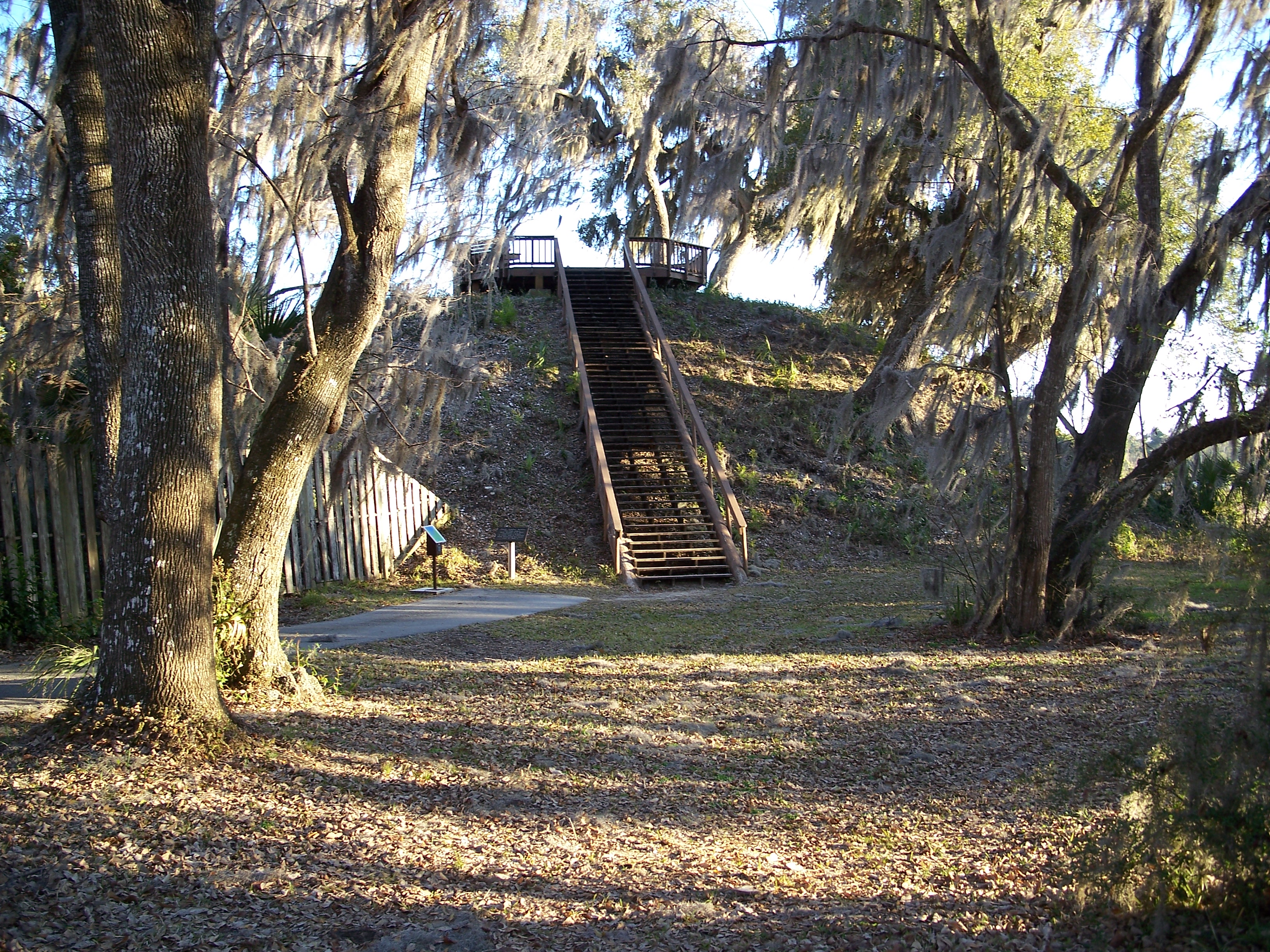
Crystal River Archaeological State Park
A carved limestone slab sits under a small roofed shelter at Crystal River Archaeological State Park, showing a human face with long hair pluming over the left shoulder. It is the kind of monument found in the Caribbean and Mesoamerica, not in Florida. Nobody knows exactly how it got here, or why it looks more like something from the Yucatan than from the Gulf Coast. But it is a fitting puzzle for a place that has been confounding expectations for over two thousand years. This six-mound complex two miles northwest of Crystal River, on a spit of land called Museum Point, was continuously occupied for roughly 1,600 years. An estimated 7,500 people visited the site annually at its peak - not residents, but pilgrims traveling long distances to bury their dead, conduct trade, and participate in ceremonies whose meaning has been lost to time.
Copper from a Thousand Miles North
The earliest burials at the Crystal River site date to approximately 250 BC, placed in a conical mound near the river. Many of these early graves contained copper tools and ornaments - remarkable objects in a place with no copper deposits whatsoever. The metal came from the Ohio River valley, carried south through an extensive trade network developed by the Hopewell culture. The Hopewell were master traders whose influence stretched across eastern North America, and Crystal River was one of their southernmost outposts of exchange. The copper artifacts tell a story of connection across vast distances: raw material mined near the Great Lakes, worked into tools and jewelry, then transported over a thousand miles to be buried with the honored dead on Florida's Gulf Coast. Later burials at the site lack these copper objects, suggesting the trade network eventually collapsed or shifted. The changing grave goods mark the rise and fall of distant civilizations.
A City of the Dead
Crystal River was not primarily a place where people lived. It was a place where people came to die - or rather, where the living brought their dead. The complex contains burial mounds, temple mounds, a central plaza, and a crescent-shaped midden that grew over 1,900 years of accumulated refuse: animal bones, fish bones, turtle shells, broken pottery, and worn-out tools. An estimated 500 people lie buried within the mound complex. Some were interred in the conical mound with elaborate grave goods. Others were placed between layers of oyster shells in the surrounding ring. Whether this difference reflected social status or simply changing customs across the centuries, archaeologists cannot say with certainty. The platform mound was constructed gradually as burials filled the gap between the ring and the cone, growing upward over generations like a geological formation made of human intention.
Stones That Shouldn't Be Here
The carved limestone slabs at Crystal River are among the site's most debated features. At least four large stones were placed by the inhabitants, and one bears the carved image of a human figure. Such stelae are characteristic of Mesoamerican civilizations - the Maya, the Olmec, the Huastec - but they are virtually unknown at mound sites in the American Southeast. The question of whether the Crystal River stelae represent direct contact with Mesoamerican cultures has fueled decades of scholarly debate. Some researchers point to possible connections between the Huastec culture of Mexico's Gulf Coast and the peoples of the American Southeast. Others argue the similarities are coincidental, that the idea of carving a figure on a stone slab is not so unusual that it requires cultural contact to explain. The debate remains unresolved. The carved face stares out from beneath its protective shelter, keeping its own counsel.
Roberts Island and the Shifting Center
Downstream on the Crystal River lies Roberts Island, where a separate complex of mounds and middens was added to the state park in 1996. Roberts Island succeeded Crystal River as the area's ceremonial center in the 9th and 10th centuries, suggesting a gradual shift in power or population rather than a sudden abandonment. The transition tells a larger story about how Native American communities adapted and reorganized over centuries. Today the park encompasses both sites, offering visitors a walk through deep time. The visitor center museum houses artifacts from the mounds - arrowheads, pottery, jewelry, stone and bone tools - and a centerpiece diorama depicting the complex as it may have appeared at its height. A designated National Historic Landmark since 1990, Crystal River stands as one of the most significant pre-Columbian sites east of the Mississippi.
From the Air
Located at 28.91N, 82.63W on the Crystal River in Citrus County, Florida, two miles northwest of the city of Crystal River on Museum Point off US 19/98. From altitude, the mound complex appears as a cluster of elevated landforms along the riverbank, surrounded by the dark green canopy of the Crystal River Preserve. The Crystal River itself is visible winding toward the Gulf of Mexico. Crystal River Airport (KCGC) is 3 miles southeast. Gainesville Regional Airport (KGNV) is 70 miles northeast. Tampa International Airport (KTPA) is 80 miles south. The Gulf Coast coastline and salt marshes are clearly visible to the west.