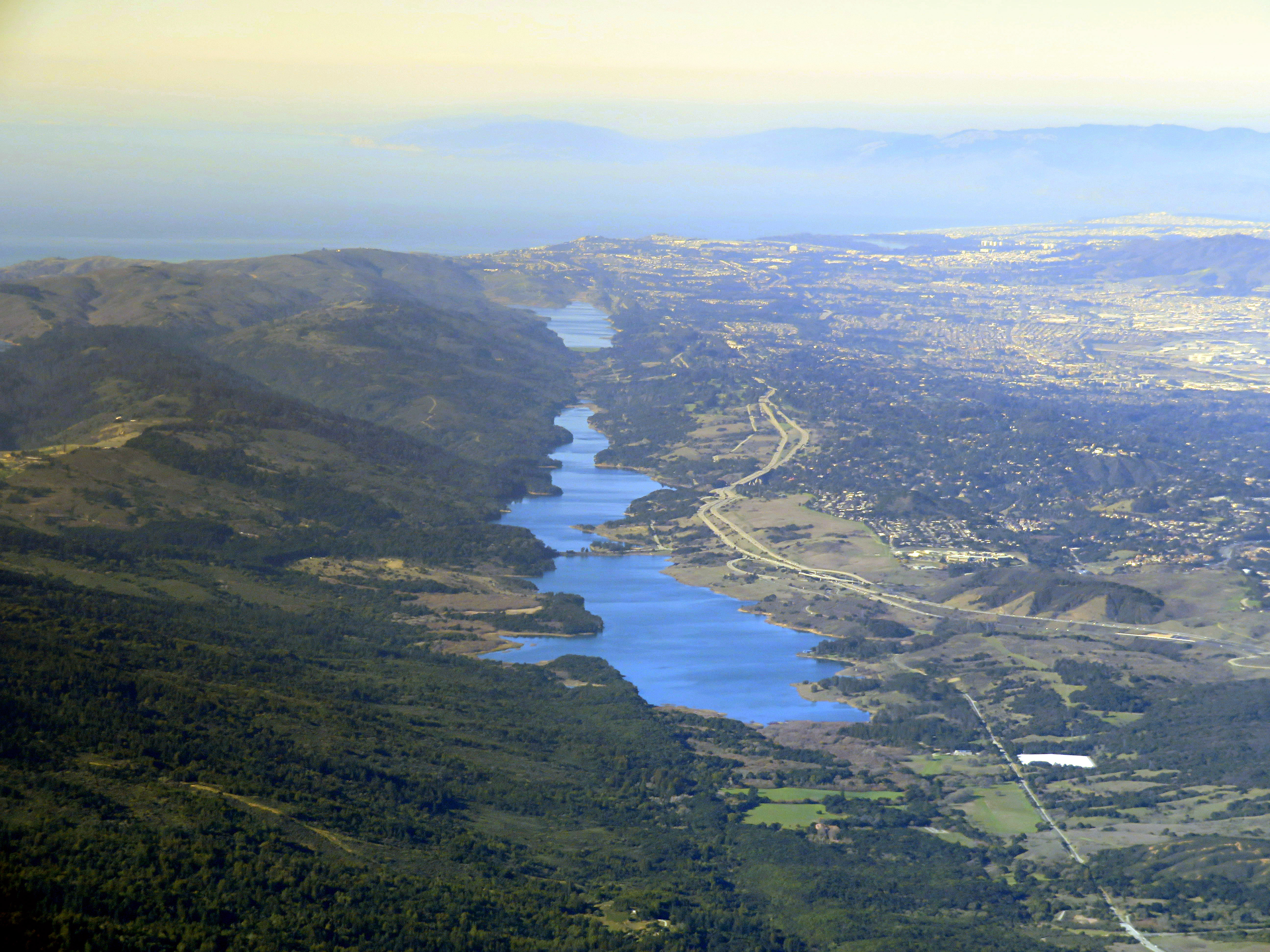
Crystal Springs Dam
Portland cement shipped from England. Almost a million barrels of sand hauled by horse-drawn wagons from San Francisco's North Beach. When Crystal Springs Dam was completed in 1889, it stood as the tallest dam in the United States and the largest concrete structure on Earth. More than 135 years later, this engineering marvel still supplies drinking water to San Francisco, perched just 1,100 feet from the San Andreas Fault that tried twice to destroy it.
A City's Thirst
San Francisco in the 1880s was a booming city with a desperate problem: water. The naturally arid peninsula had no adequate source within its city limits, forcing the Spring Valley Water Works to look south into San Mateo County's undeveloped mountains and streams. The solution they envisioned was audacious: dam the rift valley carved by the San Andreas Fault itself, creating a reservoir in the very gash that would one day shake the region to its foundations. The de Laveaga estate's canyon, where San Mateo Creek flowed through fern-draped slopes, became the chosen site. What the engineers may not have realized was that they were building atop one of the most geologically active fault lines in North America.
Materials from Across the World
The United States in 1889 had no large-scale cement manufacturer. So Hermann Schussler, the chief engineer, arranged for Portland cement to be shipped 6,000 miles from Swanscombe, England, arriving in San Francisco by sea. Local materials proved equally challenging to obtain. Sand for the concrete came from North Beach in San Francisco, transported by ship to Coyote Point Wharf, then hauled up into the canyon by teams of horse-drawn wagons. The construction technique was revolutionary: workers poured massive interlocking blocks separately, allowing each to cure before pouring adjacent sections. By completion, the dam contained enough concrete to claim the title of largest concrete structure in the world, rising 145 feet above the creek bed with a crest stretching 600 feet across the canyon.
The Fault That Could Not Break It
At 5:12 a.m. on April 18, 1906, the San Andreas Fault ruptured with catastrophic force just 1,100 feet from the dam. San Francisco burned for three days. Two older dams nearby, the Upper Crystal Springs Dam and Hayward Dam, showed considerable lateral displacement. Crystal Springs Dam emerged with inconsequential damage. Eighty-three years later, the Loma Prieta earthquake struck with similar ferocity, and again the dam held. Scientists now believe that the very foundation modern engineers might consider substandard, a fractured brecciated rock base, may have absorbed tectonic energy that would have destroyed a more rigid structure. The dam's survival was perhaps accidental genius.
Engineering for the Ages
A 2024 review by the American Society of Civil Engineers and the Institution of Civil Engineers in Great Britain confirmed what many suspected: Crystal Springs Dam is likely the oldest mass concrete dam in the world still in operation. It was designated a California Historic Civil Engineering Landmark in 1976 and elevated to National Historic Civil Engineering Landmark status in 2023. The San Francisco Public Utilities Commission completed extensive renovations between 2003 and 2018, widening the spillway, raising the parapet wall, and reinforcing the structure against future earthquakes. Today, the dam impounds a mix of water from its own watershed and the Hetch Hetchy system, continuing to serve the city that built it when cement had to cross an ocean to reach California shores.
A Precarious Guardian
The California Department of Water Resources classifies Crystal Springs Dam with an 'Extremely High' downstream hazard rating. Should the dam fail, floodwaters would inundate large portions of Foster City, Hillsborough, and San Mateo, areas home to more than a thousand people. Since 1983, regulators have limited the reservoir to 84% capacity as a precaution. Yet for over a century, through two major earthquakes and countless smaller tremors, this Victorian-era structure has held firm. Skyline Boulevard runs across its top, carrying commuters who likely never consider they are driving over a dam older than the Golden Gate Bridge, built by horse power and English cement, standing watch over the fault that shaped the Bay Area's destiny.
From the Air
Crystal Springs Dam (37.529N, -122.362W) sits in the long linear valley marking the San Andreas Fault, visible as a dark ribbon of water running northwest-southeast. Approach from the east at 2,000-3,000 feet AGL to see the dam at the reservoir's northern end. Half Moon Bay Airport (KHAF) lies 8 miles west. The reservoir and parallel San Andreas Lake to the north create distinctive geographic features easily spotted from cruise altitude. Skyline Boulevard (CA-35) traces the ridge above the reservoir.