CSS Virginia
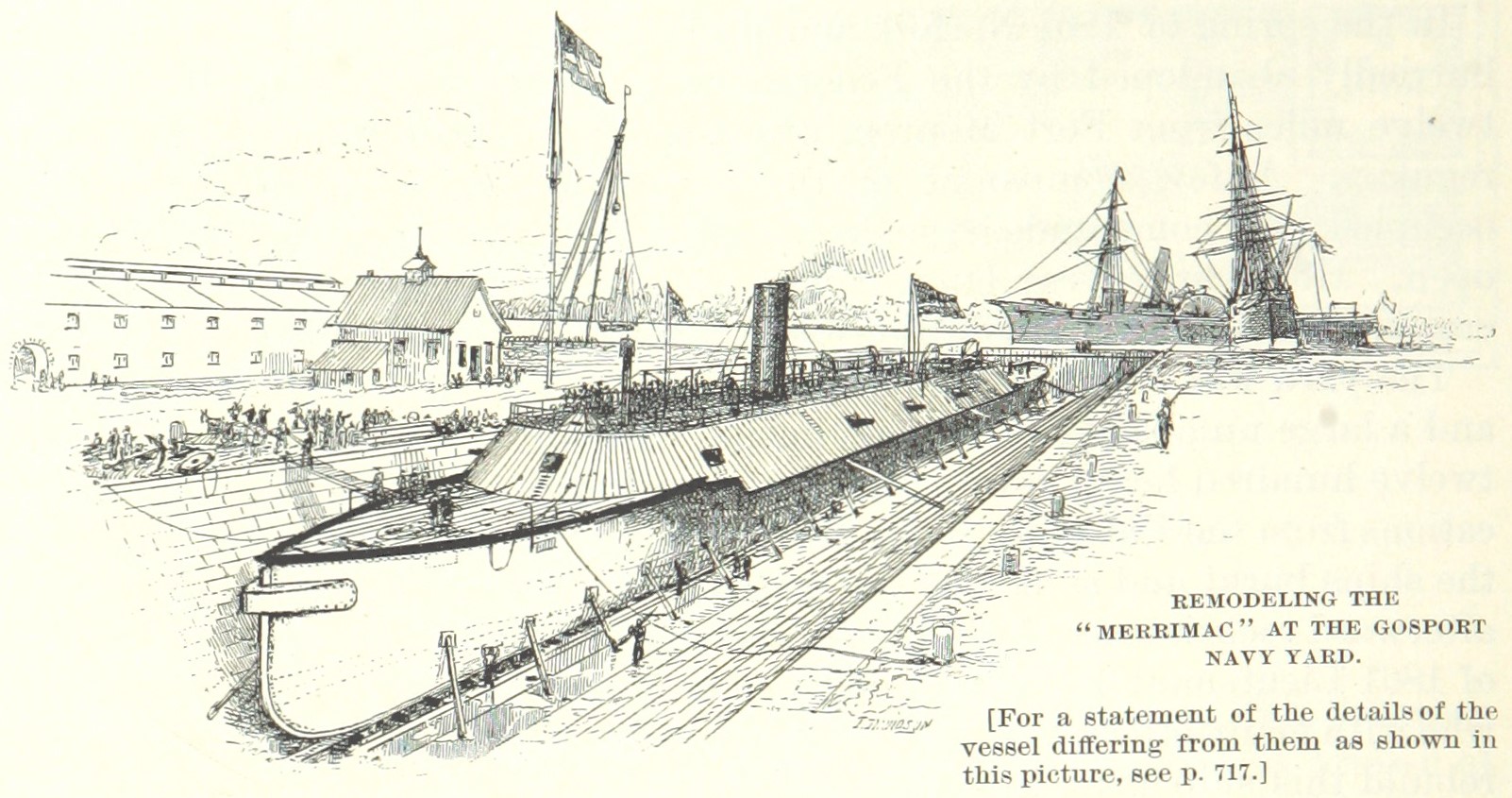
She was built from a corpse. When Union forces abandoned the Gosport Navy Yard in Portsmouth, Virginia, on April 20, 1861, they burned the steam frigate USS Merrimack to the waterline and sank her. The Confederates fished her out. Within ten days the wreck had been salvaged, towed into dry dock, and stripped to her undamaged lower hull and engines. What rose from that hull was something the world had never seen: a floating iron fortress, low in the water, bristling with ten heavy guns behind sloped armor plate. The Confederacy christened her CSS Virginia. On March 8, 1862, she steamed into Hampton Roads and single-handedly rewrote the rules of naval warfare, rendering every wooden warship on Earth obsolete in a single afternoon.
Resurrection in Dry Dock
The conversion was an act of desperation turned engineering marvel. Confederate Secretary of the Navy Stephen Mallory chose the sunken Merrimack because she was the only large vessel with intact engines available in the Chesapeake Bay area. Lieutenant John Mercer Brooke drew the general design, a casemate ironclad with submerged bow and stern, and naval constructor John L. Porter handled the detailed work. Workers cut away the charred upper hull past the original waterline, then built a sloped armored casemate of oak and pine topped with two layers of iron plate angled at thirty-six degrees to deflect enemy shells. A cast-iron ram was bolted to the bow, a throwback to ancient naval tactics. The engines, already slated for replacement before the war, wheezed under the added weight. Virginia needed forty-five minutes to complete a full turn. She was slow, ungainly, and drew so much water she could barely navigate the shallows of Hampton Roads. None of that would matter on her first day out.
The Day Wooden Navies Died
On March 8, 1862, Virginia steamed into Hampton Roads with workmen still aboard, accompanied by five support ships. Her first target was USS Cumberland, a wooden sailing warship. After a punishing cannon exchange, Virginia rammed Cumberland in her starboard bow. The impact tore away half of Virginia's own iron ram, opening a leak, but Cumberland was mortally wounded and sank. Seeing the destruction, the captain of USS Congress ran his frigate aground in shallow water. Virginia pounded Congress with cannon fire for an hour until the ship surrendered. When a Union shore battery then fired on Virginia during the evacuation of Congress's crew, an enraged Commodore Franklin Buchanan ordered hot-shot fired into the surrendered vessel. Congress burned through the night. Buchanan himself was wounded by rifle fire from shore as he stood exposed on the upper casemate deck. By the end of the day, Virginia had sunk or destroyed two major Union warships. She had also been badly battered: her smokestack was riddled, two cannon knocked out, armor plates loosened, both boats shot away, and her bow was leaking. But she was still afloat. No wooden ship could say the same.
Iron Against Iron
That night, the Union's answer arrived. USS Monitor, rushed down from the Brooklyn Navy Yard still incomplete, reached Hampton Roads by the light of the still-burning Congress. She was Virginia's opposite: small, nimble, with a single revolving gun turret and almost no freeboard visible above the waterline. On March 9, the two ironclads squared off in the world's first battle between armored warships. For hours they circled and fired at near point-blank range, shells clanging off iron plate without penetrating. Virginia's crippling weakness, her enormous turning radius, let the faster Monitor dance around her. Monitor finally withdrew into shallower water after a shell struck her pilothouse, sending a gunpowder blast into Captain John L. Worden's face and temporarily blinding him. Virginia, unable to follow into the shallows, steamed back toward Norfolk. Neither ship had defeated the other, but the message to every navy in the world was unmistakable: the age of wooden warships was over.
No Harbor, No Escape
Virginia spent April 1862 trying to lure Monitor into a rematch, but the Union vessel had orders not to re-engage. On April 11, Virginia and a Confederate squadron captured three merchant ships and hoisted their flags upside down to taunt the blockading fleet, but no Union ironclad took the bait. Then the strategic ground shifted. On May 10, Union troops occupied Norfolk, and Virginia lost her home port. Her deep draft made her unable to retreat up the James River. Her pilots judged her too unseaworthy to enter the Atlantic. Crews dumped supplies and coal overboard to lighten the ship, but even that exposed her unarmored lower hull without reducing the draft enough to matter. Trapped, her new captain, Flag Officer Josiah Tattnall III, ordered Virginia destroyed rather than let her be captured. Early on May 11, 1862, off Craney Island, Catesby Jones and John Taylor Wood set fire to gunpowder and cotton scattered across her deck. The flames reached the magazine, and Virginia disintegrated in a massive explosion, sinking to the harbor floor after just seventy-three days of active service.
Enough Iron for a Fleet
After the war, salvage crews picked Virginia's bones clean. In 1867, Captain D.A. Underdown recovered 290,000 pounds of iron from the wreck site. In 1871, E.J. Griffith pulled up another 102,883 pounds. The remaining timbers were raised in 1876. Some of the iron was melted and recast into the Pokahuntas Bell in 1907. Virginia's brass bell now resides at the Hampton Roads Naval Museum, and one of her anchors stands before the American Civil War Museum in Richmond. So many souvenirs have been sold over the decades, all supposedly crafted from Virginia's salvaged material, that a local joke holds you could outfit an entire fleet of ironclads from the claimed relics. A 1982 survey by the National Underwater and Marine Agency found essentially nothing left on the river bottom. Virginia is gone, scattered into scrap and memory, but her one day of fire and thunder at Hampton Roads changed the course of naval history forever.
From the Air
Located at 36.91N, 76.34W in Hampton Roads, Virginia, where the James River meets Chesapeake Bay. The Battle of Hampton Roads took place in the waters between Norfolk, Newport News, and Fort Monroe. Key visual landmarks include the Monitor-Merrimac Memorial Bridge-Tunnel crossing the waters of the battle site, Norfolk Naval Station (the world's largest naval base), and Craney Island where Virginia was destroyed. Nearest airports: Norfolk International (KORF) approximately 8nm south, Langley AFB (KLFI) 10nm north, and Newport News/Williamsburg (KPHF) 15nm northwest. Fly at 2,000-4,000 feet AGL for good views of Hampton Roads and the historic waterway. The area is heavily controlled airspace due to military installations; check NOTAMs and contact Norfolk Approach.