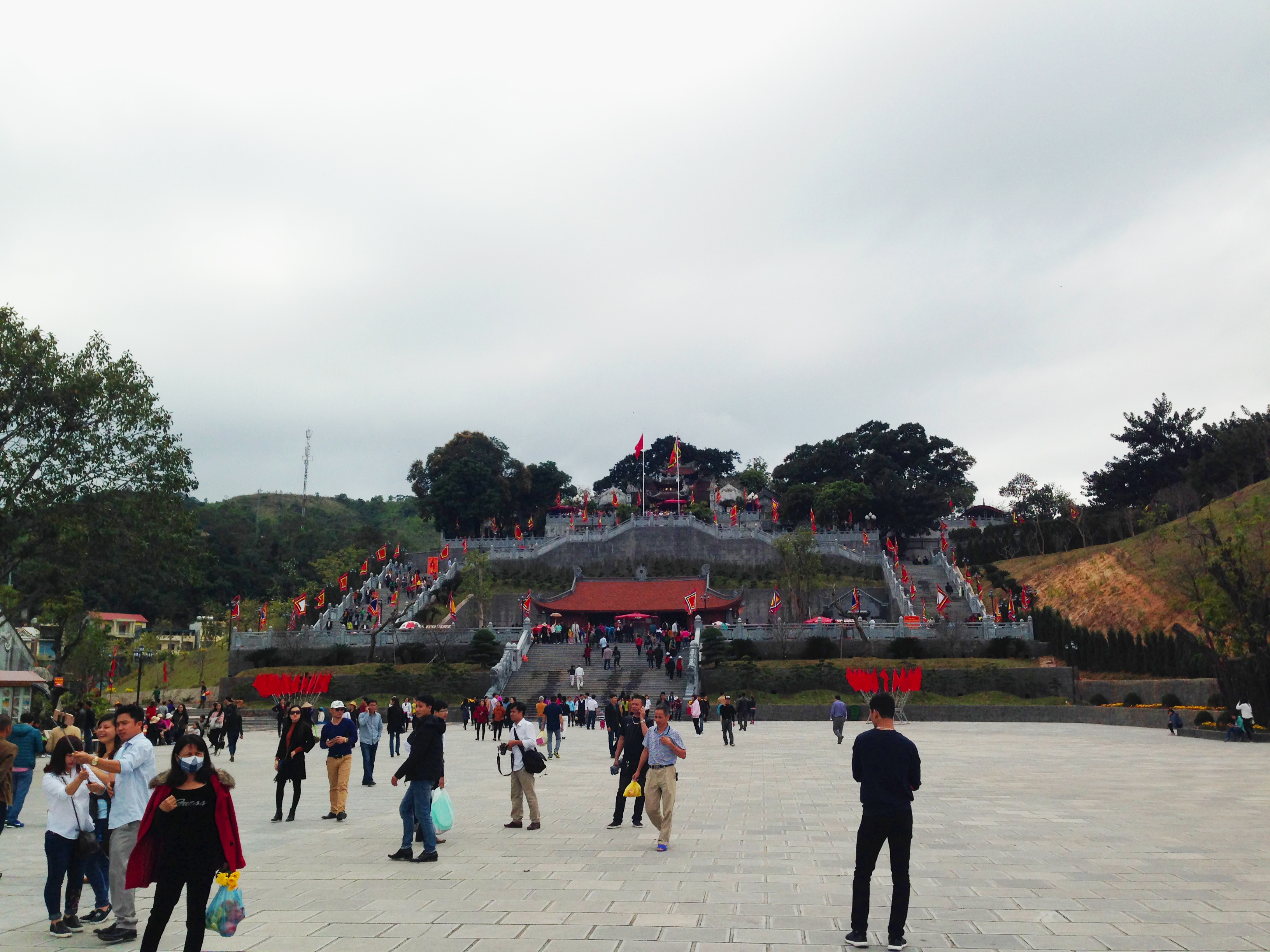
Cua Ong Temple
The name itself is a puzzle. "Cua Ong" translates roughly to "the gate of the lord," and the story of how this hilltop temple in Quang Ninh province came to bear that name involves a case of mistaken identity stretching back centuries, a prince who may or may not have been worshipped here, and a local hero whose memory was gradually overshadowed. Perched roughly 100 meters above sea level in Cam Pha City, about 40 kilometers northeast of Ha Long, the temple faces Bai Tu Long Bay with the confidence of a place that has been watching over Vietnam's northeastern coast for generations. It was designated a Special National Site at the end of 2017, but the pilgrims knew its power long before any government stamp confirmed it.
A General's Ghost, a Prince's Name
Before Tran Quoc Tang's name graced this hilltop, the site belonged to Hoang Can. A local military hero honored with the imperial title "Courageous General Defending the Eastern Sea," Hoang Can fought invaders and pirates along this coast, and the Hoang Tiet Che Temple stood in his memory. Then, at the turn of the 20th century, the temple was rebuilt and rededicated. Tran Quoc Tang, a prince of the Tran dynasty famous for his role in defending Vietnam against Mongol invasions in the 13th century, became the principal deity. The confusion traces back to an 18th-century book by Bui Huy Bich, which misidentified one Tran prince for another. By the time scholars sorted it out, the name had stuck. Today, Tran Quoc Tang presides as the main figure of worship, while Hoang Can and other deities share the altar. History, it turns out, belongs to whoever the faithful decide to remember.
Where Dragons Meet Tigers
The temple's placement is no accident. Traditional feng shui principles guided the original builders, and even a casual visitor can feel the logic of the site. To the left rises the formation called Thanh Long, the Green Dragon. To the right sits Bach Ho, the White Tiger. Bai Tu Long Bay spreads before the temple entrance like a natural forecourt of islands and open water, while behind the complex a populated valley stretches toward the Mong Duong mountains. The combination of sea, hill, and sheltering ridgeline creates what practitioners call an ideal convergence of protective energies. Whether or not one subscribes to feng shui, the panoramic views of the bay are undeniable. From the temple grounds, the limestone karsts of Bai Tu Long rise from turquoise water like a less-crowded sibling of nearby Ha Long Bay, offering a visual drama that has drawn visitors here for centuries.
Three Months of Spring Fire
Every year on the third day of the second lunar month, the Cua Ong Temple Festival begins, and it does not quiet down for three months. The opening ceremony features the procession of Tran Quoc Tang's commemorative tablet from the main temple to the Nhan Garden Temple, the place where, according to legend, the prince's spirit drifted ashore and transformed into a deity. The procession reenacts his coastal patrols, a symbolic remembrance of a warrior prince who once guarded these same waters. Dragon dances weave through the crowd. Fruit trays are arranged with geometric precision for offering ceremonies. Traditional folk games fill the temple grounds: blindfolded pot smashing, tug-of-war, stick-pushing contests. In 2016, the Ministry of Culture, Sports, and Tourism recognized the festival as a national intangible cultural heritage, formalizing what locals had practiced for generations. The event anchors a broader pilgrimage circuit that connects Con Son, Kiep Bac, and Yen Tu, drawing the faithful along a route that threads through northern Vietnam's most sacred sites.
The Weight of 800,000 Footsteps
Cua Ong Temple draws approximately 800,000 visitors each year, a staggering number for a hillside shrine in a coal-mining city. The temple's total planned area covers over 12,000 hectares, encompassing the complex and its surrounding landscape. In just the first two months of 2019, 14,000 visitors passed through, generating revenue exceeding 10 billion Vietnamese dong. The numbers reflect a particular Vietnamese devotion that blends spiritual practice with cultural tourism. Visitors come seeking blessings for business ventures, safe travel, and family health. They climb the hillside steps, burn incense at the altars, and pause at the overlook where Bai Tu Long Bay opens below them. For many, the journey to Cua Ong is not a single visit but an annual return, timed to the Tet holiday season and the spring festival. The temple manages to be both a major tourist destination and a genuinely sacred space, a balance that many sites attempt but few achieve.
From the Air
Located at 21.03N, 107.37E in Cam Pha City, Quang Ninh Province, Vietnam. The temple sits on a prominent hilltop approximately 100m above sea level overlooking Bai Tu Long Bay. From altitude, look for the coastal city of Cam Pha about 40km northeast of Ha Long Bay. Nearest major airport is Van Don International Airport (VVVD), approximately 30km to the east. Cat Bi International Airport (VVCI) in Hai Phong is about 120km southwest. Clear weather recommended for bay and island views.