Cuatro Ciénegas
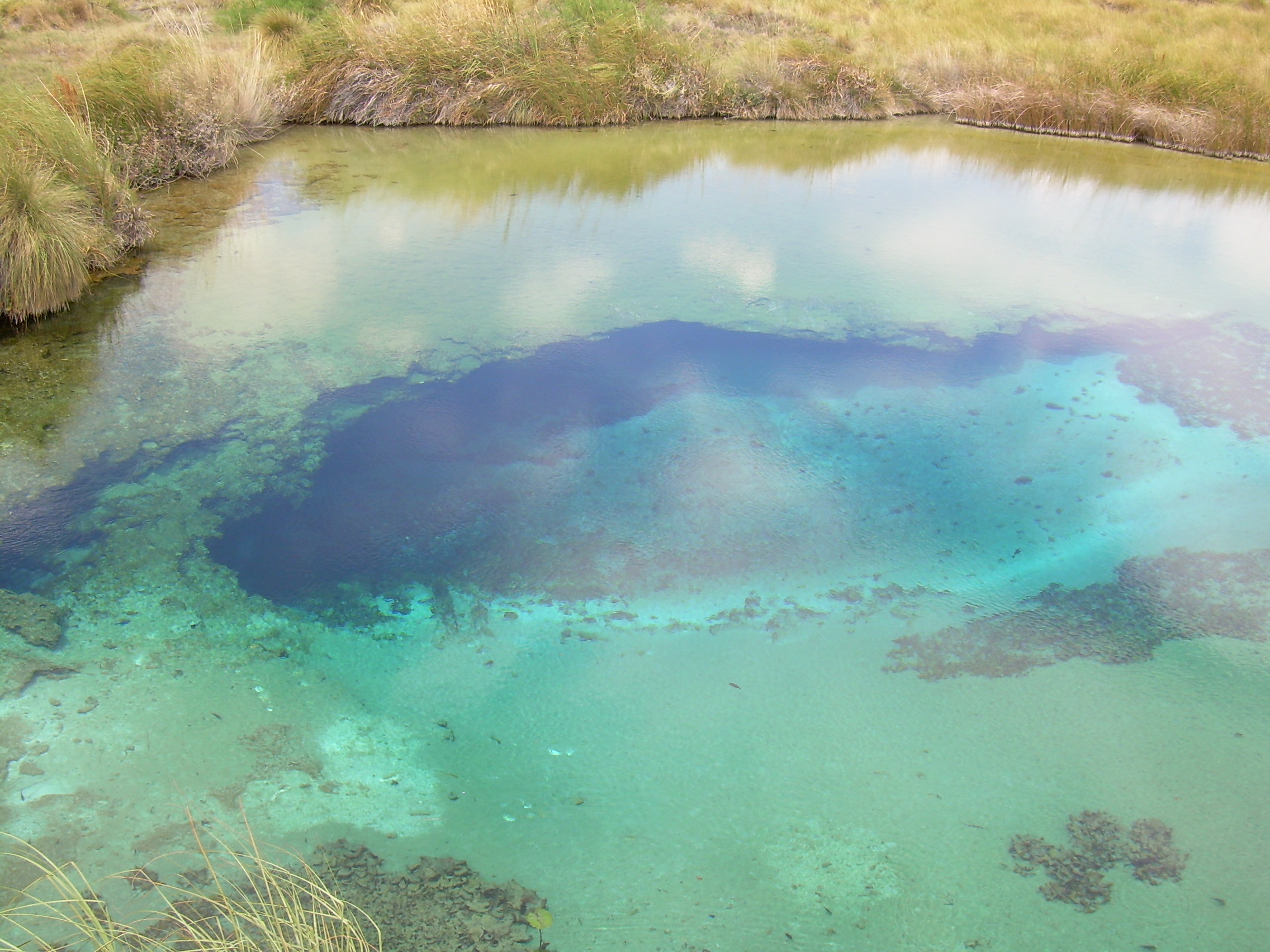
NASA studies this place for clues about life on Mars. The reason is floating in the turquoise pools scattered across a desert valley in Coahuila: living stromatolites, colonies of cyanobacteria that are essentially extinct everywhere else on Earth. More than three billion years ago, organisms like these generated the oxygen that made complex life possible. At Cuatro Cienegas, they persist in shallow, mineral-rich waters that have been isolated long enough to produce an ecosystem unlike any other -- 150 species of plants and animals found nowhere else, including three endemic turtles, eight endemic fish, and a bacterial species that has rewritten its own genetic code to survive in water almost devoid of phosphorus.
Four Marshes in the Desert
The name tells the origin story. Cuatro Cienegas -- "four marshes" in Spanish -- was chosen by early settlers for the natural springs that create wetlands and pools in an otherwise arid basin at 740 meters elevation. Archaeological evidence suggests humans recognized this oasis at least 5,000 years ago; excavations have found evidence of ritual peyote use by the area's earliest inhabitants. Several attempts at permanent settlement failed before Antonio Cordero y Bustamante successfully founded a town on May 24, 1800. It was originally called Nuestra Senora de los Dolores y Cuatro Cienegas, later renamed Villa Venustiano Carranza, and now formally known as Cuatro Cienegas de Carranza -- honoring its most famous native son, Venustiano Carranza, who was born here in 1859 and served as President of Mexico from 1915 to 1920.
A Precambrian World, Still Running
The Cuatro Cienegas Basin is an endorheic system: water flows in but has no natural outlet. In prehistoric times it connected to the Rio Grande drainage, but isolation has turned its pools into evolutionary laboratories. The stromatolites here are not fossils. They are alive, building their layered mats of minerals and microbes just as their ancestors did when Earth's atmosphere contained no free oxygen. A tiny copepod crustacean, Leptocaris stromatolicolus, exists only in the interstices of these stromatolites and the bottom sediments of the saline pools. The water itself is an oligotrophic environment, meaning it contains almost no available phosphate. One local bacterium, Bacillus coahuilensis, has adapted by acquiring genes through horizontal transfer that allow it to partially replace the phospholipids in its cell membranes with sulfolipids -- a biochemical workaround that scientists had not previously observed in nature.
White Sand and Blue Water
The valley's landscapes read as contradictions. White gypsum dunes -- Las Dunas de Yeso -- cover a vast area and rank as the largest calcium sulfate dunes in Mexico and the third largest in the Americas. A few kilometers away, the turquoise pools of Poza Azul and Poza de la Becerra shimmer against the desert terrain. The Sierra de la Campana rises on the valley's edge with El Hundido, a massive crater. Wine grapes grow here too: Bodegas Ferrino, founded by a nineteenth-century Italian immigrant, is the second largest wine producer in Coahuila. The contrast between the bone-dry dunes and the spring-fed pools is visible from the air as a mosaic of white, blue, and green patches in an otherwise brown landscape.
An Oasis Under Siege
Scientists and residents have watched the water levels drop. Springs that once flowed reliably are diminishing, and surface water in the basin has visibly decreased in recent years. Researcher Valeria Souza at the National Autonomous University of Mexico found through genetic studies of the basin's microbes that the aquifer supplying Cuatro Cienegas extends far beyond the valley itself, reaching into adjacent regions where large-scale agriculture has been pumping water for decades. Hydrogeologist Brad Wolaver at the University of Texas at Austin confirmed this finding: the aquifer is regional, and agricultural extraction in neighboring valleys is drawing down the same water that surfaces in the basin's springs. Conservation organizations, particularly Pronatura Noreste, are working to protect the valley through their Pozas Azules reserve, invasive species eradication, and water-efficient agricultural techniques. The stakes are not merely local. If Cuatro Cienegas dries out, the living stromatolites -- survivors of three billion years of planetary change -- will have been killed by irrigation ditches.
From the Air
Coordinates: 26.99°N, 102.07°W. Cuatro Cienegas sits at 740 m elevation in the desert region of Coahuila, surrounded by mountain ranges. The turquoise pools and white gypsum dunes are visible from moderate altitude as striking color contrasts against the brown desert. The basin is roughly 40 km across. Nearest airports: Monclova (MMMV) and Saltillo (MMIO/SLW). The town has about 12,000 inhabitants. Best viewed from 3,000-6,000 ft AGL to see the pools and dune fields.