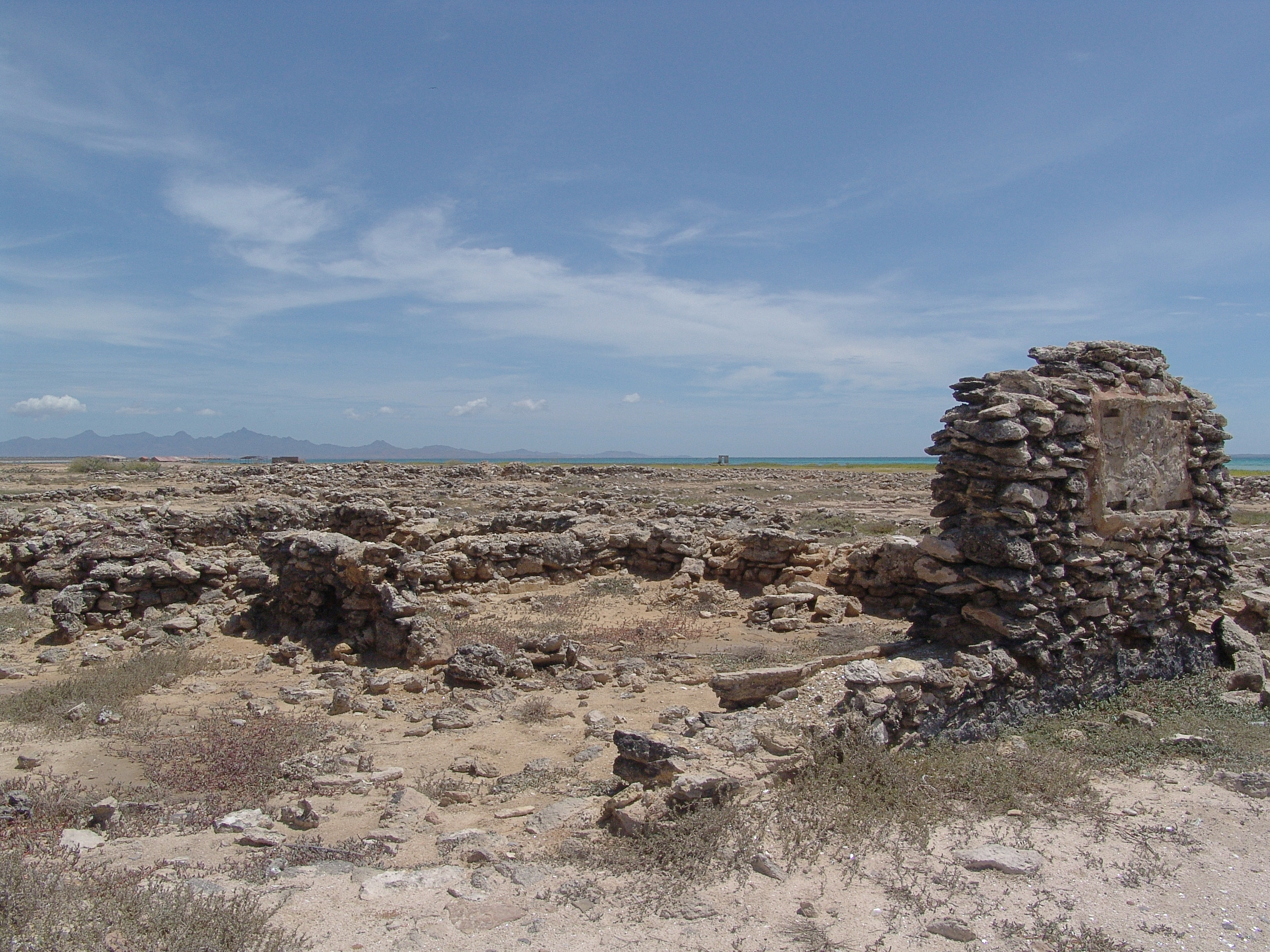
Cubagua Island
From the air, Cubagua looks like nothing. A flat, sun-blasted ellipse of rock and cactus barely rising 32 meters above the Caribbean, with no rivers, no forests, no visible reason for anyone to care. Yet this waterless speck of land -- just 22 square kilometers -- once held the most valuable real estate in the Spanish Empire's New World. The pearl oyster beds surrounding Cubagua produced wealth so extraordinary that the Spanish built their first Venezuelan city here, a place called Nueva Cádiz. The pearls are gone now. The city is rubble. And the island has returned to what it was before the Europeans arrived: a place too harsh for permanent settlement, visited only by fishermen and the occasional documentary filmmaker.
Before the Pearl Rush
Humans first came to Cubagua around 2325 BC, during what archaeologists call the Meso-Indian Period. They did not stay. The island offered no fresh water, no significant vegetation, no shade -- only oysters. For thousands of years, indigenous peoples visited seasonally to harvest them, then returned to the mainland or neighboring Margarita Island. Christopher Columbus sighted Cubagua in 1498, and within a year Spanish expeditions returned with a different purpose. They were not interested in food. They wanted the pearls. By 1501, Cubagua's pearl beds had become one of the most valuable resources in the incipient Spanish Empire.
The Human Cost of Pearls
The pearl harvest demanded divers, and the Spanish met that demand through enslavement. Indigenous people were forced to dive the oyster beds, an exhausting and dangerous occupation. By 1513, the local indigenous population had been devastated. When the Spanish realized that the Lucayan people of the Bahamas were skilled divers accustomed to deep-water work, they transported them to Cubagua by the thousands. Within two years, the southern Bahamas were largely depopulated -- as many as 40,000 Lucayans may have been carried away. The first enslaved Africans arrived between 1526 and 1527 to replace the dying and the dead. In 1528, the settlement received the name Nueva Cádiz and the title of "city" -- the first in Venezuela -- with a population between 1,000 and 1,500. It was a city built on suffering.
Decline of a Desert Metropolis
Wealth built on a finite resource has a predictable trajectory. By 1531, the depletion of Cubagua's pearl oyster beds had become acute enough that the Spanish began limiting production. New pearl beds discovered on the distant Guajira Peninsula drew investment and divers away. By 1539, fewer than 50 people remained on Cubagua. An earthquake and tsunami in 1541 destroyed what buildings still stood. The pearl beds continued to be worked sporadically for centuries, but the complete exhaustion of the oysters in 1857 ended even that. The ruins of Nueva Cádiz, some of them now submerged beneath the sea, were declared a National Monument of Venezuela in 1979.
An Island Returned to Silence
Today Cubagua has no roads, no streets, and almost no permanent residents. An unofficial census in 2007 counted 51 people, 19 of them children, clustered in four small communities on the island's northwest shore. Seasonal fishermen from the mainland state of Sucre push the population above 300 at times, but they come and go. The landscape is exactly what you would expect from a place receiving just 250 millimeters of rain per year: xerophytic scrub, cacti like the cardón de dato and the melon cactus, and a few hardy legumes. Feral goats wander among the ruins. A lighthouse at Punta Charagato guides the ferry from Margarita Island, and another at Punta Brasil helps boats from Puerto la Cruz. The passage takes less than two hours, but few make the trip. Cubagua has returned to what it always was -- a place to visit, never to remain.
From the Air
Located at 10.81°N, 64.19°W in the Caribbean Sea between Margarita Island and the Araya Peninsula. The island is an unmistakable flat ellipse with its long axis running east-west, sitting 16 km north of the mainland. No airport on the island itself; the nearest is Santiago Mariño Caribbean International Airport (SVMG) on Margarita Island, approximately 15 km to the northeast. From cruising altitude, Cubagua is easily distinguished from its neighbors by its barren, desert appearance contrasting with the greener Margarita to the north.