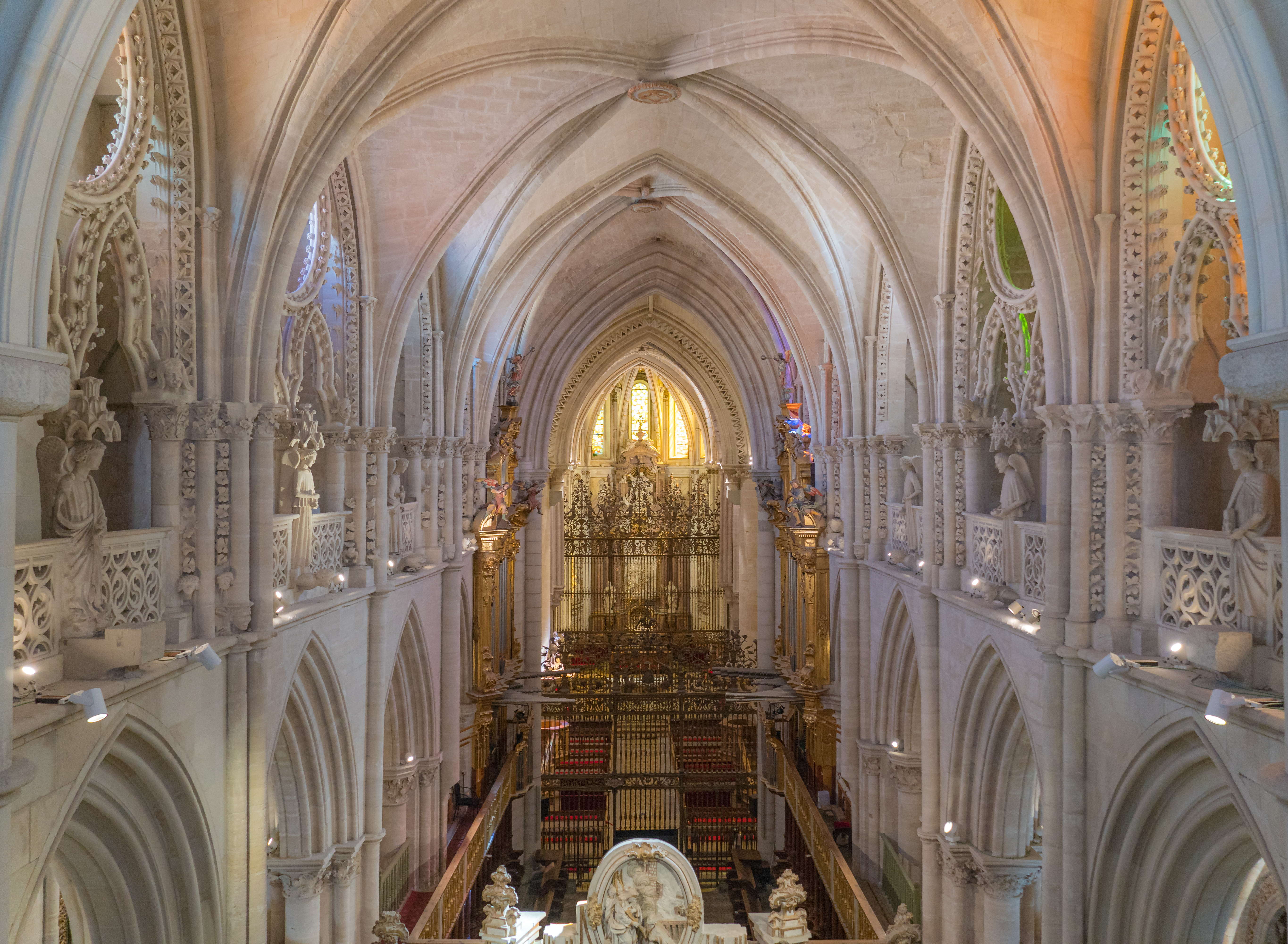
Cuenca Cathedral
Among the stone angels carved into the arches of Cuenca Cathedral, all wear somber expressions and hold books. All except one. That angel smiles and holds a goblet. According to local tradition, this is a hidden reference to the Holy Grail, supposedly preserved within the cathedral's walls. Whether or not you believe the legend, the smiling angel is real, and it watches over one of the earliest Gothic cathedrals ever built on the Iberian Peninsula, a building shaped by English queens, French stonemasons, and a lightning bolt that changed its face forever.
Conquest and Cornerstone
On September 21, 1177, Alfonso VIII of Castile conquered the city of Cuenca after a grinding nine-month siege against the Moors. The city became a diocese in 1183, and within a year, construction began on a cathedral rising directly from the foundations of the city's principal mosque. The architectural DNA, however, came not from Spain but from across the Pyrenees and the English Channel. Alfonso's wife, Eleanor Plantagenet, daughter of Henry II of England and Eleanor of Aquitaine, brought Norman aesthetic sensibilities to Castile. French stonemasons began the work between 1182 and 1189, importing techniques that were still revolutionary in Iberia. The result was a building with Anglo-Norman rib vaulting and structural ambitions that placed it alongside Notre-Dame de Paris and Laon Cathedral in architectural lineage, even as most of Spain still built in the Romanesque style.
The Giraldo's Fall
For centuries, the Giraldo bell tower anchored the cathedral's western facade, a landmark visible across Cuenca's dramatic gorge-side setting. On April 13, 1902, a bolt of lightning struck the tower directly. The Giraldo collapsed, destroying much of the facade and killing several children in the process. The disaster prompted a neo-Gothic reconstruction completed by architect Vicente Lamperez in 1910, but the work only partially repaired the damage. The rebuilt facade, while functional, has never matched the original. Plans to restore the destroyed sections have circulated for decades without reaching a technical consensus. The cathedral's face today is an unfinished compromise, bearing the scar of a single catastrophic moment more than a century ago.
Eight Centuries of Reinvention
The cathedral's interior tells the story of a building that never stopped evolving. The original 12th-century structure featured five staggered apses, a single transept, and three naves in the Romanesque manner. But each subsequent century brought changes. In the 1400s, the eastern end was rebuilt to create a double ambulatory, a dramatic expansion of processional space. In the 17th century, architect Ventura Rodriguez designed the altar of Saint Julian, known as el Transparente for its luminous stained-glass backdrop, rivaling the famous Transparente by Narciso Tome in Toledo Cathedral. An 18th-century altar brought Italian sculptor Pasquale Bocciardo's statues into the mix. The result is a cathedral that spans 120 meters in length and 36 meters in height, covering 10,000 square meters, a palimpsest of Romanesque foundations, Gothic ambition, Renaissance artistry, and Baroque drama layered one atop another.
Grail Legends and Hidden Messages
The Holy Grail theory is not the idle speculation of tour guides. Scholar and architect Rodrigo de Luz built his case from readings of the Book of Revelation and the quatrains of Nostradamus, arguing that the cathedral matches the description of the New Jerusalem with its twelve gate-shaped arches, each flanked by twelve angels. The smiling angel with the goblet, he concluded, is a deliberate coded reference. The city's coat of arms deepens the mystery: it features a cup alongside an octagram, the eight-pointed star associated with the Knights Templar. Whether these are meaningful signs or the accumulated coincidences of centuries of construction, they have given Cuenca Cathedral an aura of esoteric significance that distinguishes it from every other Gothic church in Spain.
From the Air
Located at 40.08N, 2.13W in the old city of Cuenca, perched dramatically above the gorges of the Huecar and Jucar rivers. The cathedral sits at the heart of the UNESCO-listed historic center, visible from the air alongside the famous hanging houses (Casas Colgadas). Nearest airports include Valencia (LEVC) approximately 200 km east. Recommended viewing altitude: 3,000-5,000 feet AGL to see the cathedral's position atop the gorge.