Cueva de las Manos
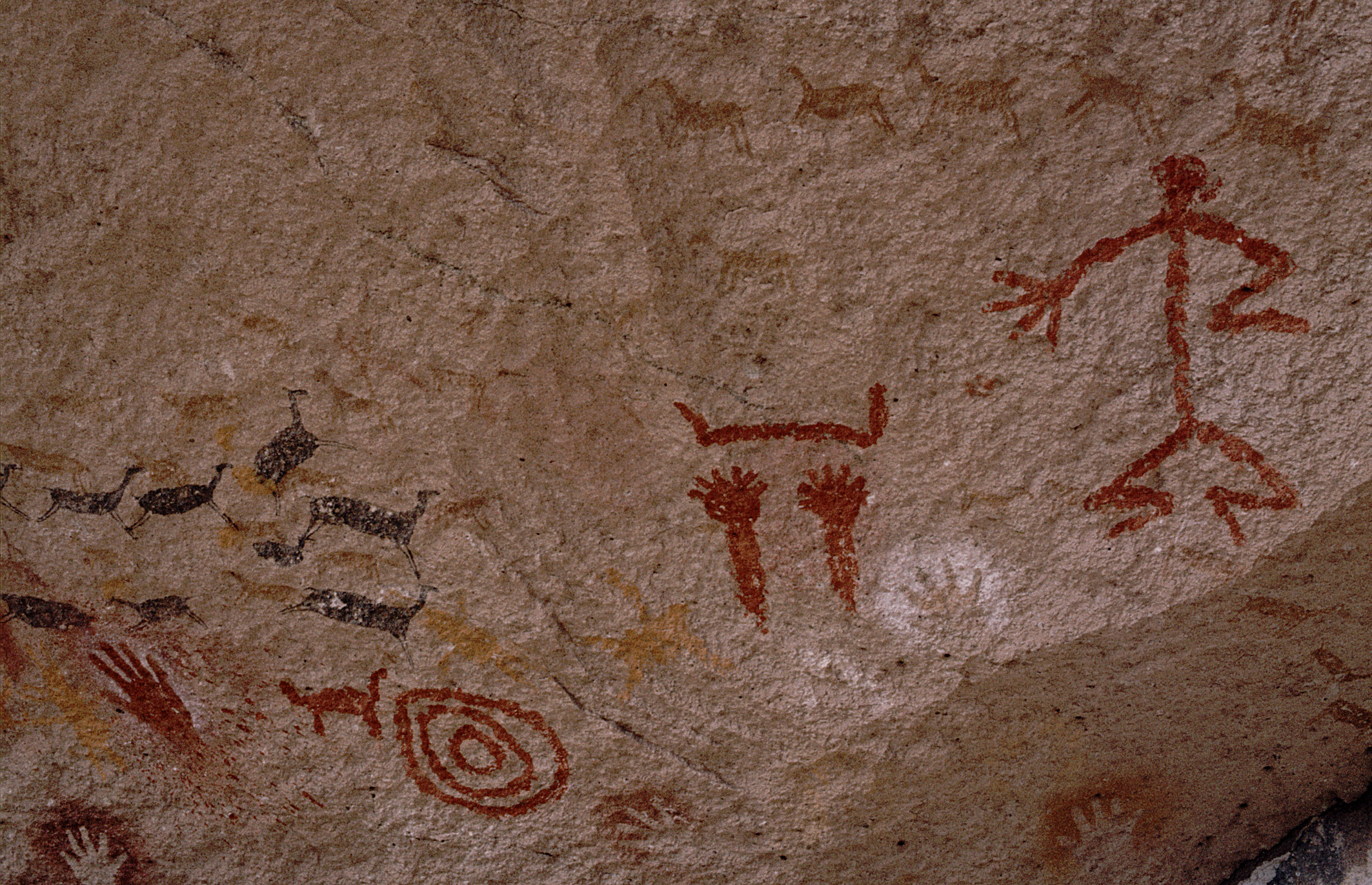
You see the hands before you understand what you're seeing. Nearly a thousand of them, pressed against the rock in pigments of red and ochre and black - left hands mostly, fingers splayed, each one a signature from someone who stood in this exact spot nine thousand years ago. The Cueva de las Manos isn't a cave of art in the way we usually mean the term. It's a cave of presence. Each print was made by holding a palm against the rock and blowing mineral pigment through a hollow bone, leaving a ghostly negative: the outline of a hand whose owner lived and died before the Egyptian pyramids were imagined, before Stonehenge, before the wheel.
The Painted River
The Río Pinturas has carved one of Patagonia's most spectacular canyons - a sinuous gash through the high steppe that drops 60 to 100 meters to the river below. The canyon walls display their own kind of painting: millions of years of geological history banded in ochre, rust, and cream, earning the river its name. A ribbon of green threads along the water, the only softness in an otherwise austere landscape of wind-scoured rock and blonde grass.
A monk stumbled upon the cave in 1941, but its existence was an open secret to anyone who'd bothered to look at the canyon walls. The cave itself is just a shallow overhang on the south wall, protected from the elements by an accident of erosion. But the location wasn't random. This narrow canyon would have funneled guanaco herds along predictable migration routes - a natural hunting ground for people who knew the terrain.
Across Nine Millennia
The paintings span an almost incomprehensible timeframe - from perhaps 9,500 years ago to around 1,000 years ago. Archaeologists have identified three distinct artistic periods. The oldest works are the handprints themselves, predominantly in red, dating to around 9,000 years ago. Most belong to adolescent males - possibly a coming-of-age ritual that connected young hunters to the generations before them. Standing in the cave, you can almost see it: a boy holding his palm against the cold rock, someone behind him blowing pigment through a bone, the hand pulling away to reveal what would remain for nine millennia.
The middle period added dynamic hunting scenes: human figures pursuing guanacos with bolas, the animals caught mid-stride, the hunters smaller than their prey in a statement about the relationship between the species. The motion feels urgent, alive.
The youngest paintings shift to static figures and geometric patterns - circles, spirals, rows of dots, serpentine lines. Something changed in how these people saw the world, though we can only guess what.
What the Hands Tell Us
The dates from Cueva de las Manos place these artists among the earliest known inhabitants of Patagonia. At 9,000 years old, the handprints were made when the ice age glaciers were still retreating from southern South America. Sites like this one, along with Monte Verde in Chile, have reshaped our understanding of human migration into the Americas - a story more complex than once thought.
What's certain is that the artists understood their materials. The pigments - iron oxide for reds, manganese for black, gypsum for white - have survived nine millennia of Patagonian wind and temperature swings. The cave's orientation protects the paintings from direct rain, and the dry climate has prevented the moisture damage that destroyed similar sites elsewhere. These were people who knew how to make things last.
The Living Landscape
The wildlife the ancient artists depicted still roams these lands. Guanacos browse the canyon rim, their silhouettes unchanged from the painted hunting scenes. Rheas - South American ostriches - stalk through the grass on legs that seem too long for their bodies. Gray foxes hunt the rocky slopes. Andean condors ride the thermals above the canyon, wings tilted against the Patagonian wind.
Pumas still patrol this territory too, though they're rarely seen. The relationship between hunter and hunted continues as it has for millennia, long before anyone thought to record it on stone walls - and will continue long after the last tourist has gone.
The nearest services are sparse. Perito Moreno (the town, not the famous glacier) sits about 160 kilometers north, connected to the outside world by Argentina's legendary Ruta 40 - a road that stretches the length of the country along the Andes' eastern flank. Getting here requires intention. The cave doesn't reveal itself to casual visitors.
Standing Where They Stood
Access to the cave is permitted only with a guide, and you approach on foot along trails that wind down into the canyon. The descent takes you through layers of rock and time, the temperature dropping as the walls rise around you. And then you're there, in the overhang, looking at hands that reached out toward you across nine thousand years.
The urge to add your own print is universal, and universally forbidden. But you can hold your palm up to the wall without touching - lining up your fingers with those of a teenager who hunted guanacos here when the ice age glaciers were still retreating. The scale of time collapses for a moment. You're both here, in the same light, in the same wind, beneath the same indifferent southern stars.
From the Air
Located at 47.15°S, 70.67°W in the Río Pinturas canyon. The cave is on the canyon's south wall - look for the distinctive banded colors (ochre, cream, rust) cutting through the pale Patagonian steppe. The green ribbon of the river provides a clear navigation aid through otherwise uniform terrain. Nearest town: Perito Moreno (pop. 6,000) about 160km north along Ruta 40. Nearest airports: Comodoro Rivadavia (CRD) to the east, El Calafate (FTE) to the south - both several hundred kilometers away. Minimal services in the area - plan fuel carefully. Best visibility in morning before afternoon winds develop.