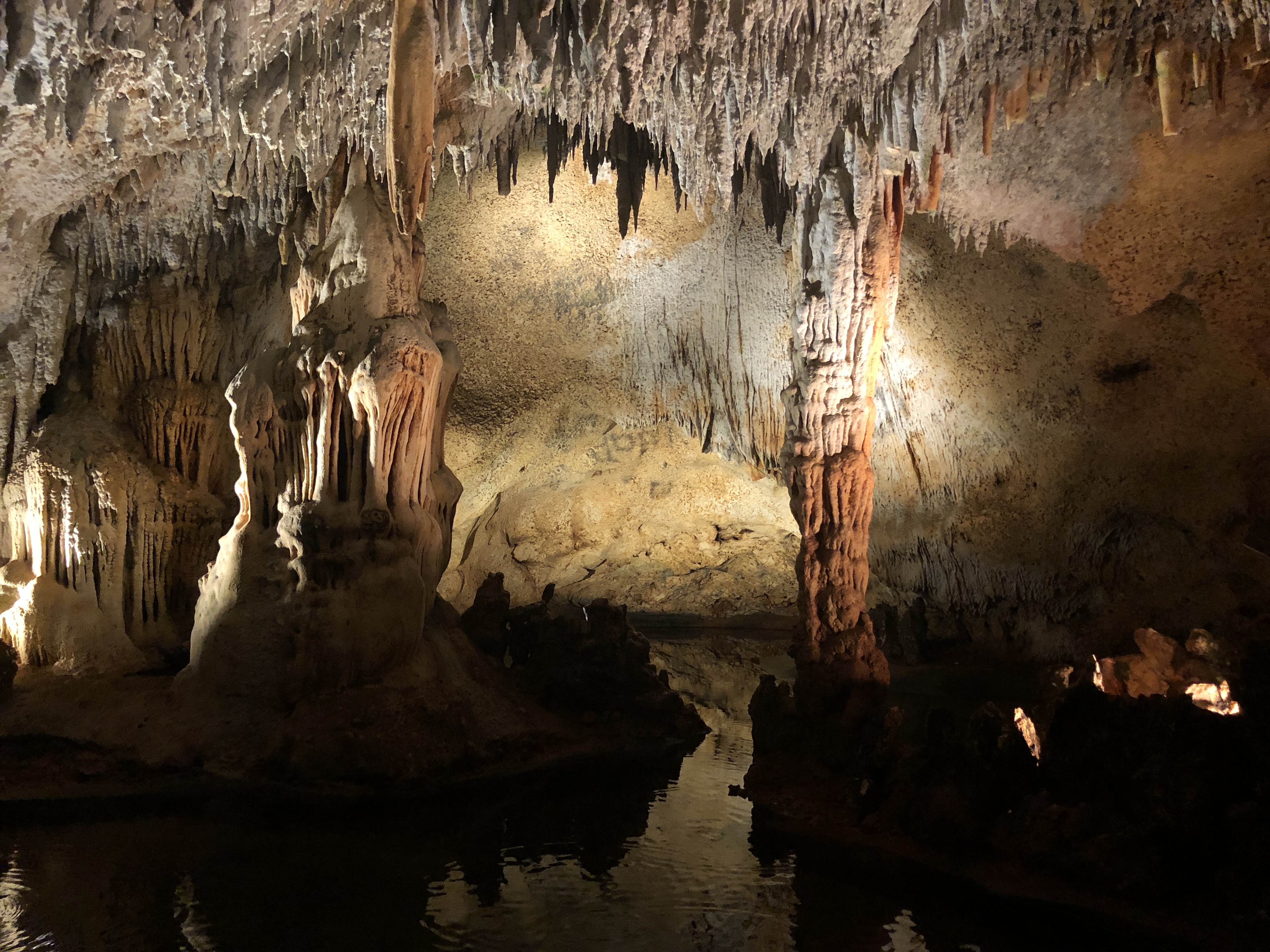
Cueva de las Maravillas National Park
Professor Francisco Richiez Acevedo stood in the dark and decided the cave needed a better name. For decades it had been called Cueva Jaguar, a serviceable label for a hole in the limestone between San Pedro de Macoris and La Romana. But what Richiez Acevedo saw in 1949 - the stalactites twisting into shapes that rewarded the imagination, the ancient faces staring from the walls in red and black pigment, the stillness of a place that had been sacred long before Columbus reached these shores - demanded something grander. He called it the Cueva de las Maravillas, the Cave of Wonders. The name stuck because it was honest.
Voices in the Stone
The Taino people who painted these walls were the original inhabitants of Hispaniola, and they left behind one of the most extensive collections of indigenous art in the Caribbean. Inside the cave, roughly 500 paintings and engravings survive on the limestone surfaces, executed in black and red pigments. According to detailed surveys, the cave contains approximately 10 petroglyphs - images carved directly into the rock - and 472 pictographs painted on the walls. Of those 472, specialists classified 135 as depicting human faces, 18 as animal forms, 41 as combined human and animal figures, and 144 as abstract or cryptic designs grouped at 69 distinct points throughout the cave. The numbers are striking, but what they represent is more striking still: a sustained creative effort by a people who used this underground space for purposes that went beyond shelter. One of the cave's most significant works, known as the Great Panel, depicts what archaeologists interpret as a funeral ritual - a window into Taino spiritual life painted on stone centuries before European contact.
The Water Mirror
Eight hundred meters of passages wind through the cave system, all of it lying 25 meters beneath the surface of the southeastern coastal plain. The geology here is limestone reef, part of the geomorphological formation known as the South East Coastal Plain, and water has been sculpting these chambers for millennia. Stalactites hang from the ceiling in formations dense enough to create the illusion of a stone forest growing downward. Stalagmites rise to meet them. In places the two have fused into pillars that look engineered rather than natural. The cave's most celebrated feature, the Water Mirror Gallery, uses this geology to spectacular effect. An artificial lake has been created within the cave, its surface so still that it reflects the ceiling formations with mirror precision. Visitors standing at the water's edge look down and see the cave above them, doubled and inverted, the stalactites appearing to grow upward from a subterranean sky. It is the kind of optical trick that makes you pause and reconsider what you think you know about up and down.
A Landscape Above and Below
The national park encompasses 4.5 square kilometers of the surrounding terrain, declared protected on July 22, 1997. Above ground, the park supports 48 documented plant species in a landscape shaped by the Caribbean coastal climate. Lignum vitae, one of the hardest and densest woods in the world, grows here alongside jasmine, cat's claw vine, and the stinging pringamosa - a plant whose local name translates roughly as 'it grabs and bites,' fair warning to anyone who brushes against its leaves. The guayiga palm, arraijanes, and yellow caya form a canopy that shelters the cave entrance. This is not wilderness in the untouched sense - the road between San Pedro de Macoris and La Romana runs nearby, and the towns themselves sit just 15 and 10 kilometers away respectively. But the transition from highway to cave mouth is abrupt enough to feel like crossing a threshold between centuries.
What the Jaguar Became
The cave's earlier identity as Cueva Jaguar, documented as far back as 1926, hints at how the site was perceived before anyone thought to count the pictographs or catalog the flora. It was a local landmark, known but not formally studied, its Taino paintings dimly visible in lamplight. Richiez Acevedo's 1949 renaming was not merely poetic - it marked a shift in how the Dominican Republic began to think about its pre-Columbian heritage. The Taino had been largely written out of the island's story for centuries, their culture overshadowed by the colonial narrative that began with Columbus's arrival in 1492. Places like the Cave of Wonders forced a reconsideration. Here was evidence that sophisticated people had lived, worshipped, and created art on this island long before any European ship appeared on the horizon. The cave became a national park in 1997 and today draws visitors who descend into the limestone to stand where the Taino once stood, looking at the same painted faces on the same stone walls. The wonders the professor named are still there, unchanged by the centuries between then and now.
From the Air
The cave is located at approximately 18.45N, 69.16W on the southern coast of Hispaniola, roughly midway between San Pedro de Macoris to the west and La Romana to the east. The park sits near the Soco River and the town of Cumayasa. From the air, the area appears as flat coastal plain with scattered vegetation - the cave system is entirely underground and not visible from altitude. La Romana International Airport (MDLR) lies approximately 10 kilometers to the east. Las Americas International Airport (MDSD) in Santo Domingo is roughly 70 kilometers west. At 2,000 feet, the coastal road connecting the two cities is the primary landmark for orientation.