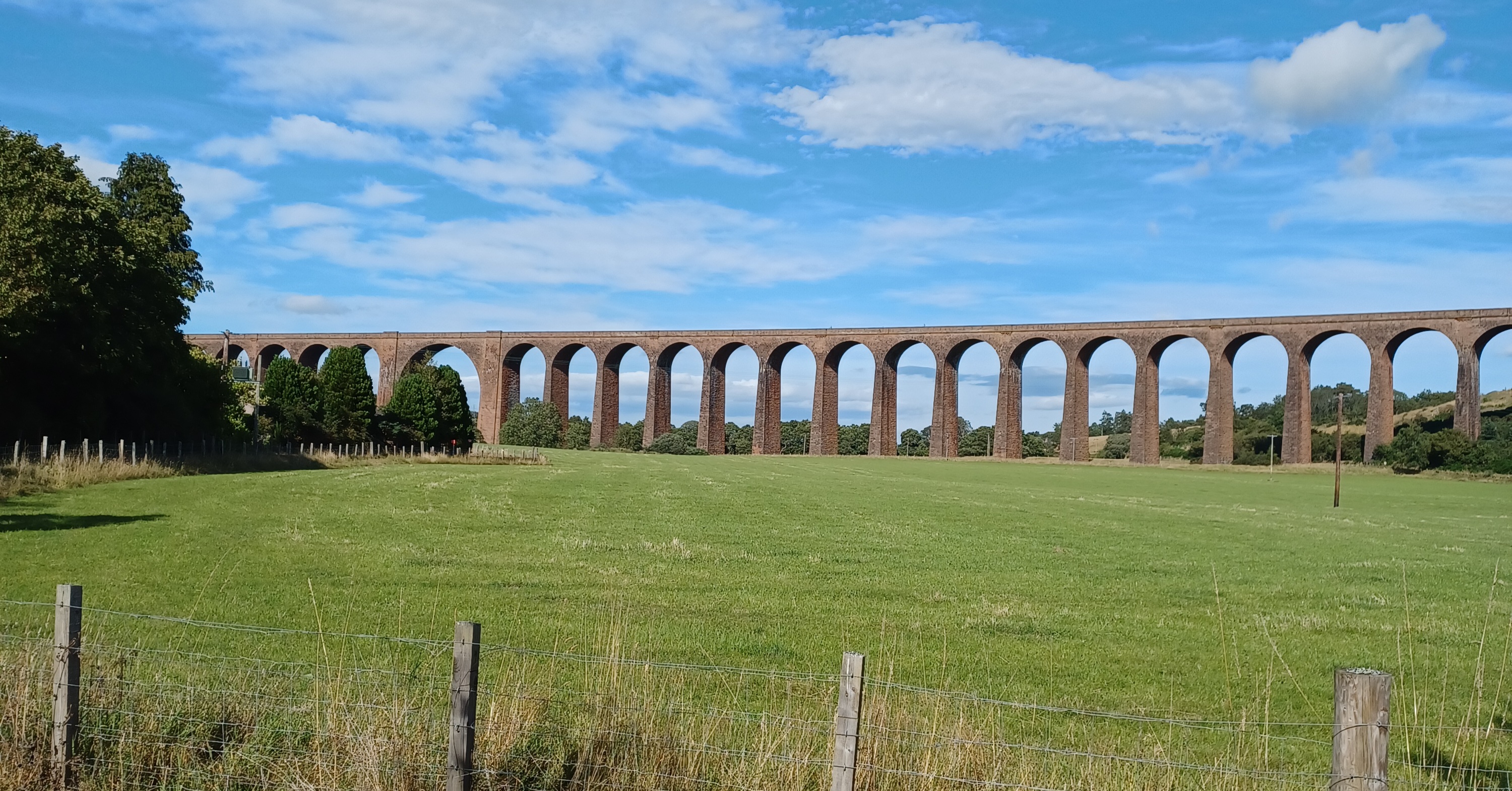
Culloden Viaduct
Twenty-nine arches of red-faced stone march across the valley of the River Nairn like a Roman aqueduct transplanted to the Scottish Highlands. The Culloden Viaduct -- also known as the Nairn Viaduct, Culloden Moor Viaduct, or Clava Viaduct, depending on who you ask -- is the longest masonry railway viaduct in Scotland, and when it opened in 1898, it was already an anachronism. By the end of the Victorian era, most railway engineers had switched to steel and iron for major structures. Murdoch Paterson, the Highland Railway's chief engineer, built his viaduct from rubble and dressed ashlar, as if the permanence of stone were itself a design requirement.
The Last Great Crossing
The viaduct was built as part of the Inverness and Aviemore Direct Railway, a line constructed by the Highland Railway to replace the more circuitous route via Forres. It opened in 1898 and immediately shortened the journey between Inverness and the south. The structure stretches approximately 1,800 feet across the Nairn valley, with 28 semi-circular arches of 50-foot span and one larger arch of 100 feet spanning the river itself, between the 10th and 11th piers from the north. The viaduct curves at its southern end to align with the hillside, a graceful adjustment that softens what might otherwise be a brutally functional line across the landscape. It was one of the last major railway engineering works in Scotland, built at a time when the railway network was approaching its maximum extent.
Stone in an Age of Steel
Paterson's choice of masonry was deliberate. The rubble construction, dressed with red-faced ashlar and finished with tooled ashlar details on the arch rings, was meant to last. And it has. The viaduct carries trains on the Highland Main Line to this day, over 125 years after it opened. Trains pass over it on the route between Inverness, Aviemore, and Perth -- a journey that takes travellers through some of the finest railway scenery in Britain. The structure was granted Category A listed building status in 1971, the highest level of protection available in Scotland, recognising it as a building of national architectural importance. From below, looking up through the arches, the engineering reads as architecture: the proportions of the piers, the rhythm of the arches, the warm colour of the stone against Highland sky.
Neighbours in Time
The viaduct crosses a landscape saturated with history. To the west, just a mile away, lies Culloden Moor, where the last Jacobite rising ended in blood and defeat in 1746. To the immediate west of the viaduct stand the Bronze Age cairns at Balnuaran of Clava, their passage graves aligned to the midwinter sunset some 4,000 years ago. The railway's builders drove their arches through a valley that had been significant to human settlement for millennia. Today, the juxtaposition is startling: you can stand beside a Stone Age burial chamber and look up at a Victorian railway bridge, both built with confidence in their respective technologies, both still standing. When a train crosses the viaduct, the sound carries down the valley and reaches the cairns, connecting the 19th century to the 3rd millennium BC in a few seconds of rumble and clatter.
From the Air
Located at 57.48N, 4.06W, crossing the River Nairn valley east of Inverness. The 29-arch viaduct is a distinctive linear feature visible from the air, running roughly north-south with a curve at the south end. Culloden battlefield is 1nm to the west, Clava Cairns are directly adjacent to the west. The Highland Main Line rail corridor is visible passing through the valley. Nearest airport: Inverness (EGPE) 6nm west.