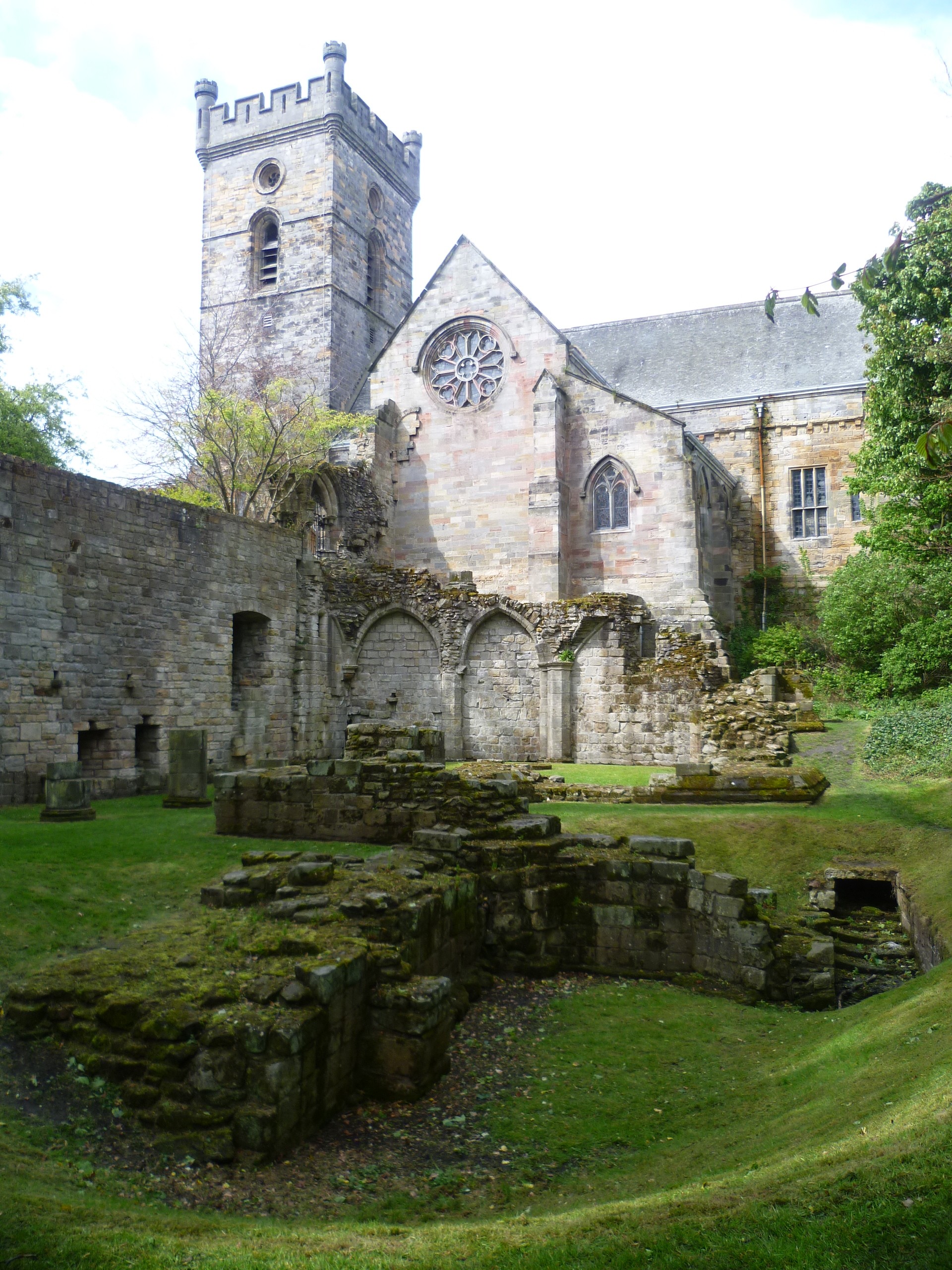
Culross Abbey
Somewhere beneath Culross Abbey, according to a story that has outlived every monk who ever prayed here, there is a tunnel. Inside it sits a man in a golden chair, waiting to bestow treasures on whoever finds him. Years ago, a blind piper decided to try. He entered at Newgate with his dog and began to play, and locals could hear his pipes beneath their feet as far as the West Kirk, three quarters of a mile away. Eventually the dog emerged into daylight. The piper never did. The legend belongs to a place that has always existed at the intersection of faith, myth, and the hard facts of Scottish history.
Saint Mungo's Birthplace
Culross sits on the northern shore of the Firth of Forth in Fife, and tradition holds that it was here that Saint Mungo, the patron saint of Glasgow, was born in the sixth century. The site's religious significance predates the abbey by centuries: a Pictish church, said to have been founded by Saint Serf, occupied the ground before the Cistercians arrived. Early medieval carved stones discovered in the ruins of the later abbey confirm that Christian worship took place here long before the twelfth century, and a ninth-century Gaelic text references a church of Saint Serf at Culross. When Malcolm, Earl of Fife, founded a Cistercian abbey here in 1217, he was building on ground that already carried the weight of sanctity. The first monks came from Kinloss Abbey in Moray, bringing with them the austere disciplines of the Cistercian order.
A Cruciform Church in a Coal Town
The original thirteenth-century abbey was cruciform in plan, a cross-shaped church without aisles, surrounded by the standard monastic buildings: cloister, chapter house, refectory, and domestic ranges. Culross was never a large community. By the late fifteenth century, the lay brothers who had once worked the abbey's lands had vanished, and the remaining community numbered only fifteen choir-monks. The western half of the cloister range was abandoned, and the nave was demolished around 1500. The town around the abbey, meanwhile, was thriving on a different kind of industry. Sir George Bruce of Carnock operated coal mines that extended beneath the Firth of Forth itself, an engineering feat that astonished James VI when he visited in 1617. The abbey existed in creative tension with the commercial energy of the town it had helped create.
Reformation and Survival
The Scottish Reformation of 1560 outlawed monastic life, but the authorities permitted existing communities to continue until their last member died. At Culross, the local parish congregation began worshipping in the eastern end of the abbey church during the 1580s, a practical arrangement that inadvertently saved the building. In 1633, the east end was formally taken over as the parish church, while the rest of the complex fell into ruin. The north transept found a different purpose in 1642, when Sir George Bruce converted it into a family tomb house. His alabaster effigies, along with those of his wife and eight children, can still be seen there today, elaborate Renaissance monuments sitting inside a medieval shell. The abbey was restored in 1823 and again in 1905 by Glasgow architect Peter MacGregor Chalmers, whose careful work reinstated the transept chapels and left the buildings much as they appear today.
The Living and the Ruined
Culross Abbey today is two places at once. The eastern portion of the church remains in active use as a Church of Scotland parish kirk, its stained glass by the Edinburgh firm of Ballantyne and Son filtering light into a space where worship has continued, in one form or another, since the sixth century. The ruins of the rest of the complex are in the care of Historic Environment Scotland, their foundation walls tracing the footprint of a monastic community that flourished for three and a half centuries. The division is itself a kind of monument to Scottish pragmatism: when the Reformation made monks impossible, the town kept the building and changed its purpose. The blind piper may still be wandering his tunnel. Above ground, at least, the abbey has found a way to endure.
From the Air
Located at 56.06N, 3.63W on the northern shore of the Firth of Forth in Fife, within the historic village of Culross. The abbey ruins and intact parish church are visible on elevated ground above the village's well-preserved seventeenth-century townscape. The Firth of Forth stretches to the south. Nearest airports: Edinburgh (EGPH) approximately 18 nm east-southeast; Glasgow (EGPF) approximately 28 nm west. Best viewed at 1,500-2,500 ft AGL.