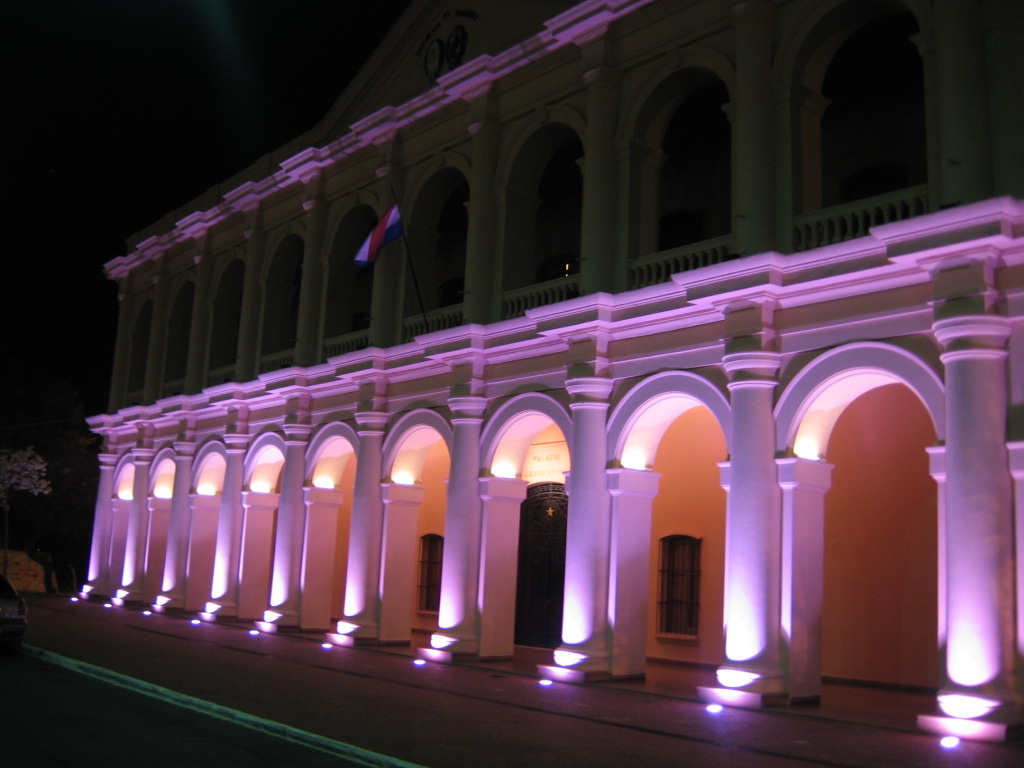
Cultural Center of the Republic
Somewhere on the second floor of Asunción's old Cabildo building, behind glass, sits a guitar that once belonged to Agustín Pío Barrios, widely regarded as one of the greatest classical guitarists of the twentieth century. It shares the Hall of Music with scores and personal effects of Luis Alberto del Paraná, another titan of Paraguayan music. That these instruments ended up here, in a building where Paraguay's congress debated laws for over a century, says something about what the country chose to do with its seat of power once democracy no longer needed it as a legislature.
From Fort to Congress to Culture
The site is older than Paraguay itself. On August 15, 1537, Juan de Salazar y Espinoza founded the military fort of Nuestra Señora de la Asunción here. Four years later, Governor Domingo Martínez de Irala established the settlement that would become Paraguay's capital. The current building dates to 1844, constructed under Carlos Antonio López to serve as the seat of both the executive and legislative branches. It was one of the most important construction projects of his presidency, which lasted from 1844 to 1862. The executive branch occupied the building until November 15, 1894, when it relocated to the Palacio de los López, and the Cabildo became the exclusive domain of the national congress. Legislators debated within these walls for over a century, through civil wars, dictatorships, and the messy process of democratization, until the congress moved to a new building in 2003.
A Second Life
Senator Carlos Mateo Balmelli, then president of the national congress, spearheaded the initiative to transform the vacant Cabildo into the Cultural Center of the Republic. It opened on March 14, 2004, with the explicit purpose of being a space open to everyone, without discrimination. The novelist Augusto Roa Bastos, Paraguay's most celebrated writer and winner of the Premio Miguel de Cervantes, served on its Permanent Council of Advisers as a member of the International Association of Art Critics. When Roa Bastos died in 2005, the Cultural Center held his funeral service -- a fitting farewell in a building that had housed the nation's political voice and was now becoming its cultural one. The center's library bears his name.
Clay, Saints, and Carvings
The center houses multiple museum collections distributed across its halls. The Hall of Clay, established as a museum in 1979, displays popular art, indigenous art, and urban art side by side, treating each tradition with equal dignity. The Hall of Sacred Art began with the personal collection of Juan Sinforiano Bogarín, Paraguay's first archbishop, and now features wood carvings from Jesuit and Franciscan missions dating to the colonial era. These carvings -- saints rendered in tropical hardwoods by indigenous artisans trained in European techniques -- represent one of the most distinctive artistic traditions in South America, a fusion of cultures visible in every hand-carved detail. The Hall of Cabildo itself displays objects tied to the building's long tenure as a seat of political power.
Where Power Becomes Memory
The building's transformation follows a pattern found across Latin America: the obsolete seat of government repurposed as a cultural institution. But in Paraguay, the shift carries particular weight. This is a country where political power was held by one man for thirty-four years, where the congress that met in this building was often rubber-stamping a dictator's decrees rather than legislating independently. Turning the Cabildo into a cultural center -- filling it with guitars, clay figurines, Jesuit saints, and a library named for the country's most celebrated dissident writer -- was itself a political act. The first floor hosts temporary exhibitions, concerts, theater, and ballet. The second floor preserves music and film. What was once the architecture of political authority now holds the evidence of a richer, more complicated national story.
From the Air
The Cultural Center of the Republic (the old Cabildo) is at 25.28°S, 57.63°W in central Asunción, near the Palacio de los López and the Manzana de la Rivera complex. It sits within the historic core of the city, a few blocks from the Paraguay River waterfront. Silvio Pettirossi International Airport (ICAO: SGAS) is approximately 15 km northeast. From the air, the colonial-era building is distinguishable from the surrounding modern structures by its lower profile and traditional architecture.