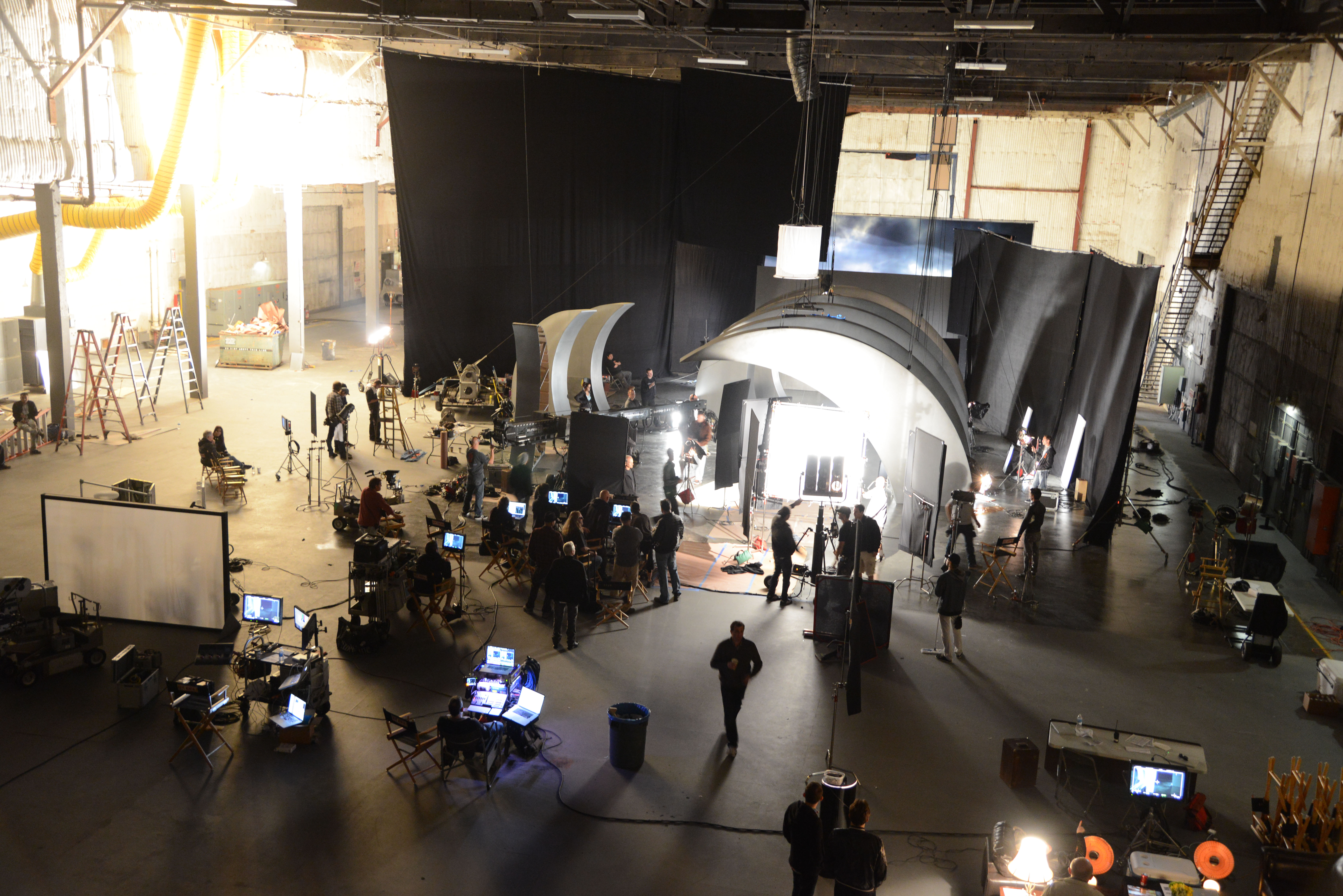
Culver Studios
They burned Atlanta to make way for Tara. In 1939, producer David O. Selznick ordered abandoned sets on the Culver Studios backlot set ablaze, filming the inferno for Gone with the Wind's most spectacular sequence. It was a fitting act of creative destruction for a studio that has reinvented itself more times than any other in Hollywood history. Since Thomas H. Ince broke ground here in 1918, the lot has operated under nine different names, sheltered everyone from Cecil B. DeMille to Howard Hughes, and somehow outlasted them all.
A Mansion for the Movies
Thomas H. Ince wanted to prove that filmmaking deserved respect. In 1918, on land purchased from real estate developer Harry Culver, he commissioned architects Meyer and Holler to build something unprecedented: a Colonial Revival administration building modeled after George Washington's Mount Vernon estate. The white-columned mansion, with its eight two-story columns and 15,000 square feet of manicured grandeur, announced that movies were no longer carnival entertainment. They were art, and art required architecture. Ince's ambitions died with him in 1924, but the mansion endures. Cecil B. DeMille worked there. David O. Selznick worked there. Today it holds landmark status, the elegant anchor of a lot that has outlived every mogul who ever claimed it.
The Parade of Owners
The studio changed hands like a hot prop. When Ince died, his widow sold to Cecil B. DeMille, who built a replica of Jerusalem's streets for The King of Kings in 1927 before financial troubles forced him to merge with Pathe. RKO absorbed Pathe in 1932, renting the lot rather than using it themselves. Then came Selznick in 1935, then Howard Hughes in 1950, then Lucille Ball and Desi Arnaz, who paid six million dollars in 1957 and pivoted the operation toward television. Sony bought it in 1991 for eighty million. Hackman Capital Partners acquired it in 2014, modernized the facilities, and leased the expanded 720,000-square-foot campus to Amazon, which now houses Amazon MGM Studios, IMDb, and Prime Video on land once walked by Vivien Leigh and Clark Gable.
Forty Acres of Make-Believe
A few blocks from the main lot sat the Back Forty, also known as Forty Acres, a triangular backlot where entire worlds materialized and disappeared. Here construction crews built Tara, the Atlanta Depot, and the burning plantation scenes that required Selznick's calculated arson. The same acreage later hosted the fictional Mayberry for The Andy Griffith Show, the prison camp for Hogan's Heroes, and alien planets for the original Star Trek pilots. Television dominated the Back Forty through the 1960s, its soundstages churning out sitcoms and dramas with assembly-line efficiency. The land is now an office park, the illusions long bulldozed, but the main lot soldiers on, still creating stories in the same buildings where King Kong first climbed a miniature Empire State Building.
A Century of Cameras Rolling
The production credits read like a film school curriculum. King Kong in 1933. Gone with the Wind and Rebecca bookending the end of the thirties. Hitchcock's Spellbound. Rocky and E.T. and RoboCop and The Matrix. Television brought The Andy Griffith Show, Batman, The Nanny, and Arrested Development. Michael Jackson rehearsed for his Dangerous Tour on these soundstages in 1992. The lot adapted to each technological shift and cultural moment, from silent films to streaming services, from black-and-white Superman episodes to Big Little Lies. Alfred Hitchcock kept an office in one of the historic bungalows, where Clark Gable and Vivien Leigh once stayed during Gone with the Wind filming. Those bungalows still exist, relocated during the recent expansion but preserved as working spaces for the next generation of storytellers.
From the Air
Located at 34.024N, 118.392W in Culver City. The studio complex is visible as a dense cluster of large soundstages and production buildings southwest of downtown Los Angeles. Look for the distinctive white Colonial mansion near the center of the lot. Nearest airports: Santa Monica Municipal (KSMO) 4nm west, Los Angeles International (KLAX) 6nm south. Approach from the north for best views of the historic buildings against the backdrop of the LA basin.