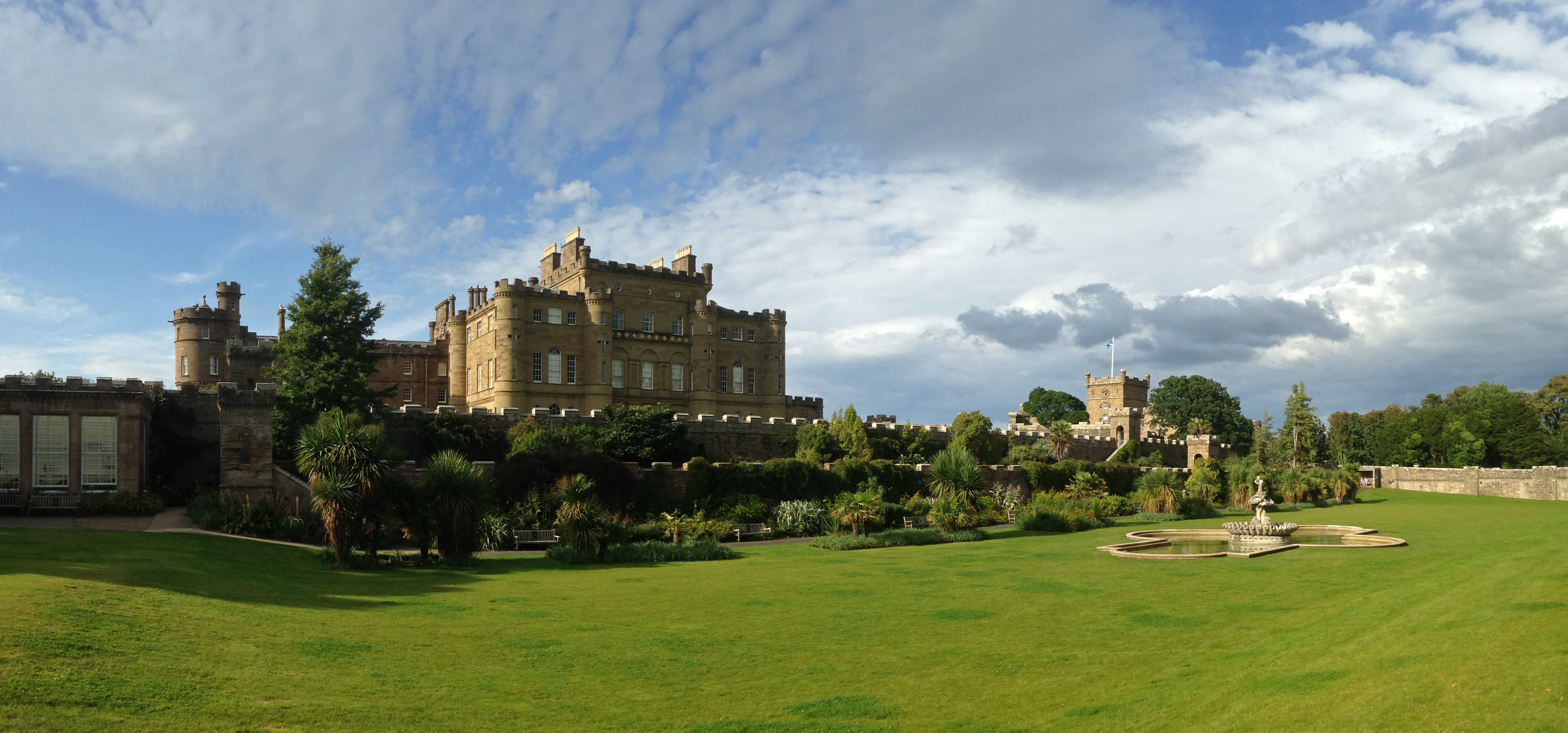
Culzean Castle
William Lindsay was an American millionaire who had never set foot in Scotland. But he loved the idea of it -- the romance, the history, the castles rising from sea cliffs. When he died, he left a significant portion of his four-million-dollar estate to the National Trust for Scotland, requesting that it go toward Culzean Castle. Lindsay was reportedly fascinated by the fact that Dwight Eisenhower, the Supreme Allied Commander and future president, had been given an apartment at the top of this castle -- a personal retreat overlooking the Firth of Clyde where the leader of the free world could escape to Scotland whenever he wished. Culzean, pronounced 'Cullane,' has attracted this kind of devotion since Robert Adam first shaped its clifftop silhouette in the 1770s.
Adam's Clifftop Masterwork
The 10th Earl of Cassillis commissioned Robert Adam, Britain's most celebrated architect, to transform a modest fortified house into something worthy of his earldom. Between 1777 and 1792, Adam created a castle that is one of his finest achievements: a large drum tower containing a circular saloon with views across the Firth of Clyde to the Isle of Arran, a grand oval staircase that remains one of the most photographed interiors in Scotland, and a suite of elegantly proportioned apartments. The castle sits within 240 acres of country park -- gardens, woodland walks, a walled garden, and an estate that receives nearly a quarter of a million visitors each year.
Eisenhower's Scottish Retreat
In 1945, when the Kennedy family gave the castle to the National Trust for Scotland, they attached one condition: the apartment at the top of the castle must be given to General Dwight D. Eisenhower, in recognition of his role as Supreme Commander of Allied Forces in Europe. Eisenhower first visited in 1946 and returned four times, including once during his presidency. The Eisenhower apartment is now a museum and exhibition space dedicated to his connection with Scotland. From 1972 until 2015, Culzean appeared on the reverse of five-pound notes issued by the Royal Bank of Scotland -- the castle's image traveling in wallets across the country that Adam had built it to overlook.
Wicker Men and Enslaved People
Culzean's screen appearances include a starring role as the castle of Lord Summerisle in the 1973 cult film The Wicker Man, with Christopher Lee filmed there in October and November 1972. But the estate also carries a history that no film has yet addressed. The castle grounds include a walled garden built on the site of the home of Scipio Kennedy, a formerly enslaved person owned by the Kennedy family. The armoury contains a propeller from an aircraft flown by Leefe Robinson when he shot down a German airship north of London in 1916. Sea caves beneath the castle, accessible by tour in summer, add yet another layer to a site that collects stories the way its cliffs collect salt spray.
Seven Ghosts and a Gas Works
Culzean is reputed to house at least seven ghosts, including a phantom piper and a servant girl -- claims that earned it an episode of Most Haunted in 2002. More tangibly, the estate preserves an unusual piece of industrial heritage: the Gas House, which provided town gas for the castle from the early 19th century until 1940. The complex includes the gas manager's house, now containing an exhibition on William Murdoch, a pioneer of gas lighting, along with the Retort House and remains of the gasometer. It is a reminder that behind the Adam elegance and aristocratic grandeur, someone had to keep the lights on. Today the National Trust for Scotland maintains the castle, its country park, and eight self-catering holiday properties, including the Brewhouse Flat within the castle itself -- a chance to sleep inside one of Scotland's most storied buildings.
From the Air
Culzean Castle is at 55.35N, 4.79W on the South Ayrshire coast overlooking the Firth of Clyde. The castle sits dramatically on clifftops surrounded by its country park. The Isle of Arran and Ailsa Craig are visible across the water. Nearest airports: Glasgow Prestwick (EGPK, 15nm north) and Glasgow (EGPF, 35nm northeast). The castle's prominent clifftop position makes it visible from altitude along the Ayrshire coast. The Firth of Clyde is a major navigational feature.