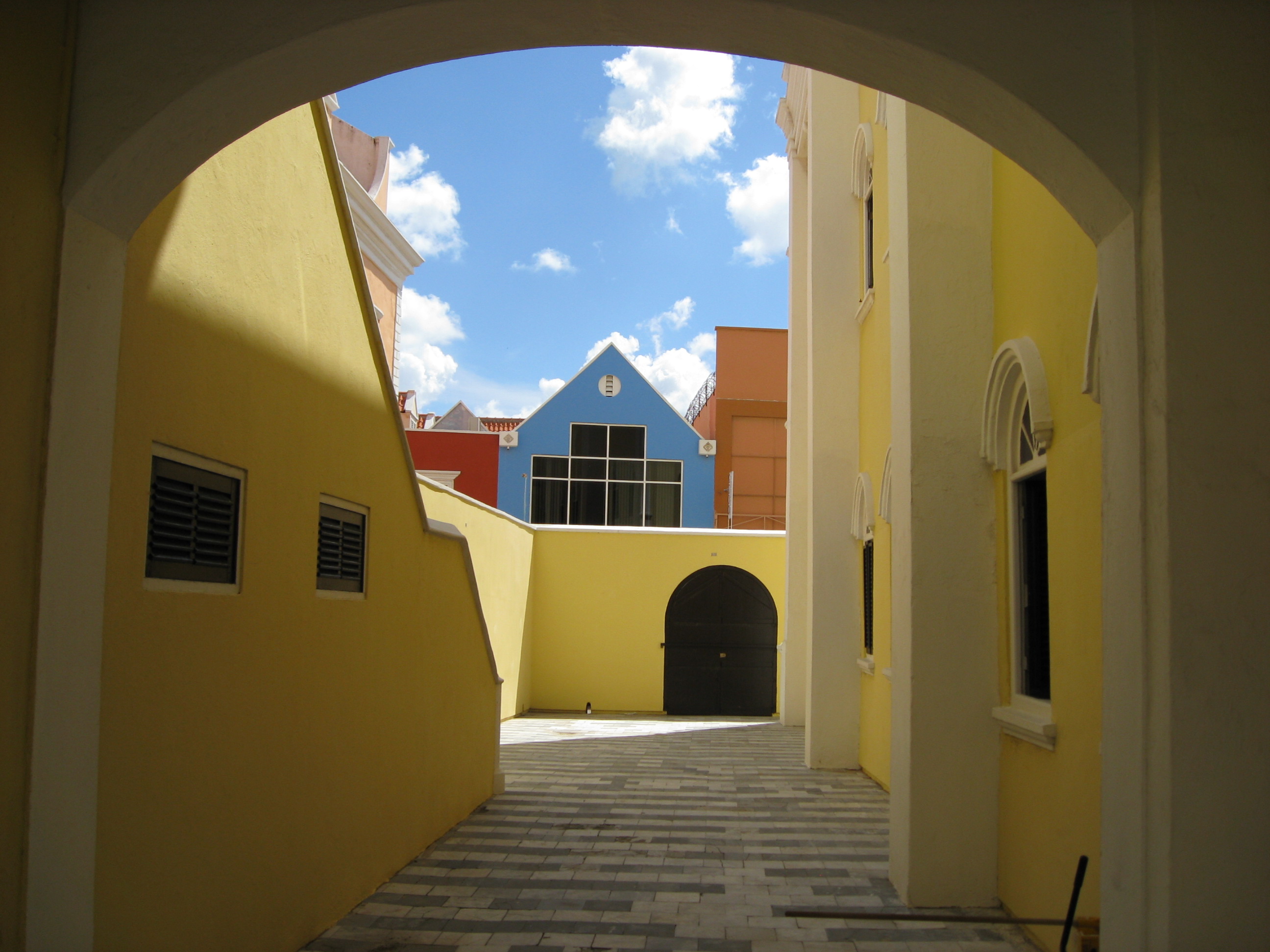
Mikvé Israel-Emanuel Synagogue
Step through the quiet courtyard, past sun-bleached walls, and your shoes sink into sand. Not beach sand tracked in by careless tourists, but sand laid deliberately across the floor of the Mikvé Israel-Emanuel Synagogue in Willemstad, Curaçao. The congregation has maintained this tradition since the building was consecrated in 1732, making it the oldest surviving synagogue in the Americas. The sand carries a double meaning. It recalls the forty years the Israelites wandered the desert before reaching the Promised Land. But it also honors something darker and more specific: the Sephardic Jews of the Iberian Peninsula who, during the Inquisition, scattered sand across the floors of secret prayer houses so their footsteps would be muffled and their worship undetected. Every grain underfoot is a reminder that this faith survived because people were willing to pray in silence.
From Persecution to the Punda
The congregation's story begins not in the Caribbean but in the Portugal and Spain of the fifteenth century, where the Inquisition forced Jews to convert, flee, or die. Many fled to the Netherlands, where religious tolerance offered refuge. From Amsterdam, Sephardic Jews followed Dutch trade routes to the New World. They arrived in Curaçao in the 1650s, establishing the Mikvé Israel congregation - "The Hope of Israel" - and building a community on this small island off the Venezuelan coast. The first synagogue building was purchased in 1674. By 1730, the community had outgrown it, and construction began on the current structure in the Punda district of Willemstad. Two years later, in 1732, the new synagogue was consecrated. It has held services continuously ever since, through colonial transitions, economic upheavals, and the slow decline of the community that built it.
An Amsterdam Echo in the Tropics
Walk inside and the resemblance is unmistakable. Three high vaulted ceilings, a carved mahogany Torah ark, brass chandeliers suspended from the beams, galleries running along the upper level - the interior of Mikvé Israel-Emanuel deliberately mirrors the Portuguese Synagogue in Amsterdam, the mother congregation from which these Caribbean Jews descended. But the tropical setting transforms the effect. Azure stained glass filters equatorial light across the sand floor. Mahogany, not the oak of Northern Europe, shapes the bimah where the Torah is read. Shuttered windows open to Caribbean breezes rather than Dutch canal damp. The synagogue is known locally as the Snoa, a shortened form of esnoga, the old Portuguese and Judaeo-Spanish word for synagogue. Attached to the building is the Jewish Historical Cultural Museum, whose collection includes replicas of tombstones from the Beit Chaim Bleinheim cemetery - the oldest Jewish cemetery still in use in the Western Hemisphere.
Schism and Reunion
No community survives three centuries without fracture. In the nineteenth century, a breakaway Reform congregation called Emanu El split from the Orthodox Mikvé Israel community, mirroring the broader tensions between tradition and modernity that divided Jewish communities across the world. For over a hundred years, two congregations served a small island's Jewish population. In 1964, they merged, forming the present-day Mikvé Israel-Emanuel. The reunited congregation affiliated with Reconstructionist Judaism, a distinctly American movement that views Jewish law as an evolving civilization rather than a fixed divine mandate. It was a pragmatic choice for a dwindling community. Curaçao's Jewish population, once among the largest in the Americas, has shrunk considerably from its colonial-era peak. Yet the congregation endures, holding Sabbath services in a building that has not missed a week in nearly three centuries.
The Last Ones Standing
The Dutch Caribbean once supported several synagogues. On Sint Eustatius, the ruins of the Honen Dalim synagogue, built in 1739, still stand along the Synagogepad - Synagogue Path. In Suriname, at the settlement of Jodensavanne, the Beracha ve Shalom synagogue rose between 1665 and 1671, even earlier than the Curaçao building. Both are gone as functioning houses of worship, reclaimed by jungle and time. Only four synagogues in the world still maintain the distinctly Dutch-Portuguese tradition of sand-covered floors: here in Curaçao, and in Kingston, Jamaica; Saint Thomas in the US Virgin Islands; and Paramaribo, Suriname. Of these, Mikvé Israel-Emanuel is the oldest and most visited. Queen Beatrix of the Netherlands toured it with her family in 1992. Tourists arrive daily to photograph the chandeliers and feel the sand give beneath their feet. The building stands as evidence of something rare: a community that crossed an ocean to worship freely, and still does.
From the Air
Located at 12.105°N, 68.933°W in the Punda district of Willemstad, Curaçao. The synagogue sits within the UNESCO World Heritage Historic Area of Willemstad, identifiable from altitude by the colorful Dutch colonial architecture along Sint Anna Bay. Curaçao International Airport (ICAO: TNCC) lies approximately 12 km north of the city. Best viewed at 2,000-3,000 feet for the Willemstad waterfront context. The island sits roughly 65 km off the Venezuelan coast. Visibility is generally excellent in Curaçao's arid climate, with trade winds from the east.