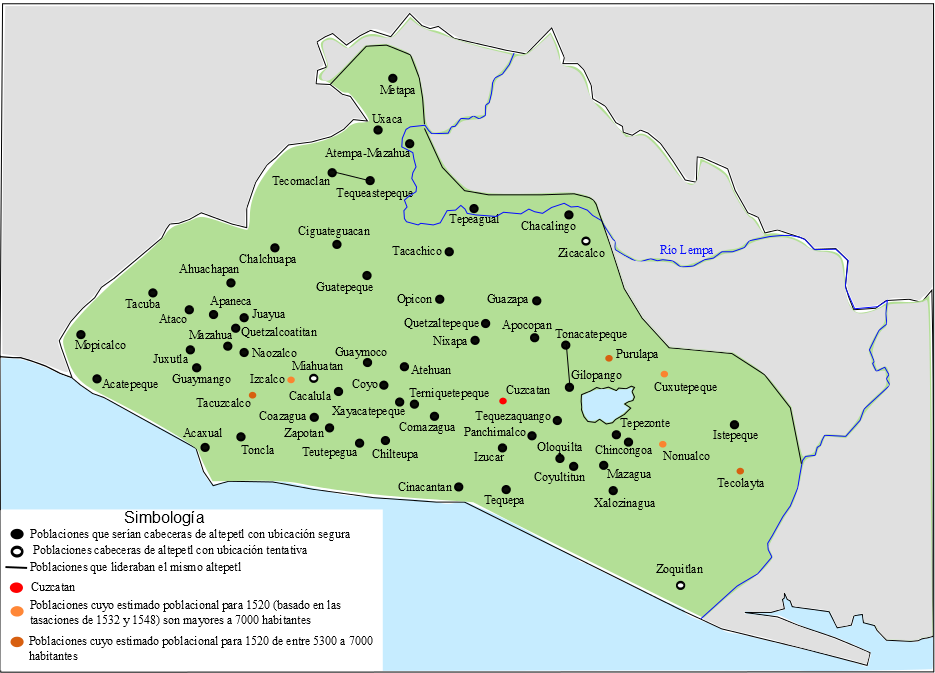
Cuzcatlan
The name meant "place of jewel necklaces." In the Nawat language, kuskat means necklace, kuzti means jewel, and tan means place -- so Kuskatan was the land where jewels gathered. The Spanish spelled it Cuzcatlan, and when Pedro de Alvarado's conquistadors arrived in 1524, they found not a disorganized scattering of villages but a powerful confederation of city-states stretching from the Paz River to the Lempa River across what is now western El Salvador. The Pipil people who built it had their own armies, their own lords, their own irrigation networks, and their own reasons to fight.
Toltec Exiles in a New Land
The Pipil were Nahua people -- linguistic cousins of the Aztecs -- who migrated south from central Mexico in waves beginning as early as the 10th century. They spoke Nawat, a language the Nahuatl-speakers of central Mexico considered a country dialect; the name "Pipil," usually translated as "boys" or "young nobles," may have originated as a condescending nickname from the Tlaxcala and Mexica allies who accompanied the Spanish. According to legend, the capital city of Cuzcatlan was founded around 1054 by the exiled Toltec leader Ce Acatl Topiltzin. The Pipil carried Toltec and Maya cultural influences south with them, building temples and practicing traditions that blended both civilizations. By the 13th century, the scattered city-states had begun to unify. By 1400, a hereditary monarchy governed the confederation, and Cuzcatlan had become the strongest military force in the region.
Jaguars, Eagles, and Cotton Armor
Every man in Cuzcatlan owed military service from roughly age 15 until he could no longer fight. Warriors painted their faces and bodies with distinctive abstract designs and organized themselves into named platoons -- the Jaguars, the Eagles, the Brave Owls. Their weapons were crafted from wood and volcanic rock: the tecuz, a lance that Pedro de Alvarado reported could reach 6.3 meters in length; the macuahuit, a wooden club edged with sharpened obsidian; bows and arrows; and the malacate, a sharpened stone disc for close combat. Most striking was their armor -- thick layers of quilted cotton that could deflect the throwing weapons of rival armies but proved useless against Spanish steel lances. Alvarado noted that when the cotton armor became waterlogged, it grew so heavy that warriors who were knocked down could not stand again.
Cacao, Indigo, and Gold for the Gods
The economy of Cuzcatlan ran on agriculture and trade. Cacao was cultivated with particular care in the Izalcos region and served double duty as both export crop and currency throughout the isthmus. Indigo, the deep blue dye, was another major commodity, requiring elaborate irrigation systems whose remnants are still visible today. Cotton, corn, beans, squash, balsam, and peppers rounded out the harvest. Chocolate, made from cacao, was reserved exclusively for the ruling class. Gold and silver were mined in modest quantities, but these metals were not currency -- they were offerings to deities like Quetzalcoatl, Xipe Totec, and Tlaloc, and only priests and the ruling family could wear them as ornaments. The confederation's wealth ultimately drew the attention of the Spanish, and the same fertile lands that sustained the Pipil would later fuel the colonial indigo and cacao export economy built on enslaved indigenous labor.
The Last Stand at Cinacantan
When Alvarado's forces arrived in 1524, Cuzcatlan's standing army met them in open battle. The Pipil warriors lost the first two engagements, and Alvarado entered the capital without resistance. The people initially offered gifts and service, but resistance continued. The legendary last lord, known as Atlacatl or Atacat, is said to have made a final stand at the stone fort of Cinacantan, killing many of Diego de Alvarado's horses and horsemen before the defense collapsed. Alvarado enslaved those Pipil he could capture. In the eastern zones, the Lenca people continued guerrilla resistance for another decade under their leader Lempira. The confederation of Cuzcatlan was finished, but the name endured. Today, Antiguo Cuscatlan is a municipality within the San Salvador Metropolitan Area, and Salvadorans still refer to their country by its pre-Columbian name -- a jeweled necklace broken by conquest but never entirely forgotten.
From the Air
The historical territory of Cuzcatlan covered approximately 10,000 square kilometers of western El Salvador. The approximate center is at 13.667N, 89.233W, near modern Antiguo Cuscatlan in the San Salvador Metropolitan Area. From the air, the region is defined by volcanic peaks, river valleys, and agricultural lowlands stretching from the Paz River on the Guatemalan border to the Lempa River in central El Salvador. Nearest airport is El Salvador International (MSLP). The archaeological site of Cihuatan, one of the confederation's absorbed city-states, lies north of San Salvador.