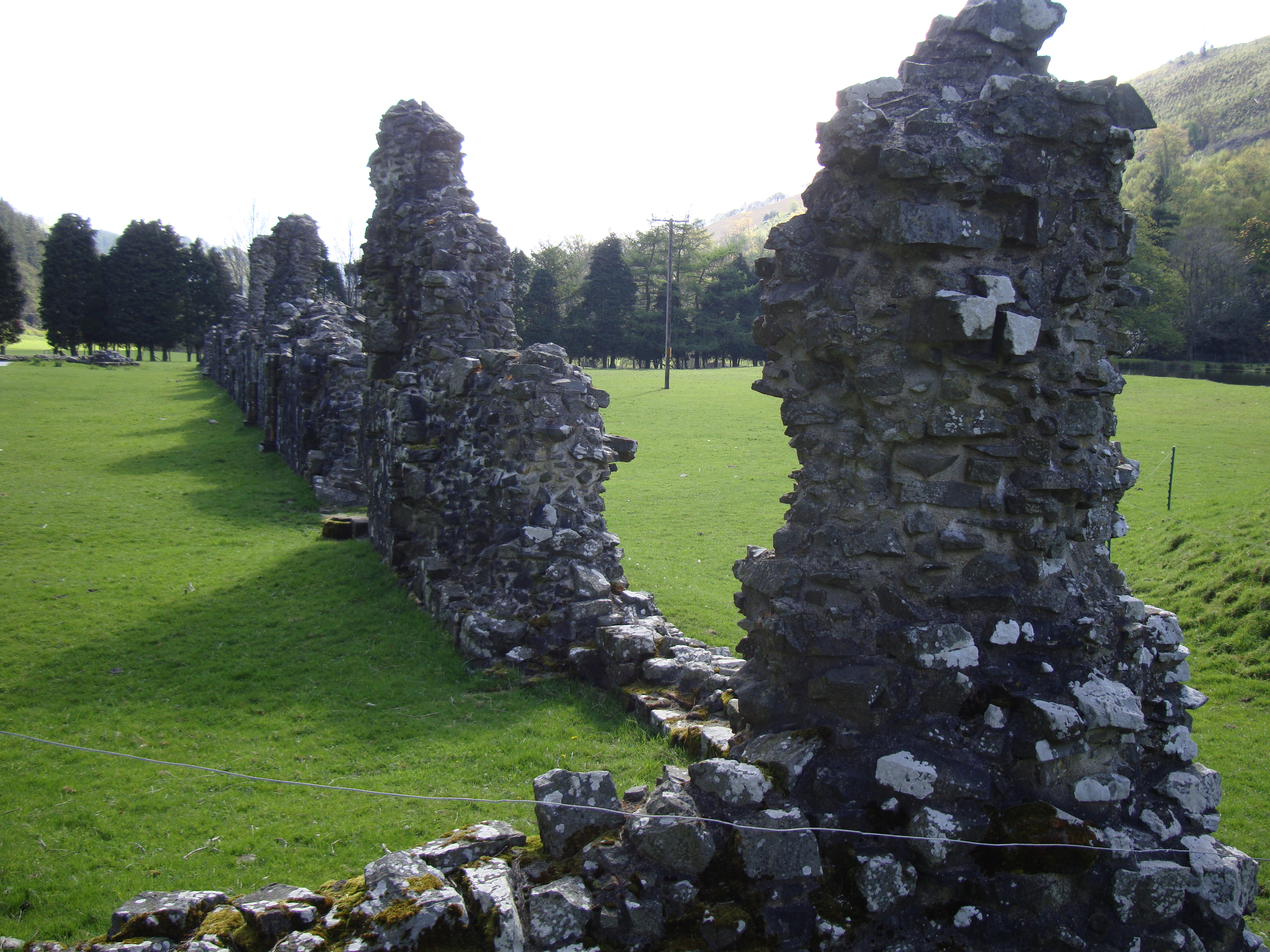
Cwmhir Abbey
Somewhere beneath the grass of a remote valley near Llandrindod Wells in Powys lies a headless body. It belongs, by tradition, to Llywelyn ap Gruffudd, the last native Prince of Wales by direct descent, killed in battle in December 1282. His head was sent to London, displayed on the Tower, and crowned with ivy in mockery. His body was carried to Cwmhir Abbey, a Cistercian monastery so entangled in Welsh resistance that it had been burned, fined, and garrisoned by the English long before it received its most famous occupant.
Blood Feud and Foundation
Cwmhir Abbey was founded in 1176 by Cadwallon ap Madog, the Welsh prince of Maelienydd. Just three years later, the English knight Roger Mortimer of Wigmore killed Cadwallon, setting off a blood feud between the Welsh house of Maelienydd and the Mortimer dynasty that would torment the abbey's monks for generations. The Mortimers made their own charter as lords of the region in 1200, but the princes of Gwynedd gave the monastery their counter-patronage, pulling it deeper into the politics of Welsh resistance. In 1231, the abbot was fined 200 pounds for helping Llywelyn ab Iorwerth destroy an English force near Hay-on-Wye. The monks paid the price for choosing a side.
A Cathedral That Never Was
In the early 13th century, probably under the patronage of Llywelyn ab Iorwerth -- Llywelyn the Great -- construction began on what would have been a spectacular abbey church, equal in scale to many a cathedral. The builders completed a fourteen-bay nave, a statement of ambition out of all proportion to the abbey's remote setting. But the project was abandoned before the church could be finished. Political upheaval and English military campaigns made sustained building impossible. The abbey had been designed to support 60 monks. By the time of the dissolution in 1536, only three remained.
The Last Prince's Grave
Llywelyn ap Gruffudd, grandson of Llywelyn the Great, was killed near Builth Wells on 11 December 1282, ending the line of native Welsh princes. His body was brought to Cwmhir for burial, though the circumstances remain murky -- the abbey was already a battered institution by then, having suffered English attacks twice in the 13th century. A modern grave slab now marks the spot in the nave where the prince is believed to lie, a simple monument to a man whose death extinguished Welsh sovereignty for centuries. The headless burial gives the ruin an emotional weight that larger, better-preserved castles and abbeys in Wales cannot match.
Dissolution, Destruction, Dispersal
The abbey closed in 1536 and passed to the Fowler family, who built a house on the site. During the English Civil War in 1644, that house and any surviving monastic structures were destroyed in the fighting. What little survived was excavated in the 19th century. Only fragmentary stretches of the nave walls remain visible today, the ghost outline of a church that was meant to be grand. But the abbey's legacy scattered further than the valley. In the parish church of St Idloes at Llanidloes, a series of 13th-century arches believed to have been taken from Cwmhir's abbey church were re-erected in 1542, transplanted fragments of a building that history would not allow to stand.
From the Air
Located at 52.33N, 3.39W in the valley of the Clywedog Brook near Abbeycwmhir village, Powys. The ruins are in a secluded valley surrounded by green hills -- look for the fragmentary walls and the adjacent village. Nearest airport: Shobdon Aerodrome (EGJA) approximately 20nm east. The terrain is hilly mid-Wales countryside. Recommended altitude: 2,000-3,000 ft. The site's remoteness is part of its character -- this is deep rural Wales.