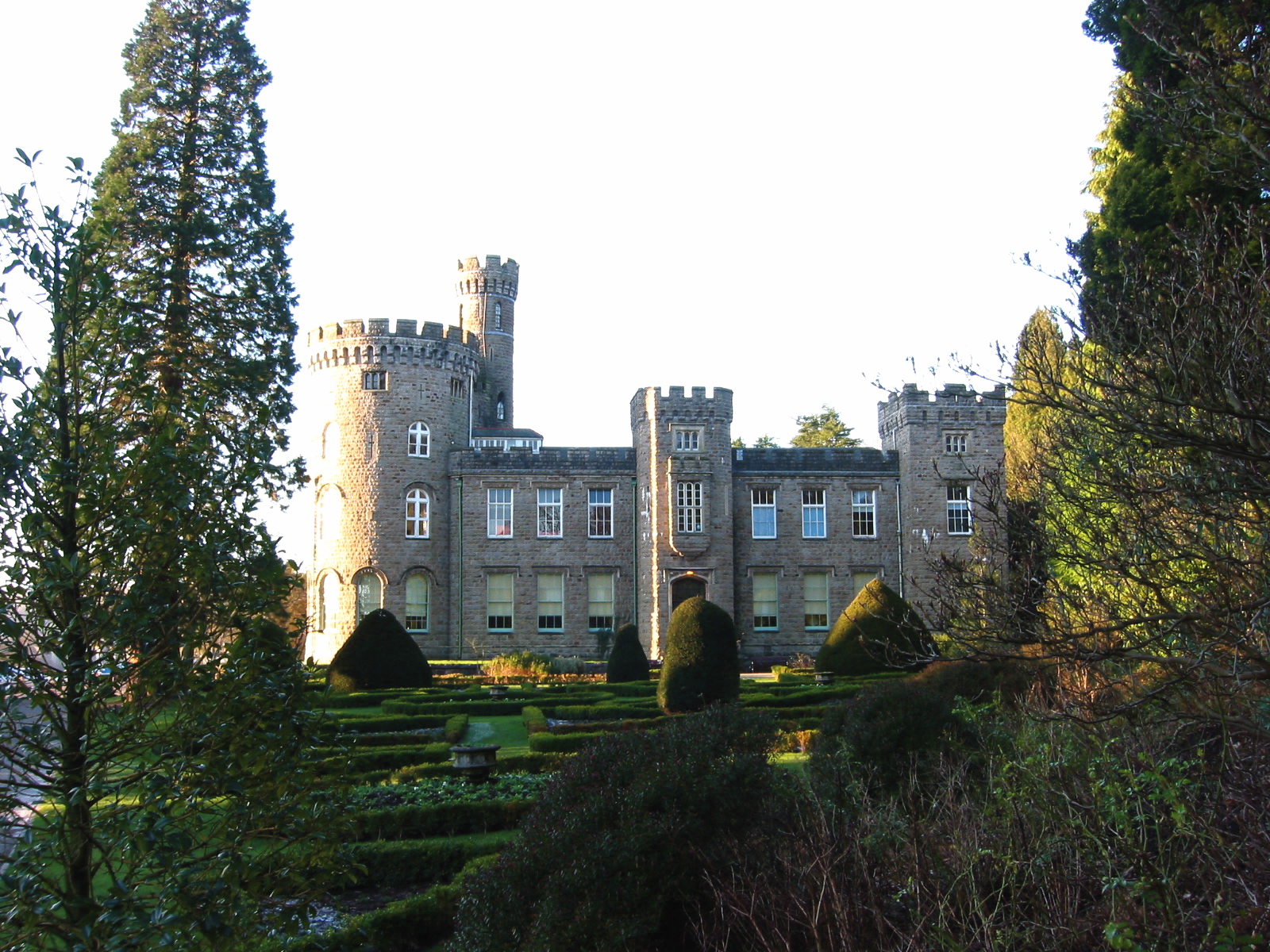
Cyfarthfa Castle
The view from Cyfarthfa Castle was the whole point. William Crawshay II built his seventy-two-room mansion on the hillside above Merthyr Tydfil specifically so he could look down on the Cyfarthfa Ironworks, which at night, as a contemporary observer noted, 'offer a truly magnificent scene, resembling the fabled Pandemonium, but on which the eye may gaze with pleasure.' The ironmaster gazed with pleasure. The workers in the furnaces below had a rather different perspective on the arrangement.
The Ironmasters' Folly
Designed in 1824 by architect Robert Lugar and completed the following year, Cyfarthfa Castle cost approximately 30,000 pounds, built from locally quarried stone. It has fifteen towers and seventy-two rooms, and despite its battlements and crenellations, it is not a castle at all. It is a mansion dressed in medieval costume, a fantasy of feudal authority built by a man whose real power came from iron and coal. The Crawshay family, originally from Yorkshire (hence the white rose on the entrance hall ceiling), had made their fortune in the Welsh iron industry, and Cyfarthfa was the largest ironworks in the world in the early nineteenth century. The cellars of the castle held over 15,000 bottles of wine and spirits: sherry, champagne, whisky, brandy, Madeira, and more than 7,500 bottles of port. Above ground, the workers of Merthyr Tydfil lived in some of the most squalid conditions in industrial Britain.
Rose Mary's Reign
The castle's most formidable resident was Rose Mary Crawshay, who married into the family in 1846 and presided over the household until her husband Robert Thompson Crawshay's death in 1889. Rose Mary was a suffragist, a philanthropist, and a woman of considerable intellect who hosted literary gatherings and championed women's rights from within the walls of a house built on industrial wealth. She lived until 1907 but chose to make her home elsewhere after Robert's death, as though the castle, stripped of its purpose as a seat of industrial power, no longer suited her either. The family's connection to Cyfarthfa had always been transactional: the castle existed to project authority over the works below. When the works declined, so did the need for the projection.
From Castle to Classroom
The castle was sold to the local council in 1908, and officials were initially unsure what to do with seventy-two rooms of faded industrial grandeur. Part of the ground floor became a museum, which still operates today in restored Regency rooms displaying family memorabilia, fine art, and social history collections. The rest of the building became a secondary school in 1913, later redesignated as Cyfarthfa Castle Grammar School in 1945 and then Cyfarthfa High School in 1970. The conversion required some architectural violence: smaller rooms were knocked together to create school halls, though the elegant entrance hall with its Gothic doors, tall pillars, and superb red glass windows survived largely intact.
158 Acres of History
The castle stands in 158 acres of parkland, now maintained by Merthyr Tydfil County Borough Council and listed on the Cadw Register of Parks and Gardens of Special Historic Interest in Wales. The park includes a miniature steam railway, a fishing lake, tennis courts, a nine-hole golf course, and the Canolfan Cyfarthfa conference centre. In 1997, the castle was briefly considered as a potential home for the new Welsh Parliament, which would have been an extraordinary irony: the seat of democracy housed in a monument to industrial autocracy. The proposal was rejected. Instead, the castle remains what it has been for over a century: a place where the wealth that iron built is preserved, examined, and remembered in a town that paid the human cost of that wealth.
From the Air
Located at 51.76N, 3.39W on a hillside above Merthyr Tydfil. The castellated mansion with its towers is visible amid 158 acres of green parkland. The town of Merthyr Tydfil lies in the valley below. Cardiff Airport (EGFF) is approximately 25 miles to the south. Best viewed at 2,000-3,000 feet, where the relationship between the castle on the hill and the former ironworks site in the valley is clearly visible.