Cypress Lawn Memorial Park
Colma, California, calls itself the "City of the Silent," and for good reason: the dead outnumber the living by a ratio of roughly a thousand to one. Cypress Lawn Memorial Park is one of the cemeteries that created this remarkable demographic, established in 1892 by Hamden Holmes Noble, a Civil War veteran who moved to California in 1865 and traded the San Francisco Stock Exchange for the burial business. Noble received his permit to establish a non-sectarian cemetery on March 9, 1892, and Cypress Lawn has been receiving San Francisco's departed ever since -- a consequence of the city's decision, beginning in the early 1900s, to remove its cemeteries and ban new burials within the municipal limits.
A Veteran's Enterprise
Noble's path from Civil War service to cemetery founder traced the arc of many 19th-century California careers: westward, opportunistic, and ultimately permanent. He arrived in California in 1865, the year the war ended, and built a career on the San Francisco Stock Exchange before recognizing an opportunity in a market with guaranteed demand. The rural cemetery movement, which had been reshaping American burial practices since the 1830s, offered a model: landscaped grounds that combined memorialization with park-like beauty, a place where the living could visit the dead amid trees, lawns, and sculpture. Noble designed Cypress Lawn to be both a business and a beautiful space.
San Francisco Sends Its Dead South
Cypress Lawn's growth was driven by San Francisco's unique relationship with its own mortality. As the city expanded in the early 20th century, its Victorian-era cemeteries -- scattered through what are now residential neighborhoods -- were deemed obstacles to development and public health risks. Beginning with the Odd Fellows Cemetery in 1901, San Francisco systematically exhumed and relocated its dead to cemeteries in Colma, a small town just south of the city line. Cypress Lawn and its neighboring cemeteries became the beneficiaries of this mass relocation. The headstones that once dotted Lone Mountain and the Richmond District were transported south, joining new burials in Colma's expanding grounds.
The Roster of the Dead
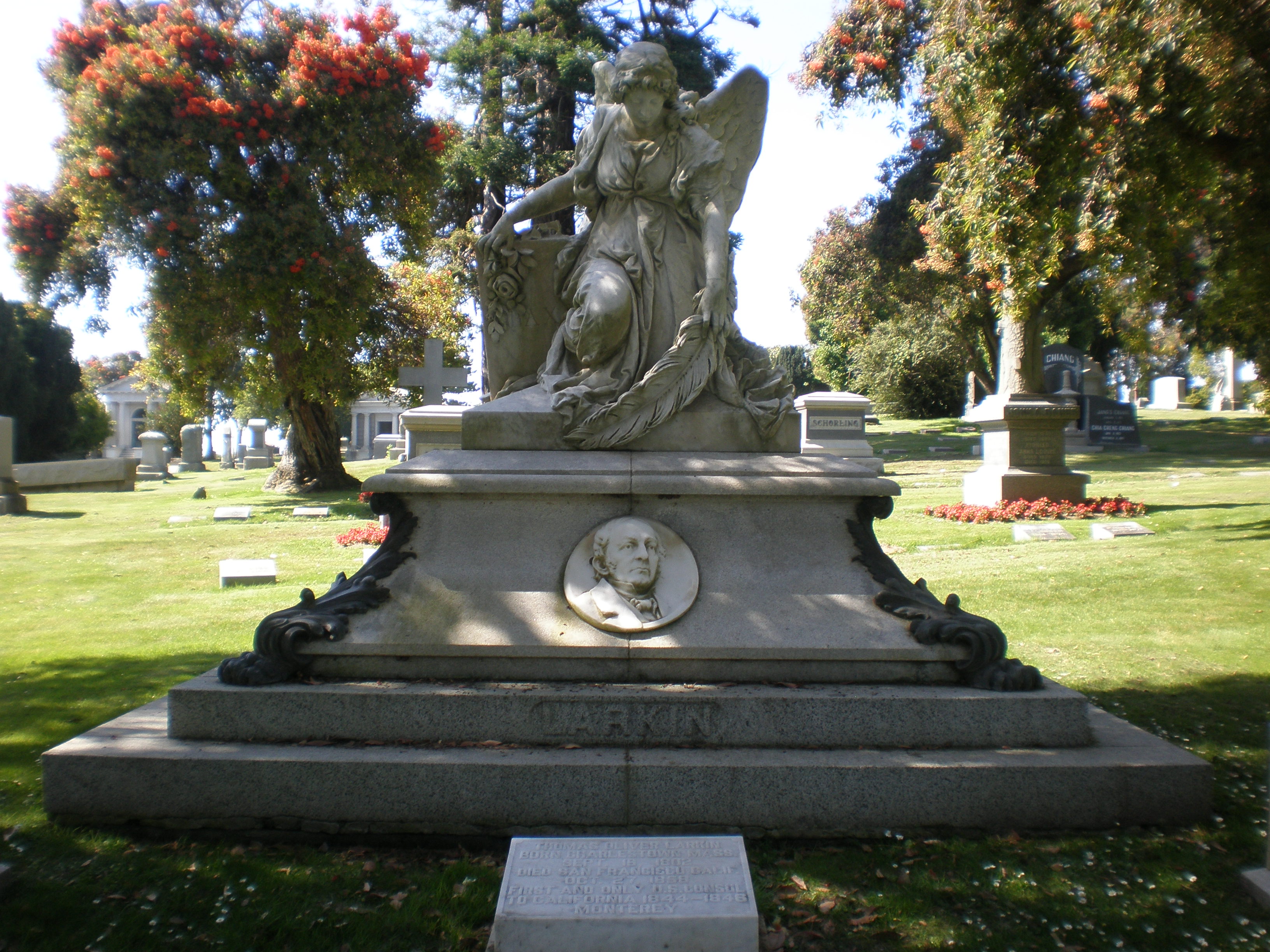
Cypress Lawn's burial rolls read like a directory of California power. Phoebe Hearst, mother of William Randolph Hearst, rests in an ornate family mausoleum. Thomas O. Larkin, the last U.S. Consul to Mexican California, lies here. Lefty O'Doul, the beloved baseball player and restaurateur, has his own headstone. The cemetery holds San Francisco mayors, Gold Rush pioneers, industrialists, and the quietly anonymous thousands who built the city without getting streets named after them. The grounds span two campuses with architecture that ranges from modest granite markers to elaborate mausoleums featuring stained glass and bronze doors.
The City of the Silent
Colma's identity as a necropolis is not metaphorical. The town was essentially founded to receive San Francisco's dead, and the cemeteries -- Cypress Lawn, Holy Cross, Hills of Eternity, Home of Peace, and others -- occupy the majority of its land area. Cypress Lawn's manicured grounds, with their rolling lawns, heritage trees, and winding roads, offer a pastoral counterpoint to the dense urban grid just a few miles north. For those who visit, the experience is less somber than expected: the cemetery functions as a park, a sculpture garden, and a history lesson, all maintained with the meticulous care that only guaranteed perpetual-care endowments can sustain.
From the Air
Located at 37.67°N, 122.458°W in Colma, California, just south of the San Francisco-Daly City border. The large, tree-covered cemetery grounds are visible from the air as green space amid the suburban development south of San Francisco. Best viewed at 2,000-4,000 feet AGL. Nearest airport: KSFO (San Francisco International, 4 nm south). Look for the cluster of green cemetery parcels along El Camino Real in Colma.