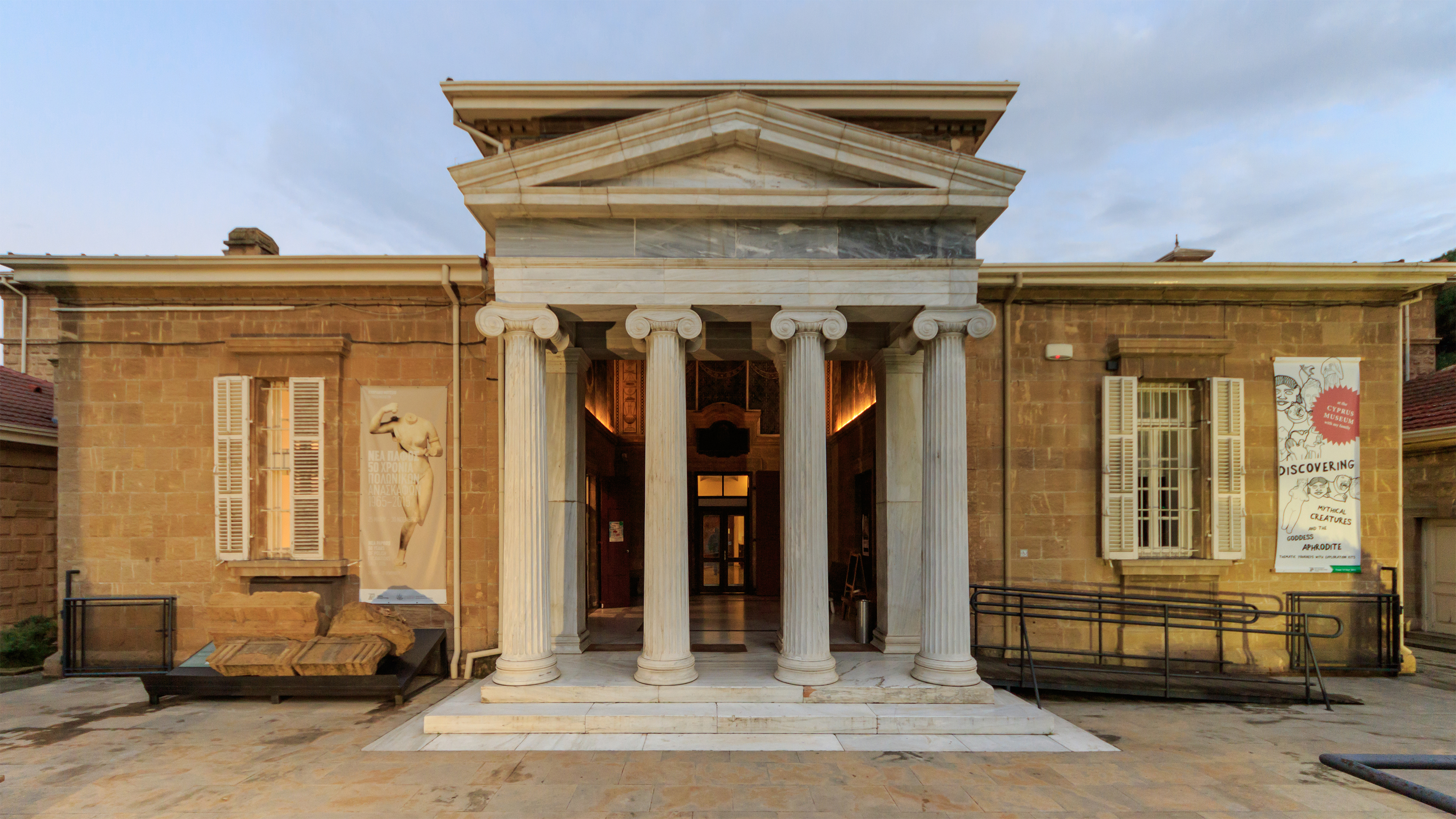
Cyprus Museum
In the 1870s, the United States Consul in Cyprus walked off the island with more than 35,000 antiquities. His name was Luigi Palma di Cesnola, and most of what he took ended up in the Metropolitan Museum of Art in New York, where his Cypriot galleries still occupy the second floor. A great deal of what he loaded onto ships was destroyed in transit. The Cypriots noticed. In 1882, four years after the British takeover from the Ottoman Empire, a delegation led jointly by Christian and Muslim religious leaders presented the new colonial administration with a petition asking for a museum on the island, so that the next ambassador to take an interest would not be able to ship the place away by the trunkful.
A Petition Across Religions
What is striking about the founding petition is who signed it. The delegation was led by the religious heads of both communities on the island - Greek Orthodox Christian and Sunni Muslim - presenting a single demand to the British administration. Cyprus had spent three centuries under Ottoman rule before the British took over in 1878 under the Cyprus Convention, and on most political questions the two communities had reasons to disagree. Cesnola's plundering, though, was a problem they shared. The artifacts he hauled off had been pulled out of Bronze Age sanctuaries, classical temples, and Byzantine cemeteries belonging to ancestors of Cypriots living and dead, regardless of who worshipped where now. The British administration agreed to the museum. Funding came from private donations at first, with the institution housed temporarily in government offices until 1889, when it moved into its own building on Victoria Street inside the medieval walls of Nicosia.
A Building Funded by Subscription
The current museum on Museum Street took sixteen years to build. Construction began in 1908, financed by public money and private subscriptions, and was completed in 1924. The architect was N. Balanos, of the Archaeological Society of Athens - the same Balanos who would spend much of his career on the restoration of the Parthenon. Construction was supervised by George H. Everett Jeffery, the museum's curator, who had also written the standard architectural survey of historic Nicosia. The original dedication was to Queen Victoria, dead since 1901 but still loomed large over the colonial imagination. In 1961, a year after Cypriot independence, a second wing was added with new galleries, storerooms, and offices. The plan is symmetrical and disciplined: fourteen display halls arranged around a square central core that holds the offices, library, storerooms, and conservation laboratories. Visitors move chronologically and thematically, beginning in the Neolithic and ending in the Roman period.
From Picrolite Figurines to a Goddess in Cement
Gallery 1 holds the oldest pieces: cruciform figurines carved from picrolite, a soft blue-green serpentine stone, made by Chalcolithic Cypriots between roughly 3000 and 2500 BC. They are small enough to wear as pendants and are believed to have been used that way. The collection grew in fits and starts. The first organized catalogue was published in 1899 by Sir John Myres and the German archaeologist Max Ohnefalsch-Richter. The most important systematic excavations, however, were carried out between 1927 and 1931 by the Swedish Cyprus Expedition under Einar Gjerstad, which surveyed dozens of sites across the island and dramatically expanded what the museum could display. The institution publishes only artifacts found on Cyprus itself: a deliberate boundary, drawn early, that distinguishes it from the great encyclopedic museums of Europe. If you want to see Greek, Egyptian, or Roman material from elsewhere, go to Athens or London or Berlin. If you want to see Cyprus, this is where its things are.
The Limits of the Building
The collection has long since outgrown the building. Only a small fraction of what the museum holds is on display at any given time, and ongoing excavations across the island keep producing finds that need somewhere to go. Recent decades have seen a deliberate decentralization, with district museums in Larnaca, Limassol, Paphos, and other towns taking custody of material from local digs that used to be funneled to Nicosia. Even so, the Cyprus Museum remains the principal showcase for everything found before independence in 1960 and the major recent acquisitions. Plans for a relocation have been floated for years - the demolished Nicosia Old General Hospital site has been suggested, as has a new cultural complex at the old GSP stadium - but no successor building has yet been chosen. The 1908-1924 structure on Museum Street, with its colonial-classical façade and its Balanos symmetry, continues to do the work it was built for: keeping the things Cesnola did not get.
From the Air
Coordinates: 35.1717 N, 33.3553 E. Suggested viewing altitude 1,500-3,000 ft AGL over central Nicosia. The museum sits on Museum Street just outside the Venetian walls of the old city, near the southwestern bastion. The walled city's distinctive star-shaped fortification, with its eleven heart-shaped bastions, is the obvious landmark from above; the museum building lies west of the walls and north of the Green Line dividing the Republic of Cyprus from the northern Turkish-administered area. Nearest airport: Larnaca International (LCLK), about 45 km southeast. Ercan (LCEN) lies in the north. Nicosia airspace has restrictions related to the buffer zone; consult NOTAMs.