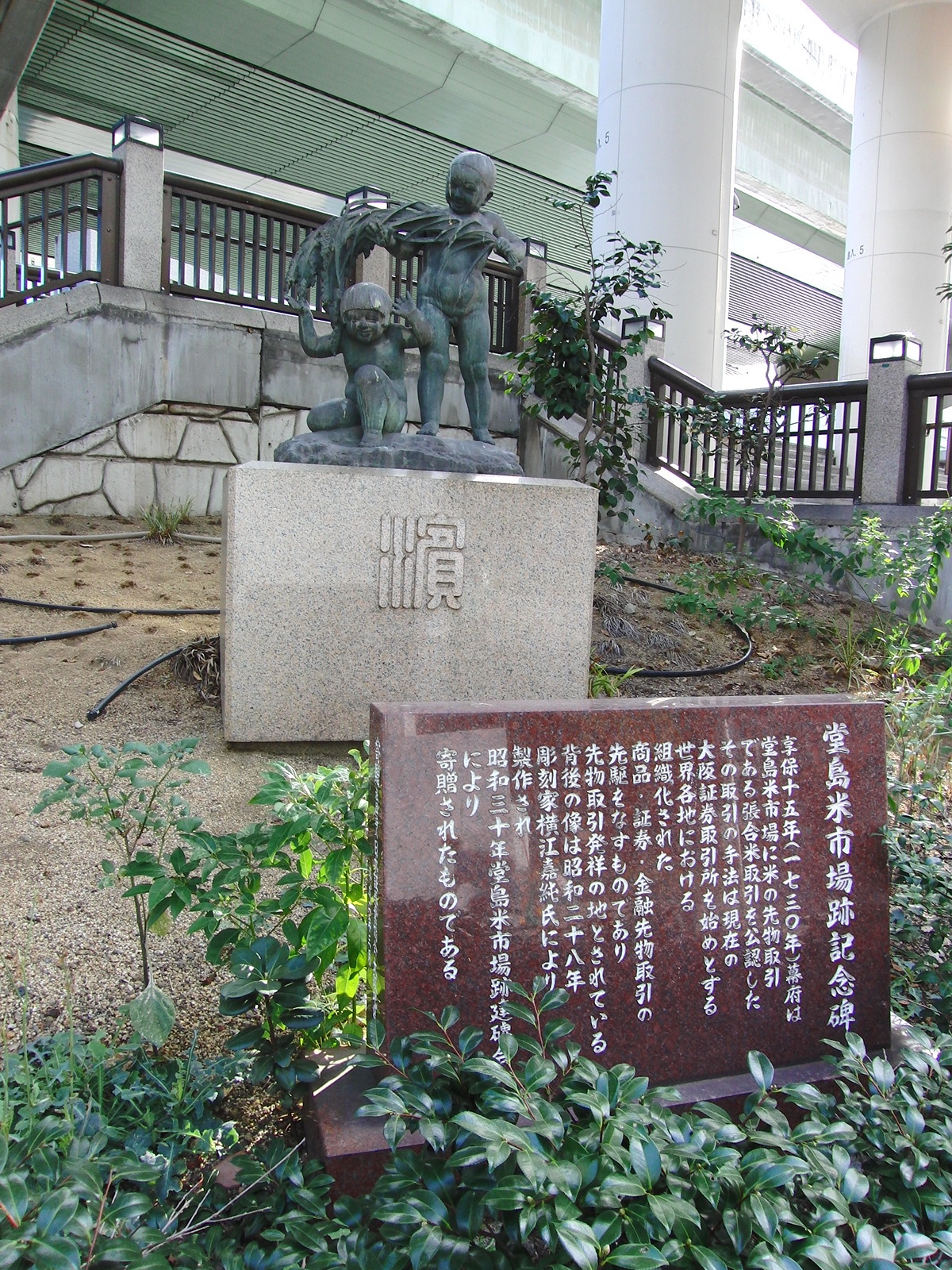
Dojima Rice Exchange
Long before the Chicago Board of Trade opened its doors, before the London Stock Exchange formalized its rules, a cluster of warehouses along a canal in Osaka was quietly inventing the future of finance. The Dojima Rice Exchange, established in 1697 during the prosperous Genroku era, was not merely a place to buy and sell rice. It was the world's first organized futures market, a place where merchants traded contracts for rice that had not yet been harvested, where prices set in Osaka rippled outward by courier and flag signal to reach the capital hundreds of kilometers away, and where a class of businessmen supposedly ranked at the bottom of the social order held the entire Japanese economy in their hands.
When Rice Was Currency
To understand Dojima, you must understand that Edo-period Japan ran on rice. Samurai, from low-ranking retainers to powerful daimyo feudal lords, received their income not in coin but in bales of rice. This created a fundamental problem: a warrior class paid in grain needed merchants to convert that grain into the money required for daily life. Rice brokers and moneychangers, known as ryogaesho, gathered their shops and warehouses in the Dojima district of Osaka during the late 17th century, and by 1697 they had received an official license from the Tokugawa shogunate to operate as an exchange. These merchants occupied the lowest rung of the neo-Confucian class system, yet they controlled a financial infrastructure that the ruling classes could not function without.
The Birth of Futures Trading
Around 1710, Dojima's merchants introduced a revolutionary concept: trading in futures, called nobemai. Rather than exchanging physical rice, traders began buying and selling contracts for rice to be delivered at a future date, with transactions recorded and settled in books of accounts. This was derivatives trading in all but name, developed independently in Osaka centuries before similar instruments appeared in Western markets. In 1730, the shogunate officially authorized both a spot market for rice bills and a futures market for representative brands of rice. Prices formed at Dojima were disseminated across the country by networks of couriers and hilltop flag signals, making the exchange the beating heart of Japan's national economy. The Chicago Board of Trade, often cited as the world's preeminent futures exchange, is said to have been developed based on principles that originated at Dojima.
The Rice Shogun's Dilemma
In the early 1730s, poor harvests and trade disruptions sent rice-to-coin exchange rates plummeting. Samurai panicked as the purchasing power of their rice stipends collapsed, while speculators hoarded vast stores of grain in warehouses to manipulate prices. In 1733, riots called uchikowashi erupted across Osaka as ordinary people starved and brokers profited. The shogunate responded by setting price floors: in Edo, merchants could sell no less than one ryo per 1.4 koku of rice; in Osaka, no less than 42 momme per koku. Shogun Tokugawa Yoshimune intervened so repeatedly in the rice economy over the following years that he earned the nickname Kome Shogun, the Rice Shogun. His attempts at reform inadvertently destabilized the broader economy, and his monetary policies, while solving some rice-market problems, led to debasement of the currency.
Bankers Before Banks Existed
By the time the shogunate re-established the Rice Exchange under government sponsorship in 1773, prompted by another wave of famine-driven riots, the merchants of Dojima had become indispensable. They stored rice for most of the nation's daimyo, exchanging it for paper money they themselves had created. They managed what were effectively bank accounts for samurai and feudal lords, handling deposits, withdrawals, loans, and even tax payments. An extraordinary proportion of Japan's monetary transactions flowed through these private, independent merchants. The shogunate recognized both the power and the danger of leaving exchange rates, monetary standards, and paper currency in the hands of a merchant class that was growing wealthier and more influential with each passing decade.
Dissolution and Legacy
Reorganized during the sweeping reforms of the Meiji period, the Dojima Rice Exchange was formally dissolved in 1939, absorbed into the Government Rice Agency as Japan's wartime economy centralized control over food distribution. But Dojima's legacy extends far beyond rice. The trading rules, clearing practices, and market structures developed in those Osaka warehouses were carried forward into commodity, equity, and financial futures exchanges around the world. Today, a monument marks the site in Osaka's Kita-ku district, and the Osaka Dojima Exchange continues to operate as a modern commodity exchange. The men who gathered along that canal more than three centuries ago, buying and selling contracts for grain that had not yet grown, had unknowingly written the first chapter of global financial markets.
From the Air
Located at 34.6952°N, 135.4987°E in Osaka's Kita-ku business district, along the north bank of the Dojima River (Dojima-gawa) near its confluence with the Tosabori River. From the air, the site sits in the dense commercial core of northern Osaka, roughly midway between Osaka Station and Nakanoshima island. Osaka Itami Airport (RJOO) is approximately 11 km to the north-northwest, and Kansai International Airport (RJBB) is about 42 km to the southwest. The river network running through central Osaka provides the best aerial reference for locating this historic site.