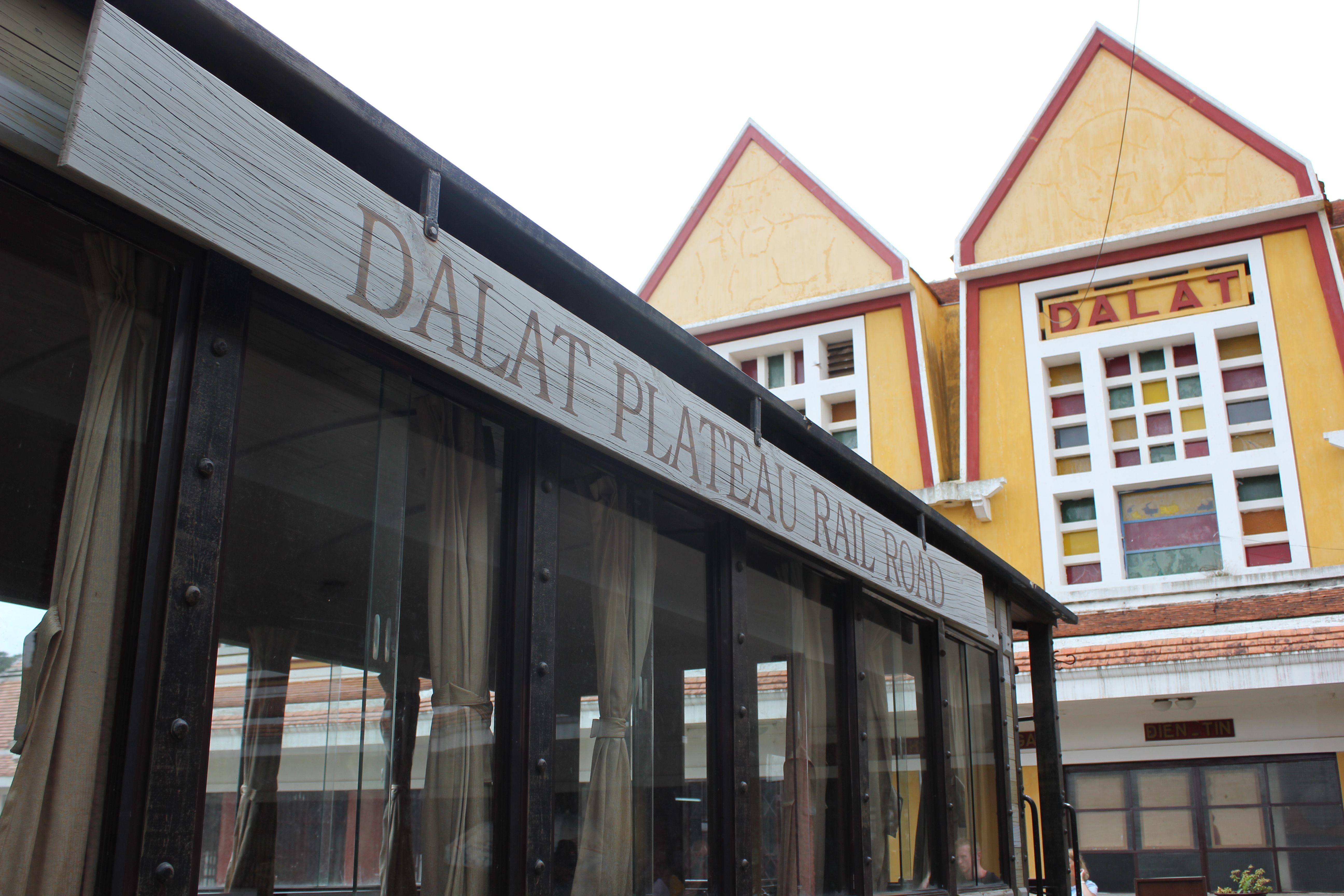
Da Lat–Thap Cham Railway
It took thirty years to build and a war to destroy. The Da Lat–Thap Cham railway, an 84-kilometer rack line threading through five tunnels and some of the steepest terrain in Southeast Asia, once carried passengers from the coastal lowlands of Ninh Thuận Province up into the cool pine forests of Da Lat at 1,500 meters. Swiss engineers brought their Alpine expertise to the project. French colonial ambition supplied the funding—200 million francs. The Vietnamese jungle provided the challenge. When the last regular train ran in 1968, sabotaged and bombed into irrelevance during the Vietnam War, the line had been operating for barely thirty-six years. Today, a short tourist segment rattles along restored track near Da Lat station, a reminder of the full journey that once was.
A Governor-General's Grand Vision
The railway began as one thread in an enormous web. Paul Doumer, Governor-General of French Indochina from 1897 to 1902, arrived with plans to lace the colony with rail lines: Haiphong to Kunming across the Chinese border, Hanoi to Saigon along the coast, branch lines reaching into Laos and Cambodia. Most of these connections were never completed—only 17 kilometers of the planned Laotian line were built before construction was abandoned. But the link between the highland resort city of Da Lat and the main North–South railway at Tháp Chàm did get built, approved in 1898 at a cost that would strain even colonial budgets. Da Lat was becoming the summer retreat of choice for French administrators escaping the lowland heat, and a railway would transform the city from a remote mountain outpost into an accessible hill station.
Climbing the Mountains with Swiss Precision
The terrain between the coast and Da Lat demanded engineering that conventional railways could not provide. The line needed to climb from near sea level to over 1,500 meters in just 84 kilometers, through mountains dense with tropical forest. Swiss engineers, veterans of Alpine rack-and-pinion construction, were hired to solve the problem. Initial surveys began in 1898, and track-laying on the first section—from Tháp Chàm to Sông Pha—started in 1908. By 1913 trains were running to Tân Mỹ, and the full 41-kilometer lowland section opened in 1919. The mountain section from Sông Pha to Da Lat, with its three rack-rail segments and five tunnels, took another thirteen years. The line finally opened in 1932. Its steam locomotives came from the Swiss manufacturer SLM Winterthur—nine machines delivered between 1924 and 1930, numbered 301 through 309, each generating 600 to 820 horsepower to haul cars up gradients that would defeat any adhesion locomotive.
War, Scrap Metal, and Silence
The railway's working life was bookended by conflict. Four of the nine Swiss-built locomotives were destroyed during the Japanese occupation of Indochina in World War II. In 1947, four replacement locomotives were acquired from Switzerland's Furka-Oberalp company, which had recently electrified its own lines. But the Vietnam War proved far more destructive than the Japanese occupation. The Viet Cong targeted the line with sabotage and mining, and as fighting intensified, regular service ended in 1968. After reunification, the new government needed materials to repair the main North–South line, and the Da Lat–Tháp Chàm railway was dismantled for parts. What could not be reused was sold as scrap metal. Eighty-four kilometers of track, five tunnels, and three decades of construction were reduced to salvage in a matter of years.
What the Station Remembers
Da Lat station survived the dismantling. Its Art Deco design—arching ceilings, colored-glass windows, and sweeping rooflines echoing the peaks visible from its platform—earned recognition as a national historical monument in 2001. A short section of restored track now runs from the station to the nearby village of Trại Mát, roughly seven kilometers, operated as a tourist attraction with refurbished rail cars. The ride offers a glimpse of what the full journey once felt like: the slow climb through pine forest, the mountain air cooling as altitude increases, the sense of leaving the modern lowlands behind for something older and quieter. Several other stations along the original route share a similar architectural style, standing now as isolated monuments along a path that no longer connects them.
The Dream of Restoration
Provincial and local governments have backed proposals to restore the entire Da Lat–Tháp Chàm line, envisioning both passenger service and light cargo transportation. The economics are daunting—a tourist train line through remote mountains is unlikely to pay for itself, and the project would require full central government funding. From the air, the old route is still legible in places: cleared strips through the forest, tunnel portals half-swallowed by vegetation, the geometry of switchbacks visible where the line once zigzagged up the steepest slopes. Whether the railway will ever run again remains uncertain. But the landscape holds the memory of the route, carved into the mountainside by Swiss engineers more than a century ago, waiting for the trains that may or may not return.
From the Air
The railway route runs from Tháp Chàm (near Phan Rang, 11.58°N, 108.95°E) up to Da Lat (11.94°N, 108.46°E) at approximately 1,500 m elevation. Da Lat station is the key visual landmark. The route crosses mountainous terrain with visible switchbacks and tunnel portals. Nearest airports: Lien Khuong Airport (VVDL) near Da Lat, and Cam Ranh International Airport (VVCR) on the coast. Best viewed at lower altitudes to trace the old railbed through the highlands.