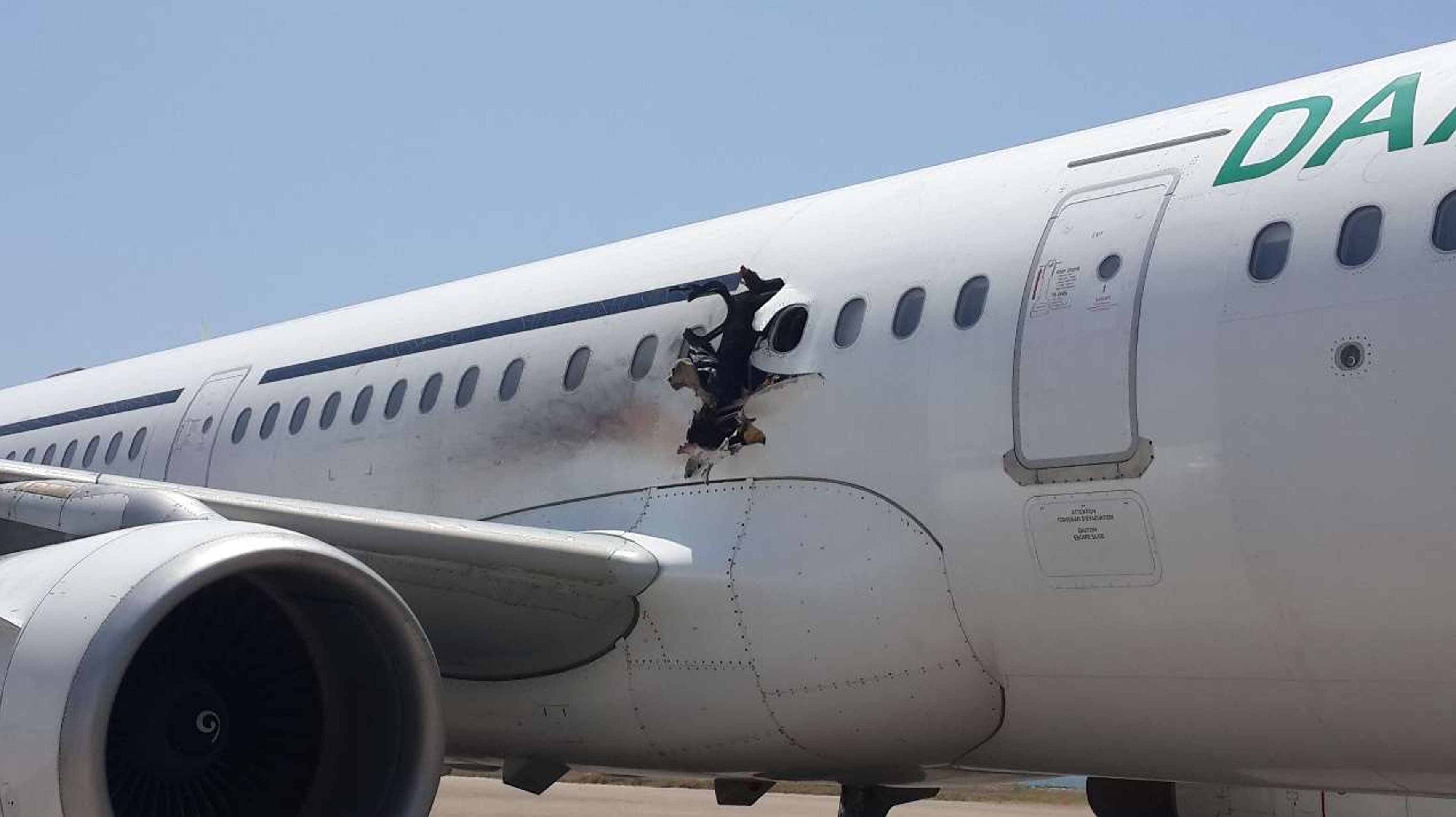
Daallo Airlines Flight 159
Twenty minutes late saved eighty lives. On February 2, 2016, Daallo Airlines Flight 159 pushed back from Aden Adde International Airport in Mogadishu bound for Djibouti City with 74 passengers and 7 crew aboard its Airbus A321. The flight had been delayed waiting for additional passengers to board -- a routine annoyance that would prove to be the difference between a survivable emergency and catastrophe. At roughly 11:00 local time, climbing through 14,000 feet, an explosion tore a hole in the fuselage behind the right rear door. Had the aircraft been at cruising altitude, where the pressure differential between cabin and atmosphere is far greater, the structural failure could have been unsurvivable. Instead, the crew brought the wounded jet back to the runway it had left minutes before.
The Blast at Fourteen Thousand Feet
The bomb detonated near seats 15 and 16F, abeam the forward wing root and perilously close to the fuel tanks. The explosion ripped open the fuselage skin and a passenger -- later identified as the bomber himself -- was ejected through the hole. His body was found by residents on the ground below. Inside the cabin, flight attendants moved quickly, shepherding passengers to the rear of the aircraft to redistribute weight away from the compromised section. The Serbian captain, Vlatko Vodopivec, contacted Mogadishu tower and reported a pressurization problem. He did not formally declare an emergency. Instead, he turned the damaged A321 back toward the airport and executed what would later be described as a remarkably composed emergency landing. Every remaining soul on board survived.
A Cancelled Flight and a Diverted Plot
The bomber had never intended to be on this aircraft. According to Daallo Airlines CEO Mohamed Ibrahim Yassin Olad, the man and 69 other passengers had originally been booked on a Turkish Airlines flight that morning. Bad weather cancelled the Turkish Airlines departure, and the passengers were rerouted onto the Daallo service to Djibouti for onward connection. The Islamist militant group Al-Shabaab later claimed responsibility, stating that Turkish Airlines had been the intended target because Turkey, as a NATO member, supported Western operations in Somalia. The rerouting put the bomb on a smaller flight operating a different schedule -- and that schedule's twenty-minute delay kept the aircraft low enough to survive what might otherwise have been a fatal decompression.
A Laptop, a Wheelchair, and a Broken System
Investigators found traces of explosive residue on the airframe and determined the device had likely been concealed inside a laptop computer. CCTV footage from the airport later showed airport workers handling the laptop before it was brought aboard. Somali authorities identified the bomber as Abdullahi Abdisalam Borleh, a 55-year-old teacher from Mogadishu. Though security agencies had monitored Borleh, they had never considered him dangerous. Captain Vodopivec, in a blunt interview with the Associated Press, described Mogadishu airport security as nonexistent: "When we park there, some 20 to 30 people come to the tarmac. No one has a badge or those yellow vests. They enter and leave the aircraft, and no one knows who is who." The investigation ultimately revealed the plot had been enabled from the inside -- a former airport security official and a financier were among those who facilitated it.
Justice and Defiance
On May 30, 2016, a Somali military court convicted two men of masterminding the attack and sentenced them to life in prison. One was a former airport security official; the other, who had financed the operation, was tried in absentia after evading arrest. Eight additional airport workers -- security screeners, a police officer, a porter, and immigration officers -- received sentences ranging from six months to four years for their roles in smuggling the device aboard. The convictions laid bare how deeply the plot had penetrated airport operations. Yet Daallo Airlines refused to retreat. "We have been there for 25 years," CEO Olad said. "Our efforts to keep Somalia linked to the rest of the world will continue." For a country where air travel is often the safest way to move between cities, that commitment carried weight beyond corporate defiance.
What Twenty Minutes Means
Flight 159 occupies a rare category in aviation history: a successful bombing that failed to destroy its target. The physics are straightforward. At 14,000 feet, the pressure difference between the cabin interior and the outside atmosphere is modest enough that a breach, while dangerous, does not produce the explosive decompression that occurs at 35,000 feet or higher. The delay that kept the aircraft low was nothing more than the ordinary friction of a busy airport in a difficult country -- passengers arriving late, logistics catching up. Vodopivec later reflected that had they departed on time, the aircraft would have been at cruising altitude when the bomb went off. The outcome would almost certainly have been different. It is a reminder that in aviation, as in much of life, the margin between disaster and survival can be measured in minutes.
From the Air
Located at 2.24N, 45.29E near Aden Adde International Airport (HCMM), Mogadishu. The incident occurred during climb-out over the Mogadishu coastline. Nearby airports include Mogadishu (HCMM) and Djibouti-Ambouli (HDAM), the intended destination. Best viewed at 5,000-10,000 ft AGL over Mogadishu's coastal strip. The Indian Ocean coastline and urban sprawl of Mogadishu are the primary visual landmarks.