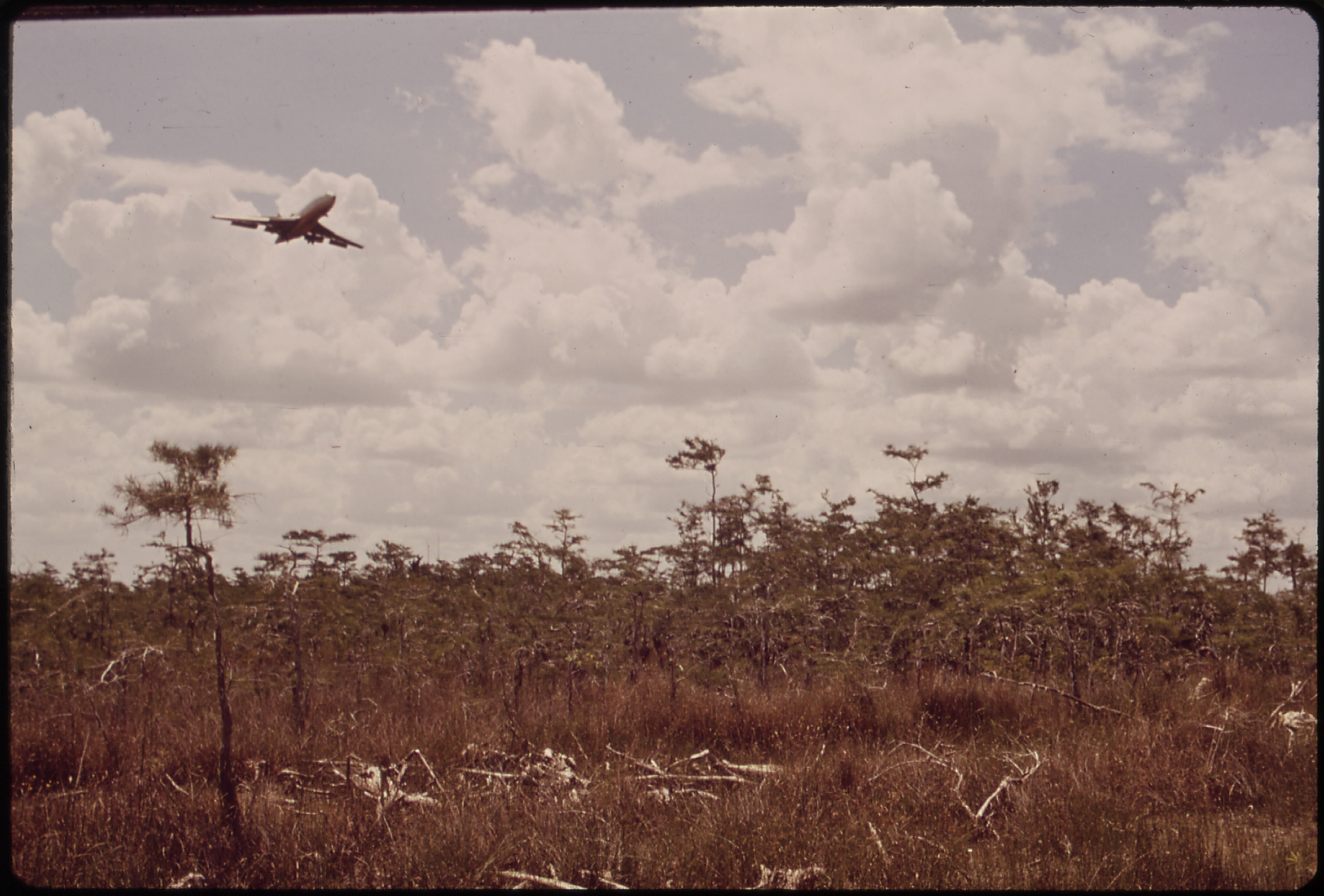
Dade-Collier Training and Transition Airport
In the late 1960s, someone looked at the Florida Everglades and saw the future of aviation: a 39-square-mile airport with six runways, designed to handle supersonic transports that would link Miami to the world. The Boeing 2707 was under development. Concorde was taking shape in Europe. South Florida seemed ideal because supersonic aircraft needed to fly over water, and the swamp was available. They broke ground in 1968, built one runway, triggered one of the fiercest environmental battles in American history, and stopped. Today, a single 10,500-foot strip of asphalt sits in the middle of the Big Cypress wilderness - the Dade-Collier Training and Transition Airport, ICAO code KTNT, a monument to the future that never arrived.
The Supersonic Dream
The Everglades Jetport, as it was originally known, was conceived when supersonic commercial aviation seemed inevitable. Boeing was developing the 2707, a Mach 2.7 transport that would carry 300 passengers. South Florida's geographic position - water to the east, south, and west - made it a natural SST hub, since sonic booms prohibited supersonic flight over populated land. The planned airport would have been the largest in the world: 39 square miles, six runways, connected to central Miami and the Gulf of Mexico by expressways. It was a vision of staggering ambition. Construction began in 1968 on a single runway in the Big Cypress Swamp, deep in the Everglades wilderness of Collier County.
The Swamp Fights Back
A 1969 federal scientific advisory report delivered the verdict: the jetport would permanently disrupt the region's hydrology and threaten the entire South Florida ecosystem, including Everglades National Park. Environmental groups mobilized. The report stated bluntly that the project would destroy the South Florida ecosystem. The resulting political battle produced the Everglades Jetport Pact, and in 1970, all construction halted after the completion of just one runway - 10,500 feet of asphalt, oriented 9/27, sitting on 24,960 acres of swamp. The Boeing 2707 program was cancelled the following year. The land surrounding the runway eventually became the Big Cypress National Preserve, and the jetport that was supposed to reshape global aviation became a footnote in the story of American environmentalism.
Pan Am's Training Ground
The abandoned runway found a second life. In the 1970s, Pan Am and Eastern Airlines used Dade-Collier heavily for commercial pilot training. The 10,500-foot runway could accommodate Boeing 747s, and its relatively new instrument landing system let pilots practice approaches in simulated low-visibility conditions. The airport's isolation was its greatest asset - training flights could operate around the clock, 365 days a year, without interfering with traffic at Miami International. For a generation of airline pilots, this remote Everglades strip was where they learned to land the biggest aircraft in the world. The advent of flight simulators eventually made such training flights less economical, and commercial use declined, though the airport remains open to general aviation.
A Runway in Search of a Purpose
Over the decades, the long, lonely runway has attracted an eclectic roster of uses. High-speed automobile events have been held on the pavement. Oil exploration was proposed in 2009 but dropped after conservation groups objected. The Carlos Gimenez administration floated the idea of a regular Miami air show at Dade-Collier, modeled on the Paris Air Show - Homestead Air Reserve Base had been considered, but the military said no. The airport's FAA identifier, TNT, fits its explosive history of grand plans and sudden reversals. Miami-Dade County still owns and operates the facility through the Miami-Dade Aviation Department, maintaining the infrastructure of an airport that was never finished and has spent half a century trying to figure out what it wants to be.
From the Air
Dade-Collier Training and Transition Airport (ICAO: KTNT, FAA LID: TNT) is located at 25.86°N, 80.90°W in the Florida Everglades, unincorporated Collier County. Single runway 9/27, asphalt, 10,499 x 150 feet. The airport sits in the middle of the Big Cypress National Preserve - from altitude, the runway is a stark geometric line against endless wetland. It is approximately 50 miles west of Miami. Nearby airports include Miami International (KMIA) to the east and Naples Municipal (KAPF) to the west. The Tamiami Trail (US-41) passes several miles to the south. The runway is immediately visible from any altitude and is one of the most striking human-made features in the Everglades. Pilots should check NOTAMs; the field status has varied over the years. Pattern altitude is typically 1,000 feet AGL.