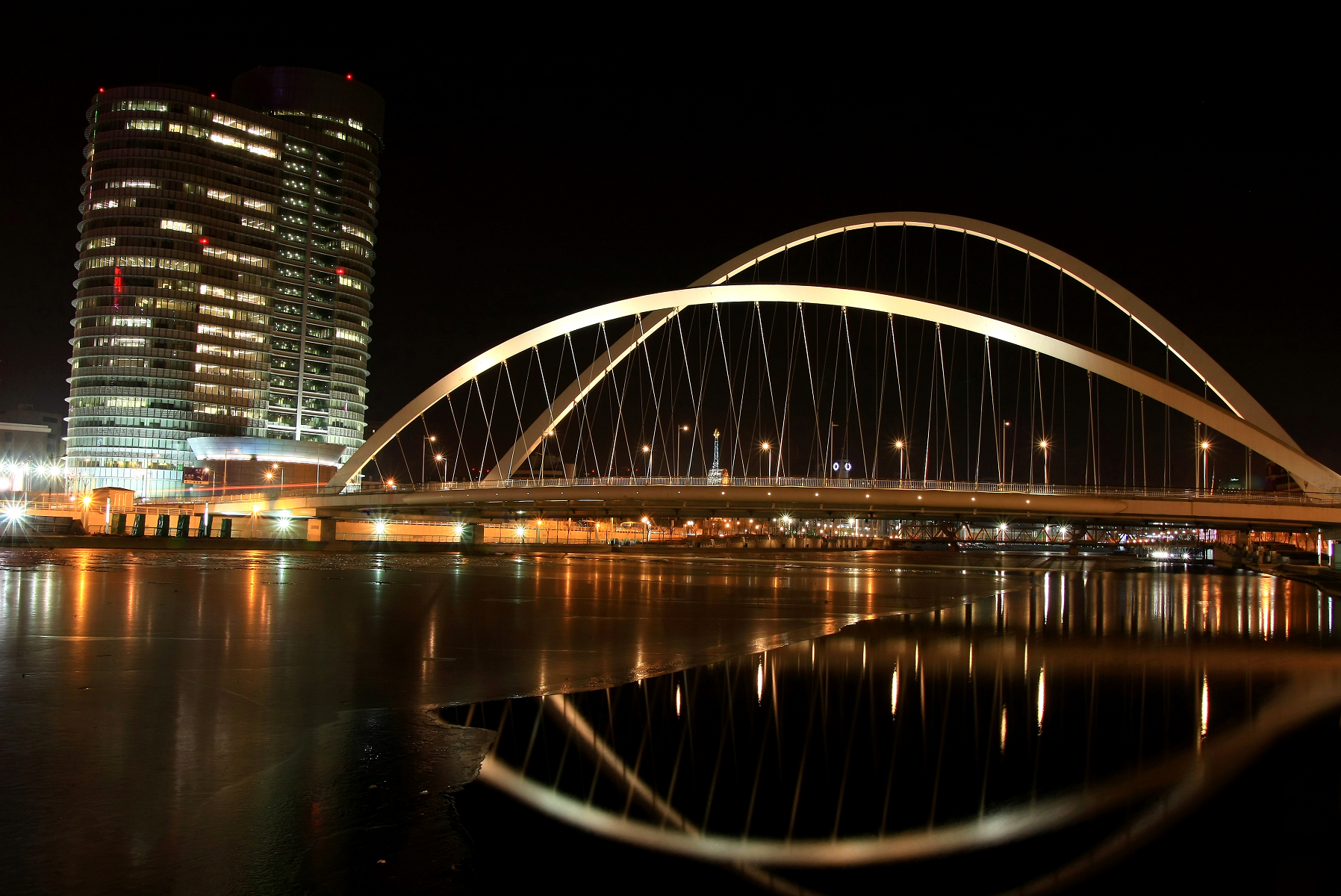
Dagu Bridge
Two arches rise over Tianjin's Hai River, one large, one small, leaning away from each other at different angles like a couple mid-conversation. The larger arch faces east and symbolizes the sun, standing 39 meters high with an arc length of 140 meters, tilted outward at 18 degrees. The smaller arch faces west, representing the moon, rising 19 meters with an arc length of 116 meters and a 22-degree outward lean. Together they form what their designers called the Sun Moon Arch -- and in 2006, this unconventional structure won the Eugene C. Figg Jr. Medal at the International Bridge Conference in Pittsburgh, Pennsylvania, placing it in the company of the Jiangyin Yangtze River Bridge and Shanghai's Lupu Bridge as one of China's most recognized feats of bridge engineering.
First Bridge of a New River
Construction of the Dagu Bridge began on July 6, 2003, as the first new bridge in the Tianjin Municipal People's Government comprehensive development and renovation project for the Haihe River. The project was ambitious: not merely a transportation crossing but a statement about what Tianjin's riverfront could become. The bridge opened on November 27, 2005, after the epoxy asphalt concrete bridge deck was completed in late 2004. The Dagu Bridge spans the Hai River perpendicular to its flow, its 154-meter total length carrying a 24-meter-wide motor vehicle roadway with the overall bridge surface expanding from 30 to 59 meters wide to accommodate pedestrian areas and the semicircular viewing platforms that extend from both sides.
Engineering Between Sun and Moon
The bridge is technically classified as an asymmetrical floating joint beam arch bridge -- a mouthful that captures its unusual structural logic. Eighty-eight booms suspended from the two arches carry the full weight of the 106-meter main span. The three-span continuous beam system uses a lower-bearing pole arch configuration, with the main structural materials consisting of orthogonal steel bridge decking, steel box arches, prestressed steel strands, concrete piers, and parallel steel wire harness booms supported by drilling perfusion pile foundations. The total steel weight of the bridge reaches 4,300 tonnes. The design emerged from collaboration between the Tianjin City Construction Group, Lin Tongyan International Company, and Canadian planning firm IDEALS, with bridge master Deng Wen proposing the final design concept that gave the bridge its distinctive visual identity.
A Bridge as Urban Landmark
The Dagu Bridge is more than a river crossing; it functions as one of the visual anchors of Tianjin's renovated Haihe riverfront. The semicircular viewing platforms that extend from the bridge deck invite pedestrians to pause above the water, turning a transit structure into a public space. At night, the arches are illuminated, their asymmetrical forms reflecting in the river and creating a skyline marker visible from considerable distance. The bridge area covers 7,000 square meters -- large enough that it reads less as a bridge and more as a small urban park suspended over water. For a city that has spent decades reinventing its relationship with the Hai River, the Dagu Bridge represents a philosophical shift: from treating the river as an obstacle to be spanned as efficiently as possible, to treating it as a destination that infrastructure should celebrate.
From the Air
Located at 39.13°N, 117.20°E spanning the Hai River in central Tianjin. The bridge's distinctive asymmetrical double-arch design is potentially visible from moderate altitude, especially when illuminated at night. It sits among a series of notable bridges along the Haihe River through downtown Tianjin. Tianjin Binhai International Airport (ZBTJ) is approximately 15 km east. Recommend viewing at 2,000-4,000 ft to see the Sun Moon Arch design and its relationship to the Haihe riverfront development.