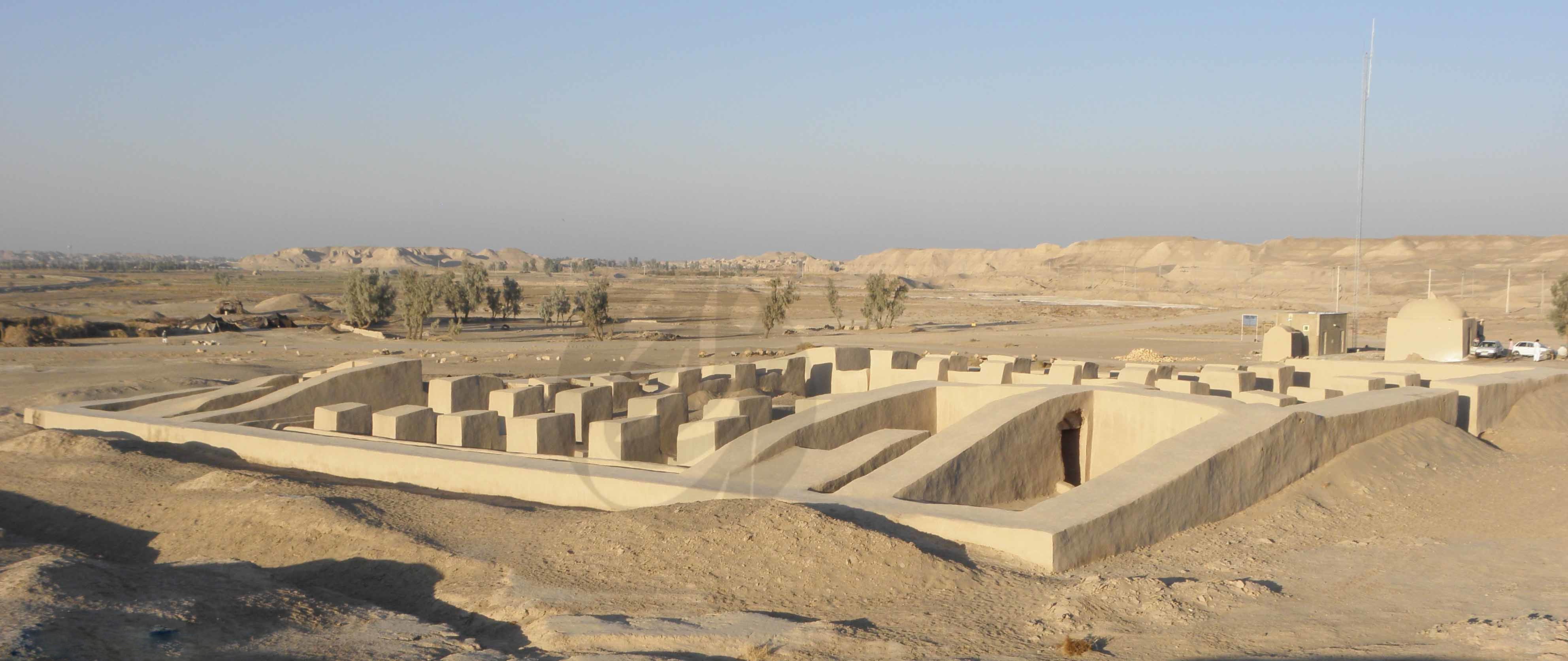
Dahan-e Gholaman
Thirty kilometers southeast of Zabol, on a narrow strip of land between two modern reservoirs and just 8.5 kilometers from the Afghan border, the remains of twenty-seven structures lie aligned in a rough line running southwest to northeast. They are built of adobe -- not stone, not fired brick, but sun-dried mud shaped by hands that understood the Sistan wind intimately. This is Dahan-e Gholaman, whose name translates to "Gateway of the Slaves," the largest Achaemenid-era site in all of eastern Iran. Archaeologists believe it was Zranka, the capital of the ancient province of Drangiana, a city that hosted Persian governors, Zoroastrian fire rituals, and quite possibly Alexander the Great himself -- before the wind and the sand took it back.
Imperial Outpost at the World's Edge
The Achaemenid Empire, at its height under Darius I in the late sixth and fifth centuries BC, stretched from Egypt to the Indus River. Governing that expanse required provincial capitals, and in the far east, where Iran bleeds into Afghanistan and the Sistan Basin collects the last trickle of the Helmand River, Drangiana needed one. Dahan-e Gholaman filled that role. The site's structures bear comparison with the palatial buildings and audience halls of Pasargadae and Persepolis -- regular rectangular plans, monumental scale, clear administrative purpose. But this was no mere copy of the imperial centers. The architects adapted to local conditions with remarkable intelligence, orienting entrances and buildings to deflect the notorious 120-day wind that blasts through the Sistan region every summer from the northwest. Where the royal capitals used stone and timber, Dahan-e Gholaman used adobe. Where Persepolis employed flat roofs, this frontier city built vaulted and arched covers to span its rooms.
Three Altars and Three Gods
Among the excavated structures, one stands apart. Italian archaeologist Umberto Scerrato, who led the first excavations between 1962 and 1965, identified a building containing three fire altars -- a configuration that suggests dedication to the leading deities of the Persian religious world: Ahura Mazda, the supreme god of Zoroastrianism; Anahita, goddess of water, fertility, and wisdom; and Mithra, god of covenant and light. If the identification holds, it places Dahan-e Gholaman among the easternmost known sites of organized Achaemenid religious practice. Iranian archaeologist S. M. S. Sajjadi continued the work from 2000 to 2005, and geophysical surveys between 2007 and 2011 revealed the outline of another monumental building two kilometers south of the main complex, suggesting the site was even larger than the initial excavations indicated. Other structures served administrative, public, and industrial functions -- the infrastructure of a working provincial capital, not just a ceremonial center.
Alexander Passed This Way
The absence of layered stratigraphy at Dahan-e Gholaman tells its own story: the city was occupied for a relatively short period, probably no more than two centuries. Its features align with the reign of Darius I, placing its construction in the late sixth century BC. If Dahan-e Gholaman is indeed the capital of Drangiana, then it almost certainly witnessed one of history's most dramatic passages. In the winter of 330-329 BC, Alexander the Great pushed through Drangiana in pursuit of Bessus, the usurper who had murdered the last Achaemenid king, Darius III. Alexander's army would have needed to resupply and rest in whatever settlement served as the provincial seat. Whether Alexander saw the fire altars, walked the adobe halls, or simply passed through a city already diminished by decades of instability, the site's location on his documented route makes the encounter plausible.
A Name That Migrated
After Dahan-e Gholaman was abandoned, the administrative center of the region shifted 31 kilometers northeast to a site now called Nad-i Ali in modern Afghanistan. By the Middle Ages, that successor settlement was known as Zaranj or Zarang -- a name likely derived from the ancient Zranka. The name migrated again: the modern city of Zaranj sits 4.4 kilometers south of the medieval site. So the ancient name has traveled across three locations and two and a half millennia, carried forward by the people who continued to inhabit this borderland even as empires rose and fell around them. Dahan-e Gholaman itself remains largely unexcavated. The wind that shaped its architecture continues to shape its archaeology, alternately revealing and burying structures that once served as the eastern edge of the greatest empire the ancient world had known.
From the Air
Located at 30.79N, 61.64E in Iran's Sistan-Baluchestan province, Dahan-e Gholaman sits on a narrow peninsula between two of the Chah Nimeh reservoirs, approximately 30 km southeast of Zabol. The reservoirs are clearly visible from altitude as dark water bodies in the otherwise arid landscape. The archaeological site is just 8.5 km from the Afghan border; the modern Afghan city of Zaranj is visible approximately 28 km to the northeast. Nearest airport is Zabol Airport (OIZB), roughly 30 km to the northwest. The terrain is flat, low-elevation desert characteristic of the Sistan Basin. The Helmand River delta system and the Iran-Afghanistan border are prominent visual references from the air.