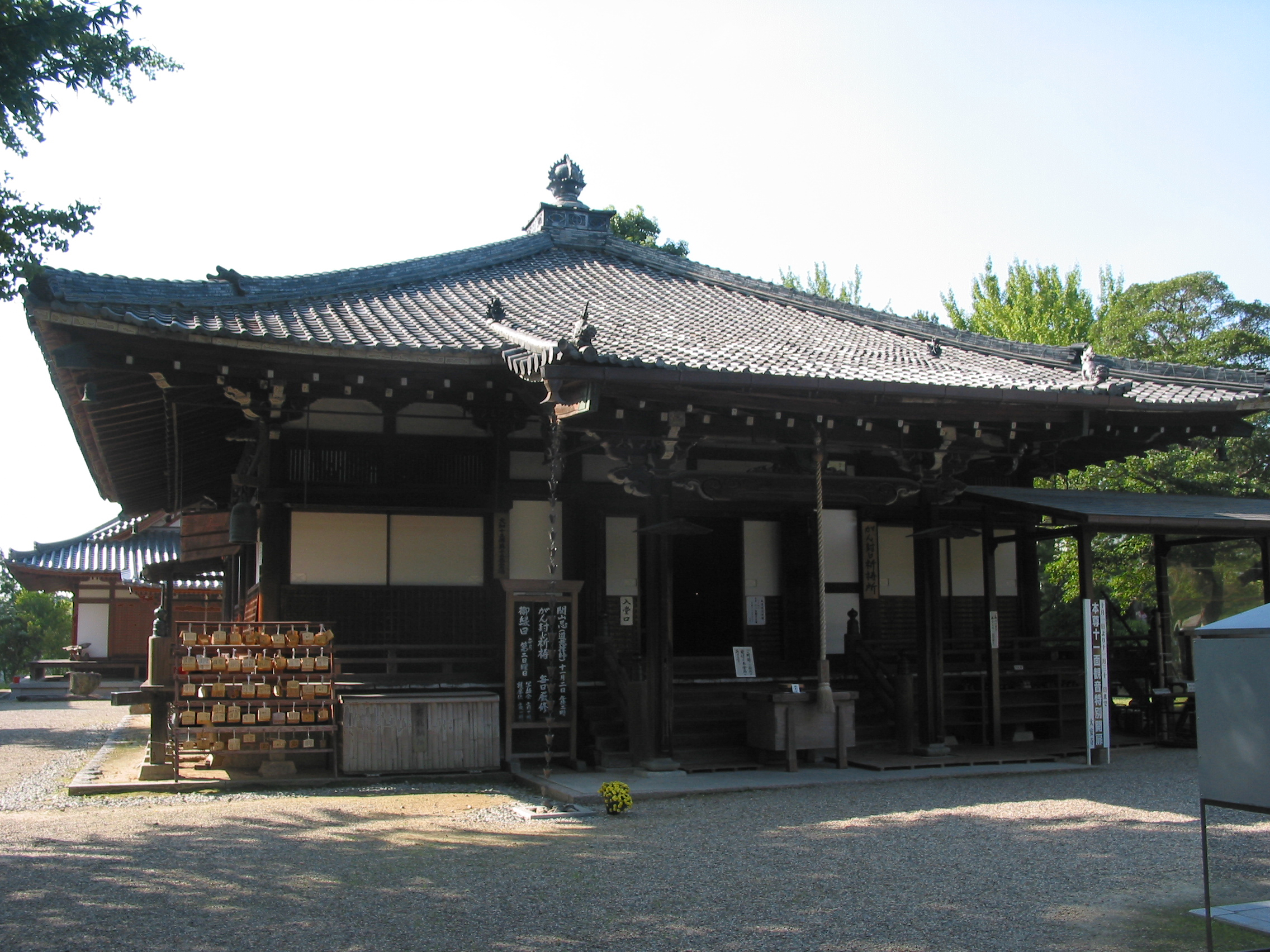
Daian-ji: The Temple That Followed the Capital
In 747, 887 monks lived at Daian-ji. The temple sprawled across an area of three cho east-west and five cho north-south -- roughly 330 meters by 550 meters -- in the grid-planned capital of Heijo-kyo. Twin seven-story pagodas flanked the Great South Gate. Monks from its halls persuaded the Chinese master Jianzhen and the Indian monk Bodhisena to come to Japan. Teachers of Kukai and Saicho, the two figures who would reshape Japanese Buddhism entirely, studied within its walls. Today, only a small fraction of Daian-ji survives. The twin pagodas are gone -- their stone bases carted off to Kashihara Jingu in 1889. The Great Buddha statue that a twelfth-century writer called the finest work in Nara was lost in the 1596 Keicho-Fushimi earthquake. By the Edo period, a single Kannon chapel was all that remained. But the story of Daian-ji stretches back to the very beginning of Japanese state Buddhism, and the temple's long decline is itself a chronicle of how empires of faith rise and fall.
A Prince's Deathbed Wish
The temple traces its origin to a promise. According to the Daianji Garan Engi and the Nihon Shoki, when Prince Tamura -- later Emperor Jomei -- visited the ailing Prince Shotoku, the great statesman asked him to rebuild the Kumagoi Seisha as an official temple. Honoring that wish, Emperor Jomei began construction in 639 on the banks of the Kudara River. The resulting temple, Kudara-no-Odera, is regarded as the first official temple in Japan. Its exact location was debated for centuries until 1997, when the Nara National Research Institute for Cultural Properties confirmed that the Kibi-ike temple ruins southwest of Sakurai matched the site. Excavated roof tiles and a layout patterned on Horyu-ji -- main hall to the east, pagoda to the west -- dated the ruins to the first half of the seventh century. Japan's earliest state-sponsored temple had been hiding in plain sight.
Following the Throne
Temples in early Japan moved with the capital, and this one moved more than most. In 673, Emperor Tenmu relocated Kudara-no-Odera and renamed it Takaichi-daiji, the move coinciding with the anniversaries of both his father Emperor Jomei's death and his mother Empress Saimei's death. By 677, the temple was renamed again to Daikan-daiji, and construction continued through the reign of Emperor Monmu. Archaeological evidence suggests that Takaichi-daiji and Daikan-daiji may have actually been two separate complexes -- the earlier one likely at the Kinomoto ruins northwest of Mount Kaguyama. When the capital shifted to Heijo-kyo in 716-717, Daikan-daiji moved alongside Yakushi-ji and Gango-ji, receiving its final name -- Daian-ji -- in 729. Each relocation brought new construction, new patronage, and a new identity. The temple that arrived in Nara was the product of nearly a century of reinvention.
A Crossroads of Buddhist Thought
At its peak in the Nara period, Daian-ji was not merely large but intellectually pivotal. It served as one of two major centers of Sanron Buddhism in Japan, alongside Gango-ji. Sanron -- the 'Three Treatise' school of Madhyamaka philosophy -- had been transmitted from China through monks like Doji, who spent sixteen years studying in Tang China before returning as Daian-ji's head abbot, bringing with him a new translation of the Golden Light Sutra. This sutra was considered a scripture of national protection, and its arrival carried political as well as religious weight. The temple's connections extended far beyond Japan. Monks from Daian-ji persuaded the Chinese monk Jianzhen to make his dangerous six-attempt crossing to Japan, where he would found Toshodai-ji and establish the Ritsu ordination lineage. They also welcomed Bodhisena, an Indian monk who brought Sanskrit learning to Nara. The great Kukai, founder of Shingon Buddhism, was appointed head priest of Daian-ji in 829 -- a measure of the temple's lingering prestige even as it began to decline.
Fire, Earthquake, Erasure
The decline came in waves. After the capital moved to Heian-kyo in 794, Daian-ji lost its political centrality. Buddhism was shifting toward the esoteric traditions centered on To-ji and Enryaku-ji, and Sanron philosophy faded from prominence. In 911, fire destroyed many of the temple's buildings. In 949, lightning burned down the West Pagoda. The catastrophe of March 1, 1017, was worst of all -- a major fire consumed everything except the honzon Shaka Nyorai statue and the East Pagoda. The main temple was rebuilt by 1116 but never regained its former scale, eventually becoming a branch temple of Kofuku-ji. The Shaka Nyorai statue, described by twelfth-century chronicler Oe no Chikamichi as the finest Buddhist work in all of Nara, survived fire but not seismology; it was lost in the devastating Keicho-Fushimi earthquake of 1596. By the Edo period, a single Kannon chapel stood where hundreds of monks had once studied. In 1889, the stone bases of the twin pagodas were removed and repurposed at Kashihara Jingu.
What Survives
Daian-ji's former precincts were designated a National Historic Site in 1929, preserving the footprint even as the structures themselves had long vanished. The ruins of its predecessor, Daikan-daiji, also carry National Historic Site status. What remains within the small temple today includes several Important Cultural Properties: statues of Senju Kannon, Fukukensaku Kannon, Yoryu Kannon, Sho Kannon, and the Four Heavenly Kings. Temple records from the Tenpyo era -- the same 747 asset register that counted 887 monks -- are also designated Important Cultural Properties, though they are now held far from Nara, in Chiba Prefecture. The Sugiyama Kofun, an ancient burial mound that was incorporated into the original temple grounds, still lies to the north. Daian-ji today is a quiet, modest place in the city of Nara, a few minutes from the main tourist temples. Its smallness is the point. Here is a temple that was once among the most important in all of Japan, and the quiet grounds tell the story of thirteen centuries of Buddhist history compressed into a garden.
From the Air
Located at 34.67°N, 135.81°E in the city of Nara, Japan, south of the main historic temple district. From altitude, Nara's grid layout -- inherited from the eighth-century Heijo-kyo capital plan -- is still partially visible in the street pattern. The temple site sits in a residential area south of Nara Park and the famous deer grounds. Todai-ji and Kofuku-ji are approximately 2 km to the north-northeast. Osaka Itami Airport (RJOO) is roughly 35 km to the west. Kansai International Airport (RJBB) is approximately 60 km to the southwest. Best viewed at 3,000-5,000 feet AGL to see the temple's position within Nara's urban fabric.