Daigo Fukuryu Maru
The fishermen called it shi no hai -- death ash. On the morning of March 1, 1954, the crew of the Daigo Fukuryu Maru watched the western sky light up like a second sunrise from their position in the Pacific Ocean, roughly 80 miles east of Bikini Atoll. They were outside the danger zone the U.S. government had declared. What they did not know was that Castle Bravo, the thermonuclear weapon detonated that morning, had yielded more than twice its predicted power. Within hours, a white powder -- pulverized radioactive coral and sand laced with strontium-90, cesium-137, and uranium-237 -- began falling on their deck like snow. One fisherman, Oishi Matashichi, took a lick. It was gritty, he said, but had no taste. That tasteless powder would kill one of them, sicken the rest for life, and change Japan forever.
The Fifth Lucky Dragon
Built in March 1947 and launched from Koza, Wakayama, the vessel began life as a bonito boat moored in Misaki Fishing Harbor in Kanagawa Prefecture. By 1953, she had been remodeled into a tuna fishing boat and relocated to Yaizu Port in Shizuoka Prefecture, where she received a new name: Daigo Fukuryu Maru, translated as Lucky Dragon No. 5. Her final voyage began on January 22, 1954, with a crew of 23 heading toward waters near Midway Atoll. When they lost most of their trawl nets, they altered course southward toward the Marshall Islands. That detour placed them 14 miles outside the 57,000-square-mile danger area established by the U.S. Navy -- close enough to be dusted by fallout, but undetected by radar or spotter planes.
Six Hours in the Ash
The crew could not simply flee. Nearly six hours passed as they hauled fishing gear from the sea and processed shark and tuna caught on their lines, all while radioactive dust settled on their skin, entered their nasal passages and ears, irritated their eyes, and collected inside their clothing. They scooped the white powder into bags with bare hands. Radiation sickness symptoms appeared that evening: pain, headaches, nausea, dizziness. By the third day, blisters formed wherever the ash had touched their bodies. Their faces darkened. A week into the return voyage, their hair began falling out. One crewman kept a sample of the dust in a pouch hung from his bunk, exposing the sleeping men to concentrated radiation for the entire two-week journey home. When Tokyo University later analyzed that sample, they confirmed what the Americans had tried to keep secret: the ash came from a hydrogen bomb.
Fourteen Months in Hospital
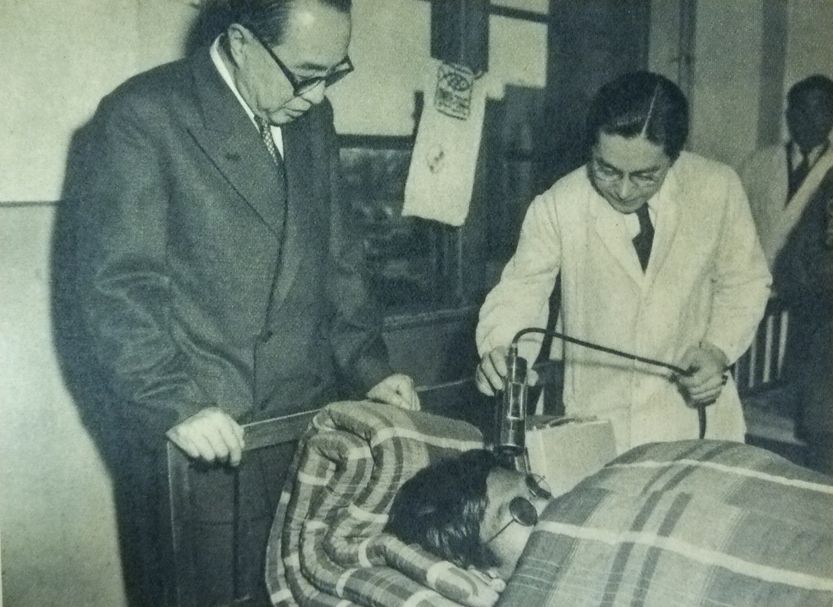
At Yaizu Public Hospital, a surgeon applied zinc ointment to the men's faces and sent them home. It was not enough. Within days, the crew was transferred to Tokyo University Hospital, where bone marrow tests revealed white blood cell counts at half normal levels. Japanese biophysicist Nishiwaki Yasushi wrote to the U.S. Atomic Energy Commission requesting treatment information; the letter went unanswered. The men endured 14 months of quarantine -- daily examinations, blood draws, bone marrow extractions. Their red and white blood cells plummeted, causing internal bleeding. They bled from their noses and gums. Their sperm counts dropped to near zero. Chief radioman Kuboyama Aikichi's condition deteriorated most severely. He developed meningitis, became delirious, fell into a coma, and on September 23, 1954, became the first crew member to die from radiation complications. The remaining 22 were released on May 20, 1955.
Stigma and Silence
Like the hibakusha -- survivors of the Hiroshima and Nagasaki bombings -- the Lucky Dragon crew faced social stigma rooted in the widespread belief that radiation exposure was contagious. Most tried to disappear. Oishi Matashichi left his hometown to open a dry cleaning business. His first child was stillborn, a loss he attributed to his exposure. Crew member Masayoshi Kawashima tried making pouches for a living, failed, divorced, returned to fishing, and died at 47. Sanjiro Masuda contracted cirrhosis, sepsis, stomach ulcers, and diabetes before dying at 54. Unlike the hibakusha, the Lucky Dragon crew never qualified for government medical care benefits. Only decades later, beginning in the 1980s, did Oishi begin speaking publicly, eventually publishing The Day the Sun Rose in the West in 2011, combining his personal account with declassified documents about the fallout's toll.
From Garbage Canal to Monument
When first docked at Yaizu's fish market, the ship radiated at levels detectable 100 feet away -- a Geiger counter read 120 milliroentgens on her deck. The Japanese government purchased the vessel and towed it to the Tokyo University of Fisheries. Kuboyama's death galvanized a movement: the National Council for a Petition Movement to Ban Atomic and Hydrogen Bombs was founded in Tokyo, launching annual conventions beginning in 1955. But the ship itself was forgotten for years, sitting in garbage within a canal until a 1970 media report drew attention. The area was cleaned up, the ship pulled from the water, and a park created around it. Since 1976, the Daigo Fukuryu Maru has been preserved at the Tokyo Metropolitan Daigo Fukuryu Maru Exhibition Hall, a quiet monument in eastern Tokyo. The vessel also left an unexpected cultural legacy: the 1954 Toho film Godzilla was inspired in part by the incident, transforming nuclear anxiety into one of cinema's most enduring monsters.
From the Air
Located at 35.651N, 139.826E in Yumenoshima Park, Koto ward, eastern Tokyo. The exhibition hall sits near Tokyo Bay, identifiable from the air by the adjacent park and marina complex. Nearest airports: Tokyo Haneda (RJTT) approximately 10 nm southwest, Narita International (RJAA) approximately 35 nm east. Best viewed at 2,000-3,000 feet AGL. The surrounding Koto ward waterfront and reclaimed land areas are distinctive from altitude.