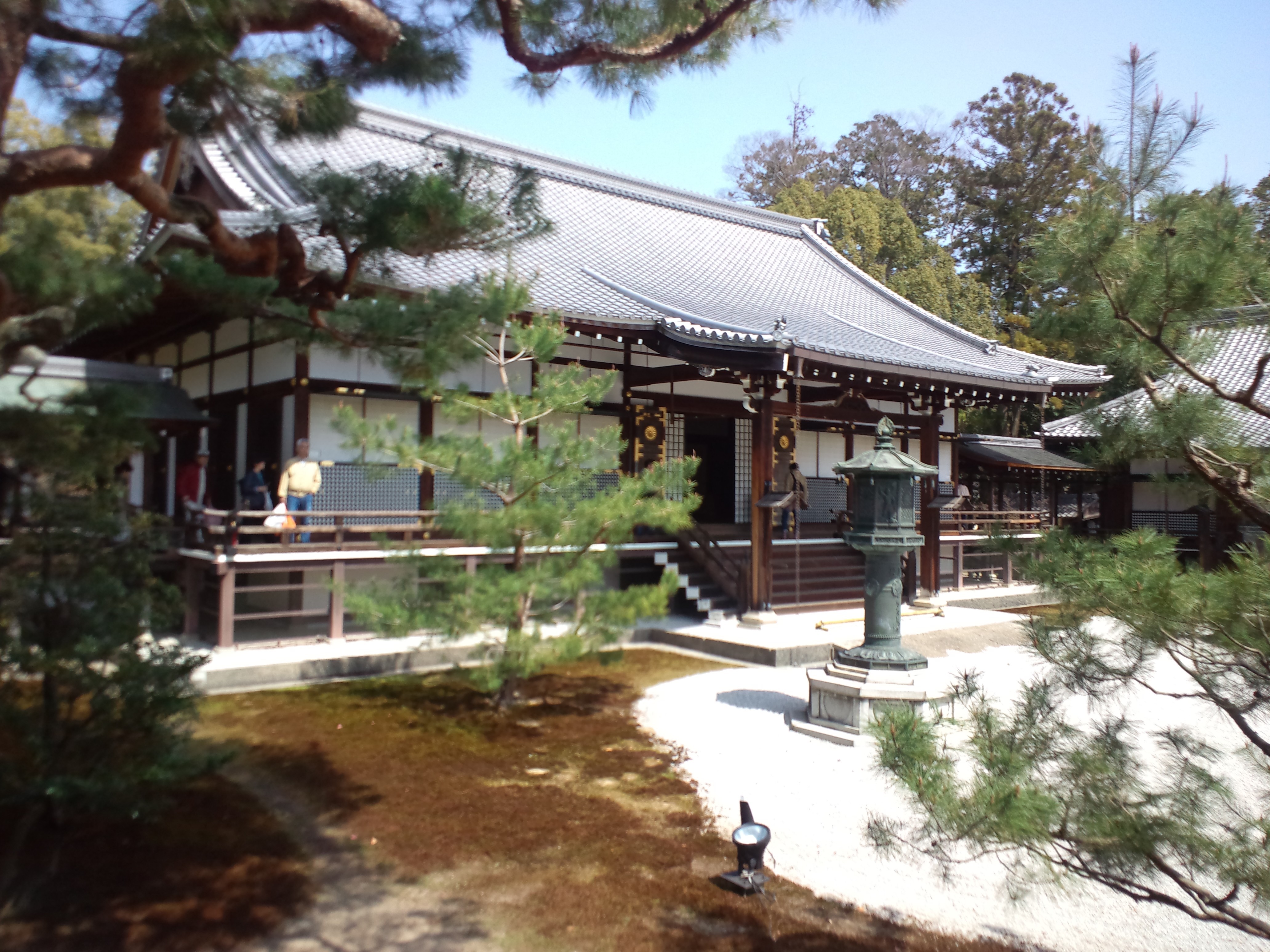
Daikaku-ji
The handwritten sutra inside the Shingyoden hall is shown to the public once every sixty years. The next viewing is in 2078. Pilgrims who miss it can still come to Daikaku-ji to copy the sacred text by hand, their reproductions stored alongside the original that Emperor Saga brushed with ink in the 9th century to end a devastating epidemic. This is the rhythm of the place -- centuries measured in patient intervals, power exercised from behind monastery walls, and a pond older than the temple itself reflecting the same moon that Heian-era courtiers watched from gilded boats.
An Emperor's Retreat Becomes a Throne
In 814 CE, Emperor Saga built his retirement palace on this site in what is now Ukyo-ku, the western ward of Kyoto. The Saga-in, as it was known, became the Saga Rikyu imperial villa -- a place where an emperor who had formally abdicated could enjoy the aesthetics of withdrawal while still pulling the strings of governance. The tradition stuck. When Saga's daughter Princess Masako, consort of Emperor Junna, converted the complex into a Buddhist temple in 876, she named it Daikaku-ji and established it as a monzeki temple, meaning only imperial princes could serve as abbot. Over the following centuries, retired emperors Go-Saga, Kameyama, and Go-Uda took up residence here, ordaining as monks while continuing to wield real political power in the system known as cloistered rule. The temple was not merely spiritual refuge -- it was an alternative seat of government.
Fire, Rebuilding, and Borrowed Grandeur
The temple burned in 1336 during the violent transition from the Kamakura to the Muromachi period, a reminder that even sacred ground was not immune to Japan's cycles of upheaval. It was rebuilt, but much of what visitors see today arrived during the Edo period, when Emperor Go-Mizunoo relocated Momoyama-era buildings wholesale from the Kyoto Imperial Palace. The main hall and Founder's Hall were transplanted to a graveled courtyard beside the pond. Inside the Shoshinden, the sliding door paintings in the Okanmuri-no-ma room bear the brushwork of Kano Sanraku and Shiko Watanabe -- peonies, red and white plum blossoms, a hawk rendered in spare Indian ink, and a hare painted on the wooden beam above. These works carry the designation of Important Cultural Properties. The temple's main images depict the Five Wisdom Kings, centered on Fudo, the immovable protector of Buddhist law.
Osawa Pond and the Birth of Ikebana
The pond predates the temple. Emperor Saga created Osawa Pond -- a 2.4-hectare artificial lake -- either during his reign (809-823) or during his retirement before his death in 842. He designed it to echo the shape of China's Dongting Lake, a landscape of deep cultural significance. This was a chisen-shuyu garden, meant to be experienced from a boat gliding across the water, in the manner of imperial Chinese gardens. Two islands anchor the northern end: a large one and the smaller Chrysanthemum Island, with rocky islets between them shaped to resemble Chinese junks at anchor. On the hillside beyond sits a karedaki -- a dry cascade where carefully placed stones suggest a waterfall without water. Heian poets celebrated the garden. Ki no Tomonori wrote of chrysanthemums reflected in the pond's depths. Another poem from the Hyakunin Isshu speaks of a cascade that ceased to roar, yet whose murmur endures in memory. The flowers of this pond are said to have given birth to the Saga school of ikebana, which was formally established at the temple in 1936 under the Saga Go-ryu lineage.
Moonlight on Ancient Water
Osawa Pond was designed for one purpose above all others: watching the moon rise. Every autumn, for three days around the harvest moon, Daikaku-ji hosts a moon-viewing party that reaches back across twelve centuries to the aesthetics of the Heian court. Costumed dancers and musicians perform on dragon boats that drift across the dark water, their reflections doubling the lantern light. Cherry blossoms ring the pond in spring, drawing crowds who come for hanami as their predecessors did a thousand years before. Today the lake serves as a public park for Kyoto's residents, a rare piece of Heian-period landscape design still functioning as its creator intended -- a place where beauty is not preserved behind glass but lived in, season after season, under the same sky that Emperor Saga knew.
From the Air
Located at 35.028N, 135.678E in the Sagano district of western Kyoto. The temple complex and Osawa Pond are nestled at the base of the Arashiyama hills. From the air, look for the distinctive oval shape of Osawa Pond amid the dense temple grounds northwest of central Kyoto. Nearest airports: Osaka International (Itami, RJOO) approximately 20nm south-southeast; Kansai International (RJBB) approximately 55nm south. The Arashiyama bamboo grove and Togetsukyo Bridge are visible landmarks approximately 1km to the south. Best viewed at 1,500-2,500 feet AGL.