Daikandai-ji: The Grand Temple That Burned Before It Was Finished
Somewhere in the flat farmland south of Mount Amanokagu, beside the Asuka River, lies the outline of an ambition that almost reached the sky. Daikandai-ji was designed to be the grandest Buddhist temple of the Asuka period -- a sprawling complex anchored by a Main Hall nine bays long and a pagoda so massive that archaeologists believe it rose nine stories above the Nara plain. The temple was the flagship of imperial Buddhism, built and renamed by three successive emperors over nearly four decades. And then, while its middle gate and corridors were still under construction, scaffolding still standing, it burned. The charred rafters fell into the earth and left their marks in the soil, where they remained for more than a thousand years until excavators found them in the 1970s. Today, the site is a designated National Historic Site -- a place where the scale of what was attempted is visible only in foundation stones, earthen platforms, and the ghostly dimensions of what once stood here.
Three Emperors, Three Names
The temple's origins trace to a deathbed promise. When Prince Tamura -- later Emperor Jomei -- visited the ailing Prince Shotoku, the great regent asked him to rebuild a small temple called Kumagoi Seisha as an official state temple. In 639, Tamura began construction of a grand palace and temple on the banks of the Kudara River. That first incarnation, known as the Kudara Dera, is believed to correspond to the Kibi-ike temple ruins in present-day Sakurai. The temple was relocated by Emperor Temmu in 673 and given the name Takaichi-no-Odera, then renamed again in 677 to Daikandai-ji -- literally "Great Government Great Temple." Construction continued through the reign of Emperor Monmu, who ruled from 697 to 707. Each renaming reflected a deepening imperial commitment: this was to be the foremost temple of the Japanese state, a physical declaration that Buddhism and imperial power were one.
A Pagoda for the Sky
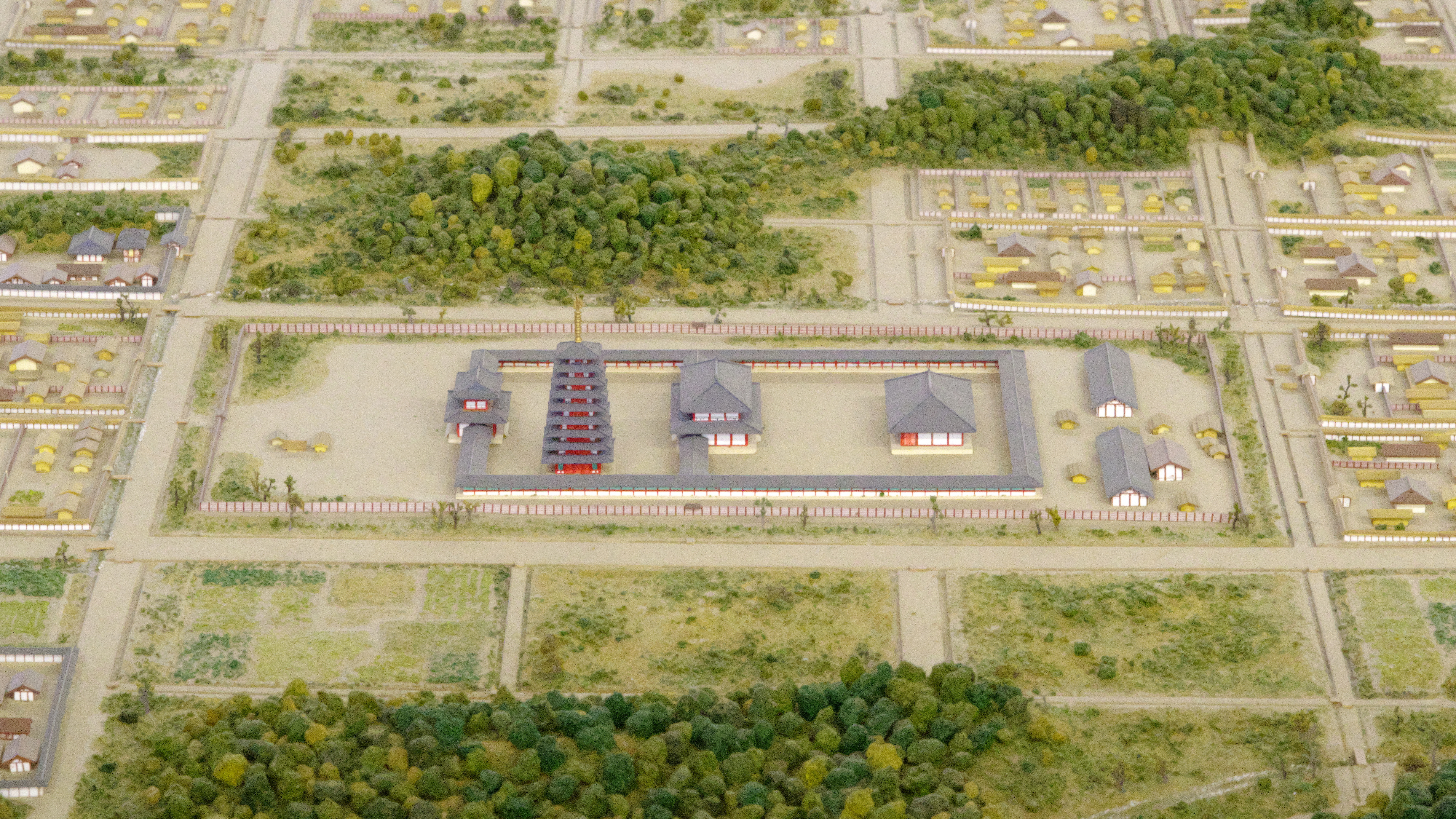
Excavations by the Nara National Research Institute for Cultural Properties between 1973 and 1982 revealed the staggering scale of the complex. The Main Hall measured 45 meters long and 21 meters wide -- nine bays by four, among the largest temple halls of the era. The central gate, Main Hall, and Lecture Hall stood in a straight north-to-south line, connected by corridors that enclosed a square courtyard. On the east side of this courtyard, directly in front of the Main Hall, stood the pagoda. Its first-floor base measured five bays across -- 15 meters -- with six pillars on each side. Based on these dimensions, archaeologists believe it was a nine-story pagoda, a structure that would have been comparable to the grandest Buddhist towers in contemporary China and Korea. It was, by any measure, the largest temple of the Asuka period, and its grounds were planned to align precisely with the grid of Fujiwara-kyo, the imperial capital.
Fire in the Scaffolding
The most haunting discovery at Daikandai-ji was evidence of the fire that ended it all. Burnt soil and scorched roof tiles were found scattered across the excavated temple grounds. In places, the charred remains of rafters that had fallen from the roof left clear impressions in the earth below. Most telling were the burn marks found inside scaffolding holes at the middle gate and corridors -- the construction apparatus was still standing when the flames arrived. The archaeology tells a precise story: the main buildings, including the Main Hall, had been completed or nearly so, but the middle gate and corridors enclosing the courtyard were still being built. The fire struck during construction. Everything suggests that this enormous project, decades in the making, was destroyed before it could be finished.
Foundation Stones and Afterlives
For centuries after the fire, the ruins lay untouched. The earthen platform of the Main Hall and the foundation stones of the pagoda remained visible -- enough that the site of Daikandai-ji was never truly lost, even if the temple itself was. When surveyors arrived at the end of the Edo period, they counted 45 foundation stones at the Main Hall site and 34 at the pagoda, plus the central pillar stone. Most of these were carted away in 1889 for the construction of Kashihara Shrine, an ironic fate for stones that once bore a Buddhist temple. The hamlet that grew up nearby was called Kodo -- "Lecture Hall" -- a name so convincing that scholars initially misidentified the Main Hall ruins as lecture hall remains until proper excavations corrected the record. The site was designated a National Historic Site in 1921. When the capital moved to Heijo-kyo in the early 8th century, the temple's institutional successor was relocated too, eventually becoming Daian-ji in 729 -- a temple that still exists in Nara today, a living descendant of the grand ambition that burned beside the Asuka River.
From the Air
Located at 34.49°N, 135.82°E in the village of Asuka, Nara Prefecture, on the right bank of the Asuka River on flat land south of Mount Amanokagu. The archaeological site is subtle from the air -- look for the earthen platform and open field amid surrounding farmland and residential areas, approximately 1 kilometer northwest of the Asuka Historical Museum. Best viewed at 2,000-3,000 feet AGL. Osaka Itami Airport (RJOO) is approximately 25 nautical miles to the northwest, and Kansai International Airport (RJBB) is roughly 35 nautical miles to the west-southwest. The Asuka area sits in the southern Nara Basin, a flat valley surrounded by hills.