Daimabad
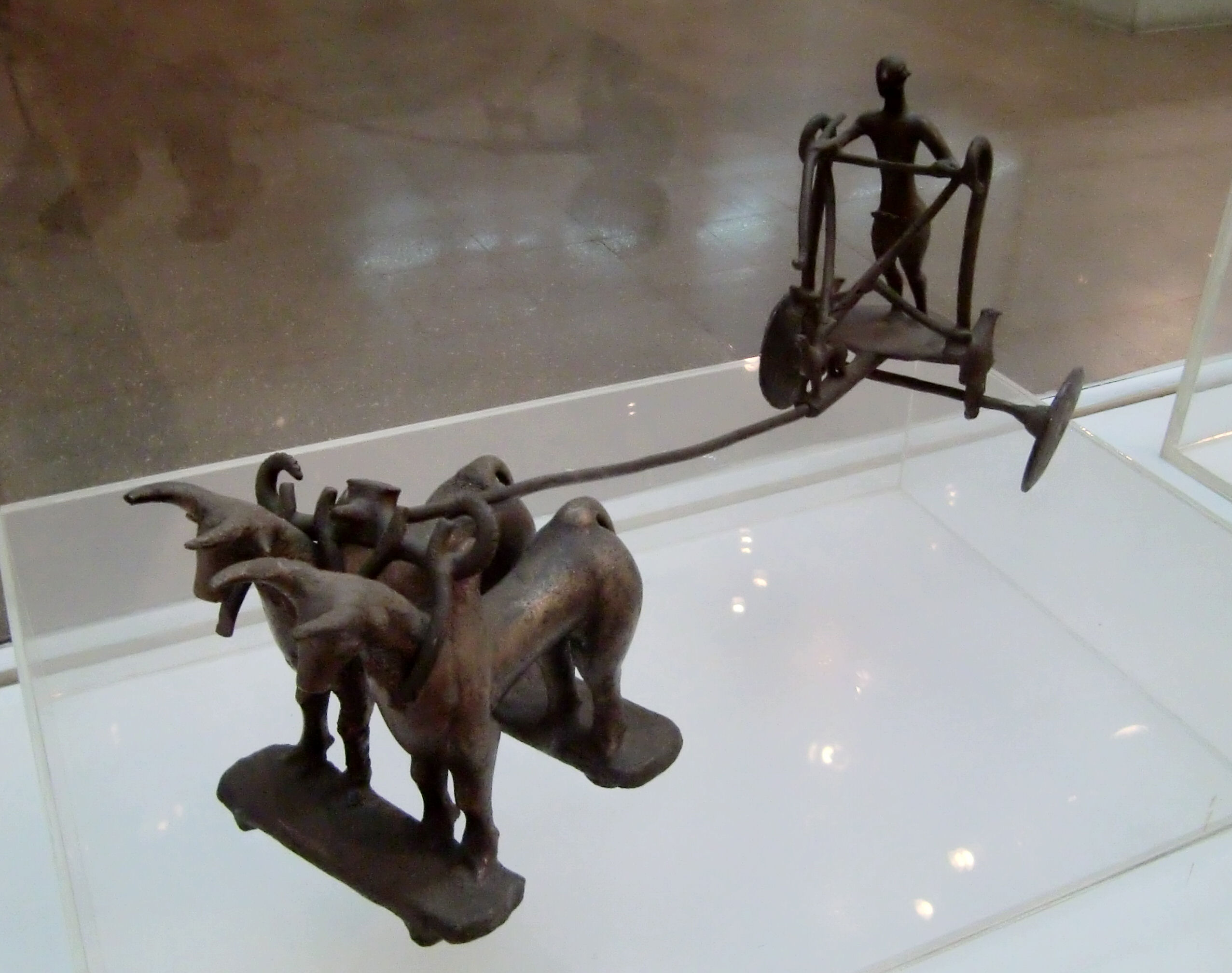
Four bronze sculptures, buried for millennia in the black soil of the Deccan Plateau, changed what archaeologists thought they knew about how far the Indus Valley civilization reached. One depicts a chariot 45 centimetres long, yoked to two oxen, driven by a standing figure. Another is a water buffalo on a wheeled platform. A third, an elephant. A fourth, a rhinoceros mounted on horizontal bars with solid wheels. These are the Daimabad bronzes, recovered from an archaeological site on the left bank of the Pravara River in Maharashtra's Ahmednagar district -- roughly 700 kilometres south of the Indus Valley heartland. Their discovery suggested that Late Harappan culture did not simply fade at the edges of the Punjab, but extended deep into peninsular India.
Unearthed by Accident
Daimabad was discovered in 1958 by B. P. Bopardikar, and since then the Archaeological Survey of India has excavated it three times. M. N. Deshpande led the first dig in 1958-59. S. R. Rao directed the second in 1974-75. S. A. Sali oversaw the most extensive excavations from 1975 to 1979, cutting through five metres of occupational deposit. What they found was not one settlement but a succession of cultures layered on top of each other, five distinct Chalcolithic phases identifiable by their characteristic painted ceramics. The site is a timeline in earth: each stratum a different community, a different set of tools, a different relationship with the river and the land. The village that gives the site its name is now deserted, but for at least two thousand years, people chose this bend of the Pravara as a place worth living.
The Late Harappan Puzzle
Phase II is the layer that drew the attention of the wider archaeological world. During this period, the settlement expanded to about 20 hectares. Houses were built of black clay with foundations set into the black soil, their floors finely plastered. The community arranged its dwellings on either side of a thick clay wall, a rudimentary form of urban planning. Among the artifacts: two terracotta button-shaped seals bearing Harappan script, four inscribed potsherds, microlithic stone blades, gold beads, shell bangles, and a terracotta measuring scale. A mud-brick-lined grave held a skeleton laid out in an extended position, the body originally covered with reeds or fibrous plants whose traces still clung to the bones. Horse gram appeared in the plant remains for the first time, joining the crops carried forward from earlier phases. Every detail points toward a community that was connected, however distantly, to the trade networks and cultural practices of the Indus Valley.
Bronzes That Defy Easy Answers
The four bronze sculptures are Daimabad's most famous and most debated artifacts. Their craftsmanship is extraordinary -- the chariot driver stands with a naturalistic confidence, the animals carry real weight and proportion. Deshpande, Rao, and Sali all attributed them to the Late Harappan period based on circumstantial evidence: their stratigraphic context, their association with Harappan-style ceramics, and the absence of comparable metalwork from later Deccan cultures. But D. P. Agarwal challenged this dating. His analysis of the bronzes' elemental composition revealed more than ten percent arsenic, and arsenical alloying has not been found in any other Chalcolithic artifacts from the region. Agarwal concluded the bronzes might belong to a much later historical period. The debate remains unresolved. What is not in dispute is the skill of whoever made them -- the rhinoceros on its wheeled platform, the elephant poised in mid-stride, the chariot driver surveying a world that would forget him for three thousand years.
A River Bend Between Two Worlds
Daimabad sits at a cultural crossroads. The Pravara River flows into the Godavari, linking this stretch of the Deccan to the great river systems of central India. To the north, the Indus Valley civilization built its cities of brick and drainage. To the south, the Deccan Plateau sustained its own Chalcolithic traditions, distinct in pottery, burial practices, and subsistence patterns. Daimabad is where these two worlds overlap. The Harappan script on its seals, the red ware painted with geometric designs in black pigment, the measuring scale -- all suggest contact with the north. But the black-clay construction, the local grasses and grains, the site's position on a tributary rather than a major river -- these belong to the Deccan. The settlement's five phases span roughly from the late third millennium BCE into the second, a period during which the great cities of the Indus Valley were declining and the center of gravity in the subcontinent was shifting. Daimabad, quiet and deserted today, was once a place where that shift was happening in real time.
From the Air
Located at 19.52N, 74.70E on the left bank of the Pravara River in Ahmednagar district, Maharashtra. The site is a flat, deserted village area along the river, not visually dramatic from the air but identifiable by the river bend and the absence of modern habitation. The Pravara flows south to join the Godavari River. Nearest major airport is Pune (VAPO), approximately 150 km to the southwest. Aurangabad Airport (VAAU) lies about 100 km to the northeast. The terrain is dry Deccan Plateau with scattered agricultural fields.