Daimyo Clock Museum: When Japan Told Time Its Own Way
For more than two hundred years, while the Tokugawa shoguns kept Japan sealed from the outside world, the country developed a clockmaking tradition that had no parallel anywhere on earth. European mechanical clocks had arrived with Portuguese missionaries in the 1500s, but once Japan closed its doors, its craftsmen adapted those mechanisms to something entirely their own: clocks that divided the day not into equal hours but into shifting periods that expanded and contracted with the seasons, matching the ancient Japanese system where daylight and darkness were each split into six segments regardless of the time of year. These were the daimyo clocks -- named for the feudal lords who commissioned them -- and by the time Japan reopened in the 1850s, they were already vanishing. Today, roughly fifty of them sit in a single room in Tokyo's Yanaka neighborhood, gathered there by a man whose friends called him Guro.
The Collector They Called Grotesque
Sakujiro Kamiguchi was born in 1892 and ran a business that was itself a curiosity: a log cabin shop in Tokyo that sold Western clothing. The shop earned the local nickname Grotesque -- shortened, inevitably, to Guro, which stuck to Kamiguchi himself for the rest of his life. He was a man of many enthusiasms, including pottery, but his life's obsession began the day he discovered an English-made watch with an attached sundial in a local shop. That chance encounter opened his eyes to the daimyo clocks, and he recognized something that few of his contemporaries had grasped: these timepieces represented a uniquely Japanese art form, created precisely because the country's isolation forced its craftsmen to innovate rather than imitate. Kamiguchi spent decades tracking down and acquiring clocks from daimyo families, eventually amassing a collection of some two hundred pieces.
A Race Against the Earthquake
Kamiguchi understood the urgency of his mission in blunt terms. Foreign collectors had recognized the cultural importance of Japanese clocks long before most Japanese scholars had, and the clocks were being bought at cut-rate prices and shipped out of the country. Kamiguchi warned that it would not be long before a Japanese researcher wanting to study the development of these clocks would be "reduced to visiting foreign collections." He drew an explicit comparison to ukiyo-e woodblock prints, another Japanese art form whose significance was first appreciated abroad. The Great Kanto Earthquake of 1923 had accelerated the dispersal, destroying collections and sending surviving pieces onto a desperate market. Each clock Kamiguchi saved was a small act of cultural preservation, pulling a piece of Japanese ingenuity back from the edge of permanent export.
Time That Breathes With the Sun
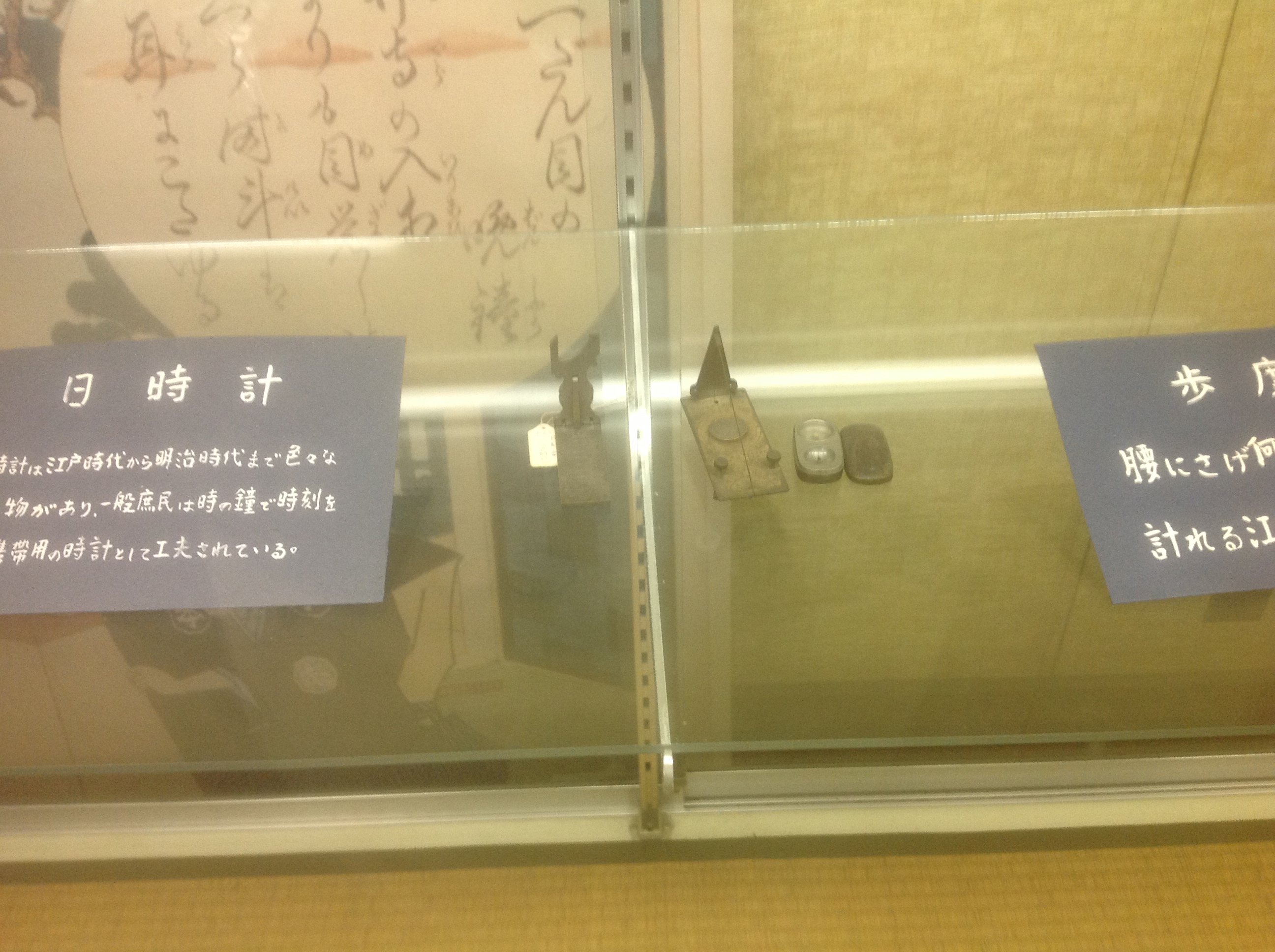
The clocks themselves are mechanical marvels adapted to a timekeeping system that most modern visitors find bewildering. In the traditional Japanese system, daylight was divided into six equal periods and nighttime into six more -- but because the length of day and night changes with the seasons, each period's duration shifted throughout the year. A summer daylight hour was far longer than a winter one. The daimyo clock mechanisms had to accommodate this constantly changing relationship, a technical challenge that European clockmakers never faced. The museum's collection includes mechanical clocks with adjustable mechanisms, sundials, and incense clocks -- devices that measured time by the rate at which a stick of incense burned, often along a calibrated path. These were the timepieces of the ruling class, commissioned by feudal lords whose wealth and status made them patrons of Japan's finest craftsmen. When the Meiji government adopted Western timekeeping in 1873, the daimyo clocks became obsolete overnight.
Eighty-Three Square Meters of a Lost World
Kamiguchi died in 1970, and in 1972 the museum was established to display his collection. It occupies a single room of 83 square meters in Yanaka, one of Tokyo's most atmospheric old neighborhoods -- a district of temples, small cemeteries, and narrow lanes that largely escaped both the 1923 earthquake and the wartime firebombing. About fifty pieces from the full collection of two hundred are displayed at any given time. Photography is not permitted, which lends the visit an attentive, almost reverent quality; you must look carefully, because you cannot take the images with you. The nearest metro station is Nezu on the Chiyoda Line, and Nippori Station on the JR lines is also within walking distance. The museum is community-run and small enough to feel personal, a quality that suits a collection born not from institutional mandate but from one eccentric collector's determination to keep a vanishing tradition from disappearing entirely.
From the Air
Located at 35.721N, 139.766E in Tokyo's Taito ward, in the historic Yanaka neighborhood adjacent to Yanaka Cemetery. The area's low-rise traditional character contrasts with surrounding modern development and is visible from altitude as a zone of dense, small-scale buildings and temple grounds. Nearest major airport is Tokyo Haneda (RJTT), approximately 14 nautical miles south. Tokyo Narita (RJAA) lies about 36 nautical miles east-northeast. Nezu Station on the Chiyoda Line and Nippori Station on JR lines are the closest transit stops. Best viewed at 3,000-5,000 feet AGL where the Yanaka neighborhood's distinctive character and nearby Ueno Park provide orientation.